Showing posts with label 2019. Show all posts

Tuesday, December 17, 2019

MY PENGUIN YEAR :: Lindsay McCrae

A version of this review previously appeared in Shelf Awareness and is republished here with permission.

Growing up on the outskirts of England's Lake District National Park, eight-year-old Lindsay McCrae was enthralled by nature and decided he wanted a career filming wildlife. A letter to a BBC nature program at age 14 resulted in him making a short film on badgers. From there his career took off, and he documented wolves in the Arctic and armadillos at the equator. McCrae's ultimate dream, to film emperor penguins in Antarctica, came true when the BBC Natural History Unit made that once-in-a-lifetime offer. The catch? He would need to prepare for a year, then be gone for 11 months.

Anyone who wonders what such an incredible and dangerous expedition entails will be enchanted by McCrae's chronicle of his time in the harshest climate on earth (reaching -60F degrees). My Penguin Year is a stunning and often gut-churning account of the lifecycle of thousands of emperor penguins from a "behind the lens" perspective. It also reveals the toll such a job takes on the participants--risk, confinement, isolation (from loved ones and medical treatment), and experiencing Mother Nature at her harshest.

McCrae carried a few added burdens: he married just before departing and his wife gave birth during his time away. His account of dedication and sacrifice, from both documentarian and penguin angles, is thoroughly compelling. The written version of McCrae's film (he won a BAFTA as director of photography for BBC's Dynasties) is an unforgettable, intimate story of survival.

STREET SENSE: Like any material on Mother Nature, there are parts of McCrae's that are tough going and difficult to read. But to get the story from this perspective was truly compelling. I have a new level of respect after scratching the surface of what goes into giving the rest of the world a window to such magnificence.

COVER NERD SAYS: Who doesn't love a penguin? This cover image is both lovely and telling, for the focus emperors have on their young is second to none. I also appreciate the fact that the image is surrounded by nothing but white, making the black marking stand out even more and providing a sense of the isolation faced by human and penguin in the Antarctic. I'm a sucker, but this would totally catch my eye on a bookstore shelf or table.

Wednesday, December 4, 2019

THE SEINE :: Elaine Sciolino

A version of this review previously appeared in Shelf Awareness and is republished here with permission.

Elaine Sciolino was seduced by the Seine at age 28. Sent to Paris in 1978 as a foreign correspondent for Newsweek, she arrived with no friends or contacts. She was alone and ill-prepared, yet found two sources of sustenance: an elderly tutor and the river Seine.

The Seine flows through almost 500 miles of France, bubbling to the surface at Source-Seine and carrying the country's ancient history through Burgundy and cities such as Paris and Rouen (symbolized by Joan of Arc) before emptying into the English Channel and onto the beaches of Normandy. Its path is lined with such famous sights as Notre-Dame, the Eiffel Tower and the Louvre. "The most romantic river in the world" has inspired artists of every medium to create countless popular works. The Seine also floods regularly, almost as if it cannot hold so much rich history within its banks and surges as a reminder of its power over France. In The Seine, Sciolino details the enthralling life and times of the river.

Sciolino, Paris bureau chief for the New York Times and one of the only American members of Femmes Forum, a private club of the leading women of France, writes about the Seine passionately yet with a reporter's eye. She brings the waterway to vivid life through surrounding sights and sounds (church bells and multilingual commentaries), yet facts are paramount. In ways big and small--the history of commerce, contamination and cleanups, lighting, origination of the daguerreotype, the officers of the River Brigade and the fascinating role of the "Unknown Woman"--she makes the stories of The Seine undeniably captivating.

STREET SENSE: Elaine Sciolino turns her reporter's eye on the force of nature that is the river Seine, bringing it to life. Fun for historians, Francophiles, and the world-curious.

COVER NERD SAYS:  This cover didn't do much for me. The font feels too casual for the subject matter, though I did appreciate the use of the French flag palette. The photo sneaks some well known structures in, but really fails to highlight the river itself. I have to think there were more iconic photos of the Seine, but perhaps there's a story behind this one I don't know. It simply didn't lure me to the cover, regardless.

Tuesday, December 3, 2019

SHOW ME THE PICTURE :: Amelia Davis

A version of this review previously appeared in Shelf Awareness and is republished here with permission.

Music fans may not realize they know Jim Marshall's photographs, but odds are they have been wowed by his iconic work. From his legendary shot of Johnny Cash "giving one" (i.e., the finger) to the warden before his 1969 concert at San Quentin Prison (purportedly the most bootlegged photograph ever) to a portrait of Miles Davis hanging in Obama's White House, Marshall is known as "the chronicler of rock royalty."

Jim Marshall: Show Me the Picture: Images and Stories from a Photography Legend is a beautifully bound and slip-covered volume of almost 300 glossy pages showcasing hundreds of Marshall's images, marked-up contact sheets, short essays and a brief story of his colorful and tragic life. Marshall respected his subjects--gaining him unparalleled insight and access--whom he captured, almost impossibly, without cropping or added lighting. The power leaps from Marshall's photographs like Peter Frampton in flight.

STREET SENSE: Music and photography fans will love this collection. Essays by those who knew rock 'n' roll, jazz and civil rights photographer Jim Marshall are woven throughout glossy pages displaying his celebrated images. Great holiday gift.

COVER NERD SAYS: A beautiful hard binding in a slipcover makes this book extra classy. The circle is a cut-out that allows the Frampton jump photo of the actual cover to take center stage. The balance and placement of the title and artist's name are bold and legible and yet the photo is still the eye-catcher. Well done and fitting to Marshall's work.

Wednesday, November 6, 2019

OUT LOUD :: Mark Morris

A version of this review previously appeared in Shelf Awareness and is republished here with permission.

Mark Morris's Out Loud is a "memoir not a cookbook." He "can't tell you the recipe exactly," but is masterful at describing the ingredients that influence his career as one of the world's foremost choreographers. Morris's influences are many and complex. He asked to flamenco at nine and at 10 won a guest role with Bolshoi Ballet. He loves The Lawrence Welk Show, opera, country music and the traditions and religious mythologies of cultures worldwide. His talent took root at a young age--he improvised shows in his Seattle living room and listened to musical pieces over and over again to decode them.

Inspiration intertwined with Morris's humor (battle-strengthened by the "queer humiliation" of junior high), style ("old men's overcoats and a different rhinestone brooch" every day), brash defiance and sense of self to form the foundation of his multi-faceted style. He beautifully exhibits these traits in Out Loud, which feels like a Morris composition--movements within movements, fits and flows, taken together to form an entrancing and hilarious whole.

Unsurprisingly, Morris is a superb storyteller. In addition to his many professional accomplishments (Mark Morris Dance Group, White Oak Dance Project, numerous awards and honorary doctorates) and high-profile collaborators (Mikhail Baryshnikov, Yo-Yo Ma), Morris shares his private life, friendships, delightful family lore and laugh-out-loud asides (how a bidet formed "the fountainhead of [a] lifelong obsession with water features"). One need not comprehend dance to appreciate Morris's impact or be a devotee to give this work a standing ovation.

STREET SENSE: As someone who has never "gotten" dance, I was "subjected" to subscription tickets to Berkeley Repertory's dance performances for several years. There were actually plenty of performances I enjoyed, none more than Mark Morris's productions. His humor always came through and while I might not get dance, I get humor. I've always appreciated him and his take on things and this memoir was a joy to read.

COVER NERD SAYS: This cover is simply glorious and one of my favorites of the year.

Monday, November 4, 2019

I HOPE WE CHOOSE LOVE :: Kai Cheng Thom

A version of this review previously appeared in Shelf Awareness and is republished here with permission.

"Deep down, I have always believed that I'm a bad person and that the world we live in is an awful place." The essays and poems in Kai Cheng Thom's I Hope We Choose Love forge a fiery path through the violence and negative messages the trans community simmers in. She seeks to find love--a lofty goal considering queer people, particularly queer women of color, are being murdered, dictated against and most often excluded by social norms, even within "Queerlandia." Thom's voice is one of power, her strength and ultimate hope punching through the tragedy, anger and crises of faith infusing these pieces.   

Thom became "queer famous" in 2016 at age 25, when she published several works and entered the fray of social justice. She was stalked and threatened, and ultimately lost faith in her community and herself. In three parts, "Let Us Live," "Let Us Love" and "Let Us Believe," Thom calls out the fragmentation of identity politics and the "Oppression Olympics" (harsh competition for resources), asks her community to acknowledge its own culpability, and highlights the importance of family (noting, somewhat tongue-in-cheek, how babies are ruining everything).

Thom yearns for "gender euphoria," the state of finding joy rather than hatred in one's own gender presentation. The revolution starts at home and inside each of us. "What's an overachieving yet politically disenchanted, attachment-traumatized East Asian tranny who wants to survive and also be a decent person in the world supposed to do?" Thom writes unflinchingly, a marginalized voice of laudable might.

Thursday, October 31, 2019

PARKING THE MOOSE :: Dave Hill

A version of this review previously appeared in Shelf Awareness and is republished here with permission.

Billed as "the greatest Canada-based literary thrill ride of your lifetime," comedian and radio host Dave Hill's Parking the Moose does not disappoint. Hill, from Cleveland, Ohio, was convinced early on by his Ontario-born grandfather that Canada was a far superior country. Tossing aside the ingrained ideology of the U.S. as the "greatest nation on Earth," Hill became obsessed with Canada. Hockey was his only sport, he eschewed bacon for the "far more delicious" Canadian variety and "whenever the subject of health care was brought up, [he] was more vocal about the vast merits of the Canadian system than perhaps any other nine-year-old you'd ever want to meet."

His passion for our northern neighbor waned following his grandfather's death, but as Hill (Dave Hill Doesn't Live Here Anymore) barreled into middle age, he felt a yearning to learn more about the man and his national pride. Over the next year and a half, Hill and various pals (some he met via social media or podcasts and was mostly convinced were not serial killers) visited cities from coast to coast to determine just what was so special about Canada.

Hill constructs his work as a loose travelogue, a tongue-in-cheek narrative steeped in humor. In this love story to his Canadian weaknesses--poutine, heavy metal and knickknacks--Hill seeks genuine connection and understanding. The result is a laugh-out-loud view of the differences between neighbors and the obvious merits of people who are kind, gentle and still imperfect. Though Canadian multitudes cannot be contained in a "mere book," readers will fall for the country that Hill's grandfather "simply wouldn't shut up about."


Tuesday, October 29, 2019

FREEMAN'S CALIFORNIA

A version of this review previously appeared in Shelf Awareness and is republished here with permission.

John Freeman grew up in the "multiverse" of California, experiencing reality as "a series of stacked versions of itself," where layers of diverse and simultaneous happenings surround its inhabitants. Freeman's: California is part of a theme-shifting anthology series Freeman edits twice yearly, and it captures the western state's complex history through the eyes of both new writers and established names.

Each piece in California provides a window into a state-shaped microcosm marked by homelessness, calamitous climate change, displacement and mental illness, while also illuminated by community, friendship, acceptance, precious avocados and glorious sunsets. In "Boxes," Matt Sumell ponders fine lines that separate people as he finds commonality with the homeless man living in a coffin-shaped structure outside his studio, their minds filled with similarly antagonistic voices.

Rabih Alameddine contributes a sublime piece on living in San Francisco during the AIDS epidemic. After he tests positive for HIV, he goes on a shopping spree, then becomes perhaps the greatest surly bartender ever to sit on a stool reading and watching soccer while resenting any patron who makes him work. Bursting with caustic humor and grace, "How to Bartend" reflects the best of California when the hard-drinking Irish regulars discover Alameddine is gay.

From every facet of the literary world, this cacophony of fresh and well-known writers (Jennifer Egan, Tommy Orange, Anthony Marra) with every award under their collective belts (Lambda, National Book, Walt Whitman, O. Henry, Pulitzer) movingly interprets struggles and dreams in the Sunshine State.


Thursday, October 24, 2019

THESE MEN AND THEIR FATHERS :: Don Waters

A version of this review previously appeared in Shelf Awareness and is republished here with permission.

Robert Waters was part of the 1950s surfing crew on the Southern California coastline that spurred the sport after its arrival from Hawaii. Don Waters (Desert Gothic) learned this from belongings his father left behind when Robert abandoned him. In 2010, Waters wrote about surfing history for Outside magazine, hoping to confront his feelings about his father. Armed with "a paper-clipped copy of his [father's] unpublished autobiography, as well as a small plastic baggie of his ashes," Waters headed for Manhattan Beach, California, and his father's past.

These Boys and Their Fathers is a son's lyrical and sorrowful memoir of lifelong efforts to deal with the emptiness and fury connected to his father. When building a custom surfboard with legend Greg Noll (who made Robert's first board) didn't create the expected touchstone, Waters's quest took a fascinating turn--he discovered another writer who shared his name. The other Don Waters, a prolific pulp author starting in the 1920s, lived aboard a sailboat with his family, doting on his daughter, and became yet another older man Waters collected as a father figure to emulate and admire.

His decades of researching the lives of Robert and the other Don Waters provided the basis the author needed to complete the memoir he'd given up on three times. After 20 years seeking clarity by writing stories about faulty fictional men, Waters found it in complicated real men, his very human father and his historically tight-lipped mother. These Boys is a powerfully candid story of discovering "closure" through accepting and living alongside the pain and truth.

STREET SENSE: Surfing fans will love the board-building details and surf history Waters recounts. His father and the other Don Waters are fascinating and flawed men, and the author's road to peace is an interesting and curious one, impacted by his own impending fatherhood.

A FAVORITE PASSAGE: This same photo was part of my childhood landscape, only I remember it differently because my father was scissored out. There were other photographs like this one, each visited by scissors, each bearing a ghostly, uneven outline. In Mom's photo albums my father was gone, cut out, vanished. Everything was gone but his hand. Mom would have had to cut part of my tiny body from the picture to remove his hand. So there was his hand. The only image I had of him him was a hand. For seventeen years, a hand.

COVER NERD SAYS: Surfing and waves, I dig it. I like the colors and the images. It doesn't tell me a lot about what's inside, but the title helps a little (though I also admittedly find it a tad confusing, since the other Don Waters, who is such a big part of the memoir, was focused on his daughter). But I would, no doubt, pick this up from a book store table or shelf, so it's a win. 

Friday, October 18, 2019

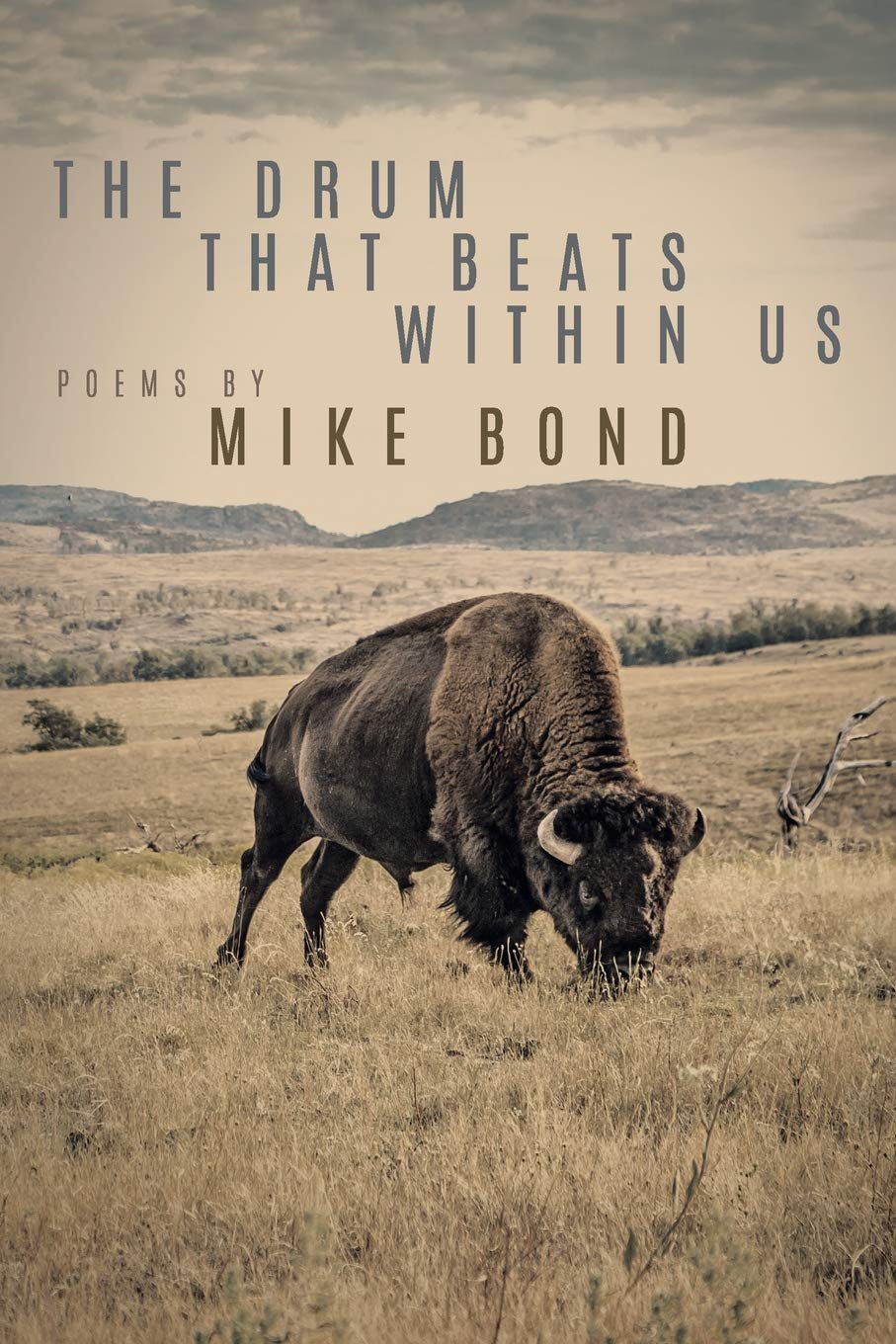
THE DRUM THAT BEATS WITHIN US :: Mike Bond

My poetry reading is still in the beginning experimental stages. Being a novice, I pick poetry books like I pick most others, I'm captured by a cover. Such was the case with Mike Bond's The Drum that Beats Within Us, which called out to the beast and nature lover in me. How could I lose when the insides seemed destined to be full of connections between humans and their surroundings?

Bond believes poetry was born the moment we began to speak. It existed before then in "what whales and wolves sing." Every clan needs stories and lessons from the past, and to make them more memorable, the stories were often told in rhythm and rhyme. Poetry and stories are "how we find meaning in the incomprehensible, beautiful, tragic and sacred mystery of life."

This line sums up how I feel about poetry: "What counts is what we learn emotionally. When something hits us emotionally it stays in our experience..." Poetry feels like the ultimate in emotional connection. I can't tell you what poetry is, what different meters and rhythms mean. I can only tell you what I happen to connect with emotionally, what gets me in my gut. Mike Bond's work does that, and I connected with the themes of the havoc we are wreaking on the earth:

Hungry Magpie

A hungry magpie
is a world
out of order,

when after so much killing
there's nothing left
to die.

The earth barren
as the raw red skin
of Mars,

the seas deadly
as the toxic
skies.

And to think
one little biped
did it all.

Paradise Ducks

Paradise ducks don't know
about men and steel.
In rainforest rivers
they love
and raise their young,
always paired, the
dark multicolored male
and white-necked female.

Paradise ducks so easily fly,
don't know about airplanes
carrying men halfway
round the world,
shotguns in their baggage,
men who shoot thousands of ducks
for fun,
who have shot ducks in Brazil,
Mongolia, Canada, and now
in the far south
of the South Island
of New Zealand.

Paradise ducks mate for life.
Men don't.
A duck never kills.
Men do.
Ducks love misty dawns
that men sleep through,
flashing rivers and skies
blue as the gun barrels
that the men to love
to kill ducks
look down
before they fire.

Most Evil Thing

The most tragic thing
humans do
is war,

our greatest joy
is life's
creation.

The most evil
is to call one
the other.

*  *  *

Mike Bond is an award-winning poet, ecologist, and war and human rights journalist. I loved his no-punches-pulled approach, addressing the our vanishing natural world and calling us to account. This is a book I will buy for my growing poetry shelf and reread with pleasure.

Wednesday, October 16, 2019

GUITAR :: David Schiller

I don't play the guitar. I'm not sure I've ever even picked up a guitar and strummed it (odd, that). But I love guitars. Their sound, of course, acoustic or screeching metal. More so their mere presence and craftsmanship, the many forms and artistic impressions they carry. All of which is what prompted me to read David Schiller's Guitar: The World's Most Seductive Instrument. I came for the pictures and good stories and I found them.

Some of the writing was over my head. This is a book for guitar aficionados, which we have already confirmed I am not. But boy is it a beauty. An encyclopedia of guitars, a photo of each accompanied by the name, model, builder, and type. Then, the stories. Stories of Elvis, Eddie Van Halen (who boils his strings, who knew?) and his "Frankenstrat," Bob Dylan, Lucinda Williams, the Beatles, Prince, and on and on.


Schiller's love of the guitar shines through in his writing: "[W]hat's most special about a guitar is the physical bond it creates. A guitar has a body. A voice. It has a look we can admire, show off, modify, identify with. Players can spend hours, days, a lifetime with it, cradled in our arms. We pack it up and carry it everywhere, and when we meet a fellow guitar lover, we can geek out and speak about guitars for hours. It's both universal and deeply intimate, as ubiquitous as any other consumable...and yet , transcendent. It even falls prey to the most believed-in romantic myth: 'The one' is out there, just for you. But unlike said myth, no guitar lover ever needs to settle for just one! So turn the pages, and maybe you'll find your next true love."

Despite not knowing or understanding the technical nature of the guitar ("it looks like an archtop, with its f-holes, but also like a flattop, with its familiar pin bridge. Yes those are pickguards hugging the f-holes..." Wha?)  this book was a joy to flip through and would be a great gift for any guitar lover.


Monday, October 14, 2019

BEYOND THE TREES :: Adam Shoalts

A version of this review previously appeared in Shelf Awareness and is republished here with permission.

"Are you insane?" he was asked. Professional adventurer Adam Shoalts wanted to do something "that hadn't already been done" in celebration of Canada's sesquicentennial. What he came up with combined his passion for paddling wild lakes and rivers with his desire for a challenge that would raise awareness about our vanishing wild places. His plan was "unlikely to succeed" and questions regarding his sanity were many, even with respect to the "easy" parts.

Beyond the Trees is the result of Shoalts surviving a months-long, 2,500-mile trek across the Canadian Arctic with nothing but his canoe, a backpack and two barrels crammed with rations (more than 170 pounds of dead weight). He faced down grizzly bears and muskox (sometimes right at his tent opening) and battled severe winds, chunks of ice drifting like jigsaw-puzzle pieces and hordes of blood-sucking insects. Most remarkable (and perilous) was that to chase the ice melt, Shoalts's route required he travel upstream, against the flow of rapids that generally called for parties of six to 12 to travel down safely.

Shoalts approaches the many dangers with smarts and aplomb, while also transmitting the tension in his recounting. Despite the risks Shoalts conveys, Beyond the Trees is an earnest love story to one of the last portions of the Earth that remains undeveloped and where large animals still roam free. Peppered with Shoalts's corny humor and legends of lone trappers' unspeakable deeds, this white-knuckle affair is a travelogue, adventure story and horror-movie-in-waiting that sparks an urge to get out and go.

STREET SENSE: An intrepid explorer paddles and portages the vast and treacherous Canadian Arctic, sharing its unparalleled beauty and crucial need for its preservation. Nature lovers, risk-takers, travel nerds alike will dig this one.

COVER NERD SAYS:  Pretty picture, passable fonts with good balance. Subtitle here passes muster, as the title needs a little more explanation. I will say this photo makes the trip look much more peaceful than it was. A little more urgency or danger might have added to it, but overall a great looking cover.

Friday, October 11, 2019

THREE SECONDS IN MUNICH :: David A.F. Sweet

A version of this review previously appeared in Shelf Awareness and is republished here with permission.

"They're all gone." These enduring words of sportscaster Jim McKay announced the murder of 11 Israeli Olympians by Palestinian terrorists at the 1972 Games. Three Seconds in Munich adeptly scrutinizes the infamous basketball tournament between the U.S. and the Soviet Union that took place at the same Games, and sportswriter David A.F. Sweet (Lamar Hunt) strikes a perfect balance in discussing both events.

Sweet takes the gracious risk of losing his audience to anguish by leading with the hostage crisis and not paying mere lip service to the horror. In doing so, he gains crucial trust in a story calling out collusion and game-fixing at one of the highest levels of sport.

Mere days after the massacre, following an undefeated 36-year Olympic streak spanning a "borderline-ridiculous sixty-two games," the U.S. lost to the Soviets 51-50 in the gold medal game. But officials twice added three seconds back on the clock--once after time had expired and the U.S. had won the gold.

Three Seconds is painstakingly researched. While Sweet exposes conspiracy and wrongdoing, he does not discount other elements working against the U.S. team, including coaching style, politics and a dearth of players due to rules prohibiting professional athletes (seemingly overlooked on the Soviet front).

Sweet does a stellar job of pulling emotional strings and revealing how "encountering the evil of terrorism and suffering an excruciating, unjust" loss in only a four-day span continues to affect the players.

STREET SENSE: I remember this Olympics vividly. Where I was (vacationing in Santa Cruz) and who I was with (my family and old family friends). The Olympics were always a special time. I wasn't even 10, but I remember the hostage-taking. I remember zero about the basketball tournament. I felt those old emotions come out as Sweet discussed the tragedy of those Games. This is a recommended work for anyone curious about the Games, athletics and politics, and sports in general.

COVER NERD SAYS:  This cover makes the content clear and the photo captures some of the ranging emotions and reactions to it. The title and subtitle are both smart (one dramatic, the other clarifies). There is nothing earth-shattering here, but any effort to be overly dramatic would be an affront to the content, I think. Overall, well done.

Wednesday, October 9, 2019

WILDHOOD :: Natterson-Horowitz and Bowers

A version of this review previously appeared in Shelf Awareness and is republished here with permission.

Advice on "how to ask out a whale" may not seem a typical means to teach about adolescence, but evolutionary biologist and physician Barbara Natterson-Horowitz and science journalist Kathryn Bowers make such compelling and scientific connections between humans and animals that readers will come to believe that one can learn a trick or two from our fluked friends. In Wildhood, a follow-up to their acclaimed Zoobiquity, the authors explore the crucial stage between childhood and adulthood across the animal kingdom.

Safety, status, sex and self-reliance are the four universal challenges adolescents must navigate while transforming successfully into adulthood. Each is illustrated through one of the following points of view: Ursula, a king penguin who risks death from a voracious Antarctic predator she has never seen before on her first trip away from her parents; Shrink, a socially adept hyena pup born on the bottom of the ladder who rises through the hierarchy; Salt, a humpback whale who learns the complicated dating rituals of her species; and Slavc, a young wolf who sets out on a solitary journey to find his forever home.

Having identified the "core four" competencies to be mastered by every adolescent on earth, the team presents their cross-species theories in a highly entertaining yet skillfully informative format that will engross animal lovers and parents alike. Without anthropomorphizing, one still can't help but fall in love with these animals and, by association, hopefully gain some understanding and empathy for human adolescents. Wildhood is a roller-coaster ride through nature's wonders.

STREET SENSE:  A cool cross between the human and animal worlds, I fell in love with each of these creatures (some more than others, not always in direct correlation with how interesting the point of the arc was) and also did come out with more empathy for human adolescents. Who can be such a true pain in the ass (Not talking about you, KRK!) I dug this one and it was apparently recently highlighted on NPR, so I'm going to check that out and also will be reading Zoobiquity.

COVER NERD SAYS: Fuckin' baby lions. Pretty much says it all.

Monday, October 7, 2019

THINK BLACK :: Clyde W. Ford

A version of this review previously appeared in Shelf Awareness and is republished here with permission.

Clyde W. Ford struts to his first day at IBM with "a ballooned Afro, pork chop sideburns, [and] a blue zoot suit with red pinstripes," knowing only shades of the legacy he carries. In 1971, more than two decades after his father's hiring as IBM's first black systems engineer, Clyde, 19, is told he "doesn't get it"--"it" being the IBM way of a dark suit and tie, button-down shirt and matching attitude. 

As Clyde digs into his father's experience, he gains fuller understanding of John Ford's path and the burdens of treading it. In Think Black, Ford winds through their lives and the corporate behemoth that influenced them. Being first carries risks, and John felt the pressures of representing his race in the face of racial codes, false diversity, sabotage and working harder for less pay. He brought change to IBM at a cost, deepening his "wound of color."

Ford illuminates the profound interaction between technology and race. A progression of machines and coding (Ford learned at a young age from his father--"For a ten-year-old, deriving 1,008 decimals from 1760 octal is no easy feat") parallels IBM's sinister history in the service of racial purity and oppression.

The Fords did not take the same path in answer to the question of who they were as black men in a society that resents their very being. In Think Black, Ford shares a peace his father never found, and food for thought for a country that hasn't come nearly as far as they did.

STREET SENSE: IBM was a huge force during my childhood in Silicon Valley, but I learned so much from this book I had no idea about. A fantastic relationship story as much as a corporate history lesson, I did glaze over at much of the tech-talk. Dude, Clyde would have kicked my ass by the time he was 5. The first description of him won me over entirely.

COVER NERD SAYS: Cover images don't come much better than this one. So cool (though I would love to see a color photo of Clyde as described in the opening). I also love the interplay of the title and the IBM logo. Sneaky smart.

Monday, September 30, 2019

AXIOMATIC :: Maria Tumarkin

A version of this review previously appeared in Shelf Awareness and is republished here with permission.

When Australian literary legend Helen Garner says, "No one can write like Maria Tumarkin," one sits up and pays attention. Cultural historian Tumarkin teaches creative writing at the University of Melbourne while writing novels and essays. Axiomatic testifies to Tumarkin's captivation by and insight into sociology; these five extended essays explore themes that stir intriguing communal reaction and response.

In "Time Heals All Wounds," several youth suicides rock a school community. Students grieve through English papers, "submitting their heartbeats as assignments." Tumarkin delves into the cultural reaction to suicide. The school's administration tries to comfort, but Tumarkin signals the particular difficulties with suicide by deftly contrasting the handling of multiple student deaths in a car accident.

Perceptions of historical trauma and the inadequacy of children's courts are depicted in "Those Who Forget the Past Are Condemned to Re--." A Polish couple abducts their grandson and hides him in a Melbourne "dungeon." Discounting the grandmother's argued protection of the boy as a misapplication of her own trauma (hiding from Nazis to survive the Holocaust), authorities prosecute her and send the boy "home" to unfit parents.

Tumarkin's writing is often hauntingly beautiful, but the exploration of the generational influences of trauma, addiction and suicide always feels journalistically balanced. The past marks us, but is only one element on the road to "junkie or philanthropist," businesswoman of the decade or abject failure. There are no Hollywood endings, just a fascinating reflection of life in the tarred trenches.

STREET SENSE: Tumarkin is a cultural historian with a knack for exploring how communities and bureaucracies handle various traumas and crimes, as well as the generational impact on those affected.

A FAVORITE PASSAGE:  Nothing is more human than the experience of feeling trapped. And everything's a trap, your past, family, genes, addictions, loneliness, that feeling that pretty much everyone else is galloping gaily ahead while you are crawling backwards like a lobster or lopsided baby.

COVER NERD SAYS:  Covers for a collection of essays feels like they would be more difficult than a straight story or non-fiction arc. That leaves me grading this cover with a less heavy hand. It's a fine cover, but I have no clue what these essays are about, or even that it's a collection of essays. But I knew this was an Australian author writing about Australian things, so I didn't really need to be sucked in by the cover. Had that need been there, I can't say this cover would have attracted me. (Though the Helen Garner quote would have, crimping my "blurbs are the worst" theory.)

Friday, September 27, 2019

TELL IT TO THE WORLD :: Stan Grant

A version of this review previously appeared in Shelf Awareness and is republished here with permission.

A television news and political journalist and a member of the Wiradjuri tribe of Indigenous Australians, Stan Grant offers a painfully insightful look at the tragic history of Indigenous people in Australia since the British arrived in the 18th century and started colonizing the continent.

Originally published as Talking to My Country in 2016, the book began as a response to the racist humiliation of Indigenous footballer Adam Goodes. Published in the U.S. for the first time as Tell It to the World, this is a transparent look at the full history of Australia and the historic efforts to marginalize and erase Indigenous people.

Grant's family is a microcosm of the horrors of early settlement. John Grant, a forebear, was an Irish Catholic who rose up against the English. He was convicted and sent to the penal colony, "a man in chains, hounded by tyranny, banished from the soil of Tipperary.... He died the wealthiest Irish Catholic in the colonies." As a white man he thrived, while the Indigenous, including his relations, were slaughtered at places now named for their atrocities, such as Poison Waterholes Creek and Murdering Island.

And still today in Australia, Indigenous people are disproportionately suicidal, imprisoned and "trapped by the tyranny of low expectations." In this memoir of a boy, his family and their land, Grant puts lyrical words and truth to the idea that "a truly great country... should be held to great account."

STREET SENSE: As a half-Aussie, I was aware, yet nowhere near sufficiently aware, of the history of Indigenous Australians. Stan Grant shares an important look at the historical repression of Australia's first people ('The Great Australian Silence") and the idea that a truly great country should be held to great account.

A FAVORITE PASSAGE: As the frontier passed, my people were not fading away. We had become 'the Aboriginal problem' and now there was a solution. It was a great Australian prophecy, written in law and given a name: Assimilation. As the policy stated: '...the destiny of the natives of aboriginal [sic] origin, but not of the full blood, lies in their ultimate absorption by the people of the Commonwealth...' Absorption: Think about that word. To us it meant that we would lose all traces of our culture and our heritage. It meant that we would lose our families.

COVER NERD SAYS: This was a book I chose based on content without regard for the cover. Which is a good thing, because the cover is something of a disappointment. It doesn't evoke any emotion in me, certainly not any emotion that serves the content. It feels cartoony, which doesn't seem right. The leaves feel like an afterthought to paint it with some cultural content. It would have been more powerful without them (just the black and white text), but it also deserved more attention from the get-go.

Wednesday, September 25, 2019

THE NATURE OF LIFE AND DEATH :: Patricia Wiltshire

A version of this review previously appeared in Shelf Awareness and is republished here with permission.

Depending on one's perspective, there are few nicknames greater than "the snot lady," the sobriquet earned by Welsh forensic ecologist Patricia Wiltshire for developing a method to obtain pollen particles from the nasal cavities of the dead. In The Nature of Life and Death, Wiltshire describes that method in terrific detail, part and parcel of her 45-year career studying the world of plants and, since the early 1990s, helping the police solve crimes through ecological trace evidence (pollen, fungal spores, soil, etc.) taken and left behind by victims and perpetrators.

Along with her practical history and pioneering of her profession, Wiltshire walks readers through numerous case studies recounting how her work helped locate a murder victim's body or linked a suspect to a crime. Those interested in plant and animal sciences or forensics will be particularly rapt at the microscopic levels of proof Wiltshire obtains.

Even as she writes for a broad audience, Wiltshire comes across as enigmatic as her subject matter. She writes from a self-centered but somewhat aloof point of view and in a straightforward manner befitting a lecturer. Wiltshire is under no obligation to share herself; her credentials and the case studies speak for themselves. Yet, at the three-quarter mark, she unexpectedly shows her animal-loving side and "explains" her "arrogance." Her disclosures can't help but thaw both writer and reader, serving not to change the absorbing material, but to heighten appreciation and understanding of its source.

STREET SENSE:  Full disclosure. I almost gave up on this book by the halfway mark. Wiltshire comes across as an arrogant jerk. I kept trying to figure out if she is one or if her writing just came across that way. It was driving me to distraction and taking away from the substance of her truly fascinating story. I'm not sure why why I stuck with it, but I'm glad I did. I judged Wiltshire without knowing why she is the way she is and writes the way she writes. I wish she would have disclosed it sooner because it would have, IMHO, made the book so much better. Don't let your readers think you're an ass before you explain why you might be an ass and where it comes from and thus why you really may not be an ass. I ended up feeling so much empathy for Wiltshire and appreciated her more after she explained. As much as I love forensics and crime scene stuff, this was almost more fascinating from a psychology/character study perspective. Which might not be a good sign since the book is supposed to be about crime scene science, but I still recommend the book. This is a very long-winded paragraph, but this book evoked so many issues and questions for me. I would love to talk to Wiltshire about this one day. I have a feeling I'd really, really like her.

COVER NERD SAYS: I "like" this cover, but I also find it a bit too ambiguous. The crime scene tape is great, but it's not 100% obviously crime scene tape. Because it's around some bland foliage, it reads a bit like a bouquet (or some other non-crime-sceney thing wrapped in a bow). The ambiguity is amplified by the image of the foliage. What does that plant (that looks quite healthy and alive and not part of a crime scene or full of pollen or other detritus one thinks of as transfer) have to do with crime scenes or the study of spores? If one or the other of the elements would have been more obvious, the entire thing might have been more obvious. That being said, it's clean and colorful. It goes a bit overboard on the subtitle side (two? really?), which is really more evidence that the images were ambiguous enough to require not one semi-explanation, but two.

It's hard to believe I liked this book when I'm having such an apparent field day punching at it, but I really did. I also had some issues with it that I'm apparently finding a need to go on about today. I think because I ended up liking and admiring Wiltshire so much. She is arrogant (admittedly). There is good substantive reasoning behind it. But she's also a tough nut that finally cracks and shows a little light and I love that about her.

Monday, September 23, 2019

GOOD MORNING, MONSTER :: Catherine Gildiner

A version of this review previously appeared in Shelf Awareness and is republished here with permission.

Any doubt that seeking therapy is courageous will be put to rest by the patient profiles detailed in Good Morning, Monster. Catherine Gildiner is a clinical psychologist and author of a trilogy of memoirs (including Coming Ashore). As pseudo-memoirist for five of her most layered and poignant clients, Gildiner clearly demonstrates the value of analysis, the resilience of the human spirit and the vast generosity of sharing one's life story.

The patients vary in culture, socio-economic background and temperament. Within their treatments, Gildiner highlights tools available to clinicians to facilitate acknowledgment and change. Despite these interesting instructive moments, Good Morning, Monster is not aimed at academics; rather, it provides a window for the lay person to bear witness to the most intimate of processes.

The levels of despair and dreadfulness underlying each of the five stories can't be overstated. There is abuse, violence and neglect of every gradient. But there is also growth, buoyancy and wonderful wit and humor ("Laura" on intimacy: "Christ! Why not just dance naked in the streets?").

Gildiner is a talented narrator and admirably summarizes years of sessions without the accounts feeling choppy or incomplete. She's also wonderfully frank about her own mistakes and misreads as a psychologist, and she is quick to seek outside guidance when beneficial (finding cultural resources to aid a Cree man, for example). With hard work, each client reckons with the demons they wake with each morning, even when they've been told they themselves are the monster.

STREET SENSE: Anyone interested in the human mind and the resilience of the spirit in the face of extreme adversity, sign up for this one. It's really beautifully done, and while at times a difficult read (due to subject matter, not the writing), the payoff is worth it. Talk therapy can be a lot of work and results can come at a cost, but the value really can't be overstated. Get yourself in there, yo. Everyone could use a little help.

A FAVORITE PASSAGE:  I'm going to include a few, about the case of Laura, who came in due to stress. Her resistance to therapy and the ultimate lengths taken by the author to break through feel like a good microcosm of how hard therapy can be, but how finding the right person to talk to can be magic.

Laura came in completely shut down, unwilling to share her story. She just wanted help with stress:

"When I said that I was empathizing with her, she rebuffed me. 'That’s what you say to people when someone dies. Listen, Doctor, if I’m ever to come back here, I never want you to do that again, or I’ll walk out. Keep your empathy or whatever it is to yourself.' 'Why?' I asked, genuinely puzzled. 'When you say things about feelings, I see a door opening that’s full of hobgoblins and I am never going to enter that room,' she said emphatically. 'I have to keep going. If I ever started to wallow, even once, I’d drown. Plus, it doesn’t make things any better.'"

Laura's story eventually started coming out, even though she was in denial about her past:

"When I asked how she felt about being abandoned, Laura looked at me as though I were being melodramatic. She said, 'We weren’t exactly abandoned. My dad knew I was there to deal with things.' 'You were nine years old, penniless and alone in a forest. What would you call it?' I said. 'I guess technically it was abandonment, but my dad had to get out of Bobcaygeon. He didn’t want to leave us. He had no choice.'"

I loved Laura because she was a fucking hard nut with an awesome sense of humor. You should read this book just to get to know Laura. She eventually came to terms with her demons, but not before Gildiner took her on a field trip to an elementary school where she saw the lives of REAL 9-year-old girls. Who were skipping rope and playing foursquare, not caring for younger siblings alone in a fucking forest. It was one of the most powerful things I've ever read.

COVER NERD SAYS: This cover is beautiful. I suppose I get the symbolism of the swan, and it's as good a choice as any for the cover of a book dealing with transformation. The connection to the text is symbolic, but it really just doesn't matter because it's pretty and well done. Minimalist, eye-catching, subtitle helps make it fairly obvious what's inside. Winner.

Monday, September 16, 2019

THE BIRD BOYS :: Lisa Sandlin

A version of this review previously appeared in Shelf Awareness and is republished here with permission.

Tom Phelan is painting over the remains of a bloody crime scene in his office as the second Delpha Wade and Tom Phelan mystery begins. The Bird Boys picks up where Lisa Sandlin's debut, The Do-Right, left off, with Delpha bloodied and under investigation for another act of violence. Vietnam vet Tom is six months into his private investigation practice. Delpha is even more tragically layered, lucky to get the secretarial gig following her release from Gatesville prison after serving 14 years for killing a man.

Xavier Bell hires Tom to find his estranged brother, with little more to go on than ancient family history and a 40-year-old photograph. Bell's strange story gets more questionable as Delpha and Tom pry into his past. The Bell investigation and a few minor cases keep things hopping, but the highlights are Sandlin's characters and their constant striving and growth. Delpha is sharp and resourceful and, as Tom's reliance on her grows, so does the trust each gives so reluctantly.

Sandlin's writing is Chandler-esque, her descriptions divine ("a comet's-tail of trouble," "a hem that would ride up to her crank case if she sat down"). Set in 1970s Beaumont, Tex., the surroundings are wonderfully suffused with Watergate, pay phones, Selectric typewriters and a little Cajun flavor. With phrasing to linger over but pacing that presses forward, The Bird Boys will have readers racing to grab the first book and crossing fingers for more of the dynamite characters inhabiting this noir series.

STREET SENSE: This one caught me unawares when I received the assignment blind. Had no clue what to expect. I'm not all that keen on dropping into an existing series. But damn if this one did hit me square and I'll both continue on and go back and hit up the first in the series. Seriously, "ride up to her crank case." How do you not love that?

A FAVORITE PASSAGE: See said crank case. There are some fabulous turns of phrase in Sandlin's work. That alone would keep me coming back.

COVER NERD SAYS: I'll be honest, this one creeped me out. Which is very interesting, because (1) I love dark; (2) I love birds; and (3) the image really isn't all THAT creepy. I'm glad I wasn't left to my own devices, because I would have passed this one up if I saw it on the shelf. Swing and a miss for me. This really is a case of "It's not you, it's me."

Friday, September 13, 2019

THE BLESSING :: Gregory Orr

A version of this review previously appeared in Shelf Awareness and is republished here with permission.

"Do I dare say my brother's death was a blessing?" Decorated poet Gregory Orr was 12 when he accidentally killed his younger brother. His memoir, The Blessing, begins with an uppercut that keeps stinging despite stunning language and insight. Ill-equipped to deal with the new reality he was trapped in forever, Orr was set adrift by his parents' emotional abandonment and an ingrained familial response of denial.

Orr struggled with his destroyed understanding of the world: "Peter's death wiped out all the easy meanings I had lived by until that day, as if a giant hand swept the counters and dice of a child's game off the board."

Like Cain, Orr wandered in despair as a fugitive from society. The accident was one of a "flurry of catastrophes" that defined Orr's youth and marked a dark trajectory. Salvation began in a soda fountain shop where Orr discovered comics, cheap paperbacks and, ultimately, "POEMS!"

"Enthralled by the possibility of making my own paths out of language," writing became a way out of the labyrinth.

Originally published in 2002, these essays feel fresh, as if the wound remains raw on the page. Orr became a poet and professor, spending much of his life compelled to probe "silence-shrouded events and their consequences"--torment, guilt and desire to survive. Orr sprinkles glorious bright spots through this haunting collection, like school buses pulling into a parking lot, "each its own distinctively faded shade of orange or yellow... gathered like old carp at the edge of an autumn pool."

STREET SENSE:  A blessing and a curse, this lovely memoir has some beautiful language worthy of a reprint.

A FAVORITE PASSAGE:  I was enthralled by the possibility of making my own paths out of language, each word put down like a luminous footstep, the sentence itself extending behind me in a white trail and, ahead of me, the dark unknown urging me to explore it.

COVER NERD SAYS:  The silhouette images of two young boys, one below the color and one above, is dazzling. Are they two silhouettes or one? Is Orr trapped below with his brother or able to rise above? Or is one rising above the clouds? So many interpretations for such simple visuals. Stunning work.

About Malcolm Avenue Review

I was lucky enough to be born and raised in a nifty, oak-shaded ranch house on Malcolm Avenue, a wide-laned residential street with little through traffic, located amid the foothills of Northern California. It was on that street and in that house I learned most of my adolescent life lessons, and many grown-up ones to boot. Malcolm Avenue was "home" for more than thirty years.

It was on Malcolm Avenue, through and with my family and the other families that made up our neighborhood of characters, that I first learned about and gained an appreciation for the things I continue to love the most to this day: music, animals, photography, sports, television/movies and, of course, books.

I owe a debt of gratitude to that life on Malcolm Avenue. It gave me a sense of community and friendship, support and adventure. For better and worse, life on that street likely had the biggest impact on the person I've become. So this blog, and the things I write here, are all, at their base level, a little bit of a love letter to Malcolm Avenue.

Labels

  © Blogger templates Newspaper by Ourblogtemplates.com 2008

Back to TOP