Sunday, April 11, 2021
A MOST REMARKABLE CREATURE :: Jonathan Meiburg
Saturday, April 10, 2021
RAFT OF STARS :: Andrew J. Graff
A version of this review previously appeared in Shelf Awareness and is republished here with permission.
At the local gas mart, Tiffany works the counter, staving off homelessness, bantering with the locals and trying to catch the attention of Sheriff Cal. Cal is new to town, up from Houston where his confrontation with a violent parolee made a fresh start necessary. After Fish shoots Bread's father to stop another beating, the boys pack supplies, leave a note for Teddy and run away to build a raft and live off the land. The life-battered locals join with Fish's stalwart mother, Miranda, in a frantic search for the boys in the Wisconsin wilderness.
As the pairs (Fish and Bread, Teddy and Cal, Tiffany and Miranda) converge at the perilous gorge rapids the boys don't know exist, they learn about themselves, each other and the things that are most important. Graff's nature writing is absorbing, and his characters generate a yearning to know them. Raft of Stars is a quest story full of heart and humor.
Wednesday, October 7, 2020
DOUGLAS FIR :: Arno & Fiedler
The Douglas-fir is complex and chock full of enigmas, even regarding something so seemingly simple as its name. "Douglas-fir" was not formally settled until 1950, despite the tree being centuries old and specimens first collected by a non-indigenous person in 1791. The tree's secrets are spilled in Douglas Fir, so titled by forestry pioneers Stephen Arno and Carl Fiedler because this is how (incorrectly) the name is used in common parlance--all the more amusing when one learns it isn't a true fir.
The Douglas-fir was once the world's premier construction lumber and changed the course of history on several fronts. Douglas-fir is a "mix of distinctive structural features and physiological attributes [producing] a tree that is puzzling, exceptional, and in ways a marvel of nature." It yields more quality lumber than any other tree in the world and its genetic diversity allows it to range from mere head-height to hundreds of feet tall. It tends to be fire-resistant, adding to the chance it can live for centuries. Coastal Douglas-fir even contributes to its own irrigation by collecting fog droplets on its needles. "Though this tree has long played an integral role in the lives of humans and animals, many of its secrets are only now being understood through modern science."
Arno and Fiedler have written other books together about the natural world (Ponderosa) and present a seamless and engaging history of one of its marvels. The narrative includes historical photos and detailed sketches and is followed by a visitor's guide to notable North American Douglas-firs--altogether a trip-inspiring package.
Tuesday, October 6, 2020
THE REIGN OF WOLF 21 :: Rick McIntyre
"Why can't I find a man like 21?" a friend asks Rick McIntyre. This bemoaning might seem strange when one learns 21 is a Yellowstone wolf, but The Reign of Wolf 21 amply explains the dismay. Picking up where he left off in The Rise of Wolf 8, his award-winning story of a runty wolf pup who rose to alpha male status, McIntyre provides another fact-filled and science-based tale that can't help but also warm hearts. The detailed daily observations of mating, feeding and hunting habits for what became the largest pack ever recorded are also a love story for the ages.
"At its height, the Druid Peak pack, led by wolf 21, comprised thirty-eight wolves and held sway over an enormous territory in Lamar Valley. The intrepid alpha male achieved all this by being fearless in battle, never backing down, never killing a rival wolf, and, even more importantly, having an equally loyal, fearless, and wise companion by his side, wolf 42." The story of how 21 and 42 became who they were, particularly through the early influence of other pack members, and their devotion to each other give soul to the story.
Wolf 21 was raised and mentored by 8, his adoptive father, and McIntyre shares enough of their relationship to evidence 8's impact. But those interested in 21's ultimate reign over the wolves infamously reintroduced to Yellowstone in 1995 will certainly want to start at the beginning or go back to fill in the details of this legendary saga so skillfully told.
Sunday, October 4, 2020
SHOOK :: Jennifer Hull
If mountaineering were a more publicized sport, Dave Hahn would be likened to Michael Jordan. The subject of Jennifer Hull's gripping first book, Hahn not only shattered records, he did it "while climbing as a working guide, with nonprofessional climber clients safely in tow." Known as an elite climber, Hahn has also received numerous awards for daring rescues and unselfish valor. Perhaps most amazingly, Hahn helped find the body of famed British explorer George Mallory, missing on Mount Everest since 1924.
In other words, if you're going to climb Everest, where "the ratio of deaths to summits... [hovers] at around one death for every five successful summits," you want to hire Dave Hahn. This may never have been truer than in 2015, a year after an avalanche in the Khumbu Icefall killed 16 Sherpas. Ongoing tectonic action wed with global warming means the mountain is changing. As Hahn's group attempted to reach the summit in 2015, their biggest worry was the rebuilt Icefall. Little did they know they would also face a 7.8 earthquake that struck Nepal, killing 22 people (the deadliest Everest disaster) and trapping the team on the mountain.
In Shook, Jennifer Hull deftly merges the story of how Hahn became the icon he is with a detailed account of the 2015 expedition that ended with so much death and destruction. The small details are magnificent, adding to the personalization of Everest, its pull and its power. Hull's narrative smoothly transitions and covers the rescue, never overshadowing the lives of the locals who sacrifice to make dreams possible.
Wednesday, September 30, 2020
OREGON, MY OREGON :: Photo Cascadia
I saw an advanced copy of the book and can't wait to get the final edition to see these photos in all their glory. They are swoon-worthy in e-format.
I recently returned from a drive up to the Bend area and back and seeing some of this gorgeous landscape in person is always a treat. This book will be a reminder of past treks and help plan future adventures.
I enjoyed the tone set by Nicholas Kristof's Foreword. It is obvious he loves Oregon and its multitude of landscapes (mountain, desert, lake, sea, rock formations to keep us rock nerds happy forever), people and pastimes. But after listing the state's positive characteristics, he also addresses some difficulties of the past and present. No state is perfect (they are full of people, how could they be?), but Oregon has much to offer.
The photos are taken of all different areas of Oregon at varying times of the day and year. In this picture to the right, seeing snow on the mountains while the leaves change below is a beauty it's hard to imagine is real. And rocks? Oregon has rocks and rock formations galore.
A favorite of mine is Haystack (below), which is on the coast and one of those landmarks that always seems recognizable, even when pictured by itself, which is pretty amazing for a rock.
I highly recommend this lovely table book whether you are an Oregon denizen, a prior visitor, or someone looking for fantastic nature photos while thinking of planning any future trips. It's tough to beat a place you can ski, mountain climb, beach comb, paddleboard, hike, rock climb, visit national forests and lava formations, or kayak through the middle of downtown (Bend). Oregon, My Oregon makes me wish Oregon was mine.
Saturday, September 19, 2020
SKUNK AND BADGER :: Amy Timberlake
Seems Aunt Lula has also offered Skunk a room in her brownstone, though Badger has been too busy doing his important rock work to read her last several letters. Badger is put out by Skunk's presence, initially trying to pass off a closet as the luxury guest quarters. He soon finds life with Skunk isn't all bad, particularly at mealtimes (breakfast hot chocolate!).Of course not all goes smoothly and soon Badger is surrounded not only by Skunk, but hundreds of chickens (because that's what happens when you blow the chicken whistle), a treacherous stoat and some odors that are not as wonderful as breakfast hot chocolate.
I adored the drawings interspersed throughout the book, particularly Skunk reading under the covers of his room in the moonlight. Although there are certain conflicts between species (stoats and chickens apparently can't bridge the gap, for instance), there is never any discussion about inter-species relationships. Aunt Lula, for instance, is a pine marten. There is just family and friends and roommates and some natural enemies, language barriers be damned. Also, CHICKENS IN BELL-BOTTOMS.
Geared for grades 2-5, which I am decidedly not, Skunk and Badger is a worthy tale for all ages. Timberlake is a Newbery Honor recipient and Klassen a Caldecott Medalist, coming together to show how we can all be better together.
Wednesday, August 19, 2020
SNAKE :: Erica Wright
Erica Wright's Snake is part of the Object Lessons series, books aimed at shedding light on the hidden lives of ordinary things (coffee, the ocean, bookshelves, hair, personal stereos, eye charts; I'd go on because despite their ordinariness you can see how a book about these items would be fascinating, but I digress).
I love snakes. Don't turn and run if you're anti-snake, Wright isn't fond of them herself. But she gives them a fair shake, and delving into why snakes seem to hold a sense of evil is part of this fascinating account of what snakes are all about and the unfair (and sometimes fair) qualities we ascribe to them. Although snakes often inspire fear, they are also the symbol of medicine. The snake is a true contradiction, "a living embodiment of duality."
Scientists believe that the medicinal potentials of venom are far-reaching. A drug for blood clots created from studies of the saw-scaled viper has been on the market since 1998. Neurotoxins might one day be used to treat brain injuries and Alzheimer’s. Some experts believe that we could see snake venom playing a role in treating Parkinson’s and breast cancer, as well. A substance that strikes fear into so many hearts could be used to restart those very organs.Wright recognizes that humans are also creatures of duality, with the power to be menacing or helpful, destructive or redemptive. "Irrational fear justifies a lot of cruelty," and if we fail to understand the serpent we run the risk of losing a valuable resource. Wright explores the snake in voodoo, church, pop culture, science, conservation, and social media. Britney Spears, David Letterman, Steve Irwin and scientists studying robotics all have snakes in common. A baby cobra still had 150,000 followers on social media eight years after he escaped the Bronx Zoo. We are fascinated with snakes, we just need to understand them more. Wright's Object Lessons installment is a great place to start.
Sunday, July 19, 2020
MIRACLE COUNTRY :: Kendra Atleework
Atleework's writing about the denizens of her area is beautiful in its honesty and grit.
To understand the place we call the Eastern Sierra, you must be able to see what is no longer here. See what hides, change your definition of big and empty and small, of good and bad. Bend and search the desert floor for the near-invisible petals of a crowned muilla and then look up to mountains that seem to rise forever. This dusty margin of California draws and then replicates the kind of people who have never completely adjusted to a human scale. They don’t quite fit other places, be it the orbit of their ideas, good and bad, or the size of the sky they require in order to carry out their lives.
Her landscape writing, however, is dazzling. Great landscape writing, in my opinion, is a very difficult thing to achieve. It takes a special voice, intimacy, caring (love or hate or a complex mixture of both). Atleework hits that recipe out of the park. She grew up in Swall Meadows, in the Owens Valley of the Eastern Sierra Nevada. Annual rainfall averages five inches. In drought years that can be closer to zero.
The wind is a major force in the Eastern Sierra, earning the moniker of "Sierra Wave," and Atleework's writing about it is sublime:
On the beaches of the Pacific, gusts arrive laden with salt spray, whooshing with enough force to make your eyes water, a persistence perfect for launching kites. By the time that breeze reaches Owens Valley, it has raced over the coastal range, up the western, windward flank of the Sierra Nevada, and it has turned powerful. Dust devils tear up the dry surface of what was once Owens Lake, tossing toxic particles miles into the sky, into the lungs of the people who live near the old shoreline. The wind blows from the west over the mountains, and the willows along the river lean east. It scatters pollen in a golden film over backyard ponds. It stretches curtains across bedrooms.
I have hiked on a day when the Sierra Wave pummeled the sky, have leaned into a gale so strong it negates the work of gravity and I can almost lie down on air, can fall forward without really falling.
I have found myself caught in a canyon when the Jeffrey pines above me thrashed their branches like furious giants and the Wave hurled stones and pine cones and I ran for my car.
The Atleeworks were raised to thrive in their harsh environment, filled with scorpions, black widow spiders, rattlesnakes, cat-stealing coyotes, and mountain lions. They were "forever at the mercy of wildfires, blizzards, and gale-force winds. Above all, they were raised on unconditional love and delight in the natural world." The care and love of Atleework's unique and charismatic parents shines through in her work.
Her mother was diagnosed with an autoimmune disease when Atleework was six and died when she was 16. This loss wreaked havoc on Robert ("a man of wild plans and long shots") and his children, particularly adopted son Anthony ("pure cooked-down rage"). The family was damaged, Kendra taking off for school in Minnesota and Anthony tearing off with ill-conceived plans. Miracle Country recounts her pull home by her family as well as the landscape ("In Minnesota, the world is blanketed in snow silence. It’s safe to say: I miss familiar disaster. I miss water’s absence.")
In addition to landscape and family love and turmoil, Atleework swirls in some fascinating history of California, particularly with respect to water and the influence of William Mulholland, who became responsible for the infrastructure that pulled water away from the Sierras and allowed Los Angeles to become the city it is. The changes were not without war-waging. "'Whiskey’s for drinking. Water’s for fighting over.' This is a western adage I have heard many times. The contest over water passes between generations like a sodden torch. Bishop folks dam the shallow tributaries that pass through town, flooding their own yards and cutting off those below."
A memoir of love, loss, landscape and (to continue the alliteration) leaving, Miracle Country is a fascinating, heartfelt read that is astonishing in breadth without feeling bogged down. The advance praise will give you an even better push to pick up this gem:
Tuesday, June 9, 2020
THE BOOK OF EELS :: Patrik Svensson
An eel's testicles don't usually leap to mind when one thinks of Sigmund Freud. Yet Freud discovered this "holy grail of natural science" when the answer had eluded many before him. The eel is unusually difficult to study-- "Science has come up against many mysteries, but few have proven as intractable and difficult to solve as the eel." Some of the most famous natural scientists in history have tried to find answers, mostly in vain.
In The Book of Eels, Patrik Svensson, a Swedish arts and culture journalist at the newspaper Sydsvenskan, traces the history of efforts to unfurl the enigma of the eel. Though we know more today than when Aristotle gave it his best shot, the eel remains a fascinating puzzle in the modern era. "Somewhere in the darkness and mud, the eel has managed to hide away from human knowledge," forcing scientists to rely, to some extent, on faith.
An eel can live 50 to 80 years, during which time it metamorphosizes multiple times, dictated not by time, but by migration location. We "know" the eel procreates in the equally curious Sargasso Sea, yet no one has ever seen a mature eel or eels mating there. Answers seem only to create more questions, rendering the eel a perpetually interesting riddle with no end. Winner of the 2019 August Prize for nonfiction, The Book of Eels is nature writing at its finest. Svensson's memories of eel fishing with his father speak to the intersection of life and science, and add to its heart.
STREET SENSE: This in-depth investigation into the scintillating and mysterious life of eels is super fun reading. I thought I knew a few things and it turns out I knew very few things. I had no idea just how cool eels are.
COVER NERD SAYS: Totally dig everything about this. Color, image, cute face on that little f'er. It's pretty clear the book is non-fiction, but the small subtitle confirms it if there is any question. I like the font, type size, everything about it. The #1 bestseller "sticker" is not obtrusive and I don't have a problem with that like I do with blurbs. In fact, it's more helpful information than a blurb. This gets a solid A in my book.
Friday, April 24, 2020
EDGE OF THE MAP :: Johanna Garton
When chapter one is entitled "Missing," the gut-clenching starts early. Those who follow mountaineering are likely all too familiar with world-renowned alpinist Christine Boskoff, who left a successful career at Lockheed Martin at almost 30, a latecomer to climbing, and rocketed to the top of the sport. Humble and driven, Boskoff is the only American woman to have summited six 8,000-meter peaks.
In Edge of the Map, Johanna Garton (Awakening East) lovingly takes over her journalist mother's efforts to write a book about Boskoff, derailed by Parkinson's disease. She depicts the themes that ran through Boskoff's life: battling the odds, surviving loss and grief, and pursuing dreams.
The climbing community is a close-knit and often tragic one. Boskoff's path is filled with examples that give rise to the adage "If you can't handle death, you shouldn't be in the business of climbing." She and her husband, Keith, took over legend Scott Fischer's Mountain Madness following Fischer's death in the 1996 Everest catastrophe (the subject of Jon Krakauer's Into Thin Air). Boskoff ran the international guide service alone after Keith's death, and turned it into a highly successful venture. She unexpectedly found late love and a new climbing partner in the renowned Charlie Fowler; the two later disappeared while climbing in China in 2006.
Garton excels at creating and maintaining interest and tension even when the reader knows the tragic ending. From the unlikely climber's childhood to the trek to bring Boskoff home, Garton captivates readers with an engaging narrative style that gives them a taste of the summit.
STREET SENSE: A tragic yet lovely memoir of a woman driven to excel in a sport dominated by men, finding an outlet so natural to her that it almost seemed fate that only the treachery of a mountain could stop her. A wonderful read for lovers of the outdoors, climbing, finding your purpose and pursuing it despite the odds.
COVER NERD SAYS: I'm of two minds about this cover. As a painting or piece of art, I love the image. Yet it may not do the book proper service. From any distance it's hard to tell what's depicted and the lack of focus means it might be passed over on a shelf. That being said, the colors and flow are beautiful and the mountain outline at the top and bottom "edges of the map" are a great touch. I appreciate the fonts and sizing differentials, which were a good choice here, though perhaps highlighting Boskoff's name might have helped with identifying the subject and catching the eye of climbers and climbing fans.
Tuesday, April 21, 2020
TREES IN TROUBLE :: Daniel Mathews
Trees in Trouble "is a book for everyone who cares what happens to these trees, groves, and landscapes." Natural historian and lifelong backpacker Daniel Mathews concentrates on the history and decline of 12 pine species emblematic of the North American West. He provides a disconcerting look at how the landscape is transforming under the pressures of climate change, pests, pathogens and ill-conceived fire suppression strategies. Trees are seeking relief from grave circumstances causing their demise: "Groves where we sought refuge will themselves be refugees."
"Threats to forests today are bewilderingly numerous," he writes. While Mathews concedes we cannot restore the status quo of even the year 2000, it is possible to take on the enormous challenge of influencing our forests for the better. He explains with scientific authority how warmer temperatures and reduced precipitation trigger migration of species, a natural occurrence made problematic by marginal habitats that no longer support trees.
Even more fascinating is our relationship to fire and how a poor understanding of wildfire dynamics has increased the occurrence of firestorms and deadly fire vortices (California's 2018 Carr fire produced winds of 143 miles per hour, equivalent of an EF-3 tornado). Human actions have increased fire fuels while lessening trees' ability to adapt and recover, also negatively affecting water and air. Not all gloom and doom, in "Future Forests" Mathews speaks eloquently of what can be expected and how people can influence change. Trees in trouble means trouble for us all, as they make every breath possible.
Wednesday, February 12, 2020
CAT TALE :: Craig Pittman
Equal parts cautionary and alluring, Cat Tale is a story about which Craig Pittman warns, "This being Florida, there's going to be some weirdness sprinkled into this tale." The state's reputation as home to the bizarre is enhanced by Pittman's recounting of efforts to save Florida's official animal (and how that came to be is itself an oddity within oddities). A Tampa Bay Times journalist and author of several books about zany goings-on in his native state (Oh, Florida!), Pittman turns his environmentalist eye to the plight of the Florida panther.
Panthers (aka cougars, mountain lions, catamounts--all pumas) once ranged across North America, playing a crucial role in ecosystem health. As development expanded, so did conflicts between fierce predator, man and machines, until just between six and 20 big cats remained in the state. Those stragglers were in bad shape, and at risk of disappearing altogether by 2016. Cat Tale shares the extraordinary efforts of the individuals who set out to save the Florida panther from extinction.
As advertised, Pittman provides plenty of the peculiar, sprinkled liberally over absorbing science (and attempts to undermine it), dedication and courage (panther mouth-to-mouth resuscitation, anyone?), colorful heroes and villains, local lore and, naturally, political and governmental shenanigans. Pittman admirably distills decades of history and research with a reporter's acumen and a humorous soul. An enthralling story that begins with "a fussy archaeologist, a tiny wooden carving, and a wealthy playboy with a ninety-foot houseboat" ends up as a timely cautionary tale of what it takes to undo humanity's continuing ravaging of the Earth.
STREET SENSE: Florida. Need I say more?
COVER NERD SAYS: I'm not entirely sure why this cover is yellow/orange (Sunshine state? Oranges? Eye-catching?) Whatever the reason, the striking coloring along with the funky font makes this cover stand out and marks it as a little nutty. I love that the panther is rolling its eyes at its own story. That look was EARNED.
Wednesday, January 8, 2020
SNOW :: Giles Whittell
When Giles Whittell's mother read him Laura Ingalls Wilder's Little House in the Big Woods, it made an instant, indelible impression, like "air conditioning in book form" for an eight-year-old in the thick of a Nigerian summer. As an adult, Whittell's fixation gave rise to Snow, a comprehensive look at the science behind, impact of and somewhat surprisingly vast cultural influence of flakes. "Snow irrigates. It gives skiers something to slide on. It covers mountains... like thick icing. It is the only thing on Earth that brings quiet to New York City, and it makes curlicues out of molasses."
From this soul-felt introduction, U.K. journalist Whittell shovels into heady science, including the mystery of snow's formation. "We can edit genes and create membranes a single atom thick, but we still don't know how snowflakes grow." Not that we aren't trying. Machines at Caltech create "the world's most perfect artificial snowflakes" for study. Who knew dust was a key? But why always six sides? The complex answer lies in angles, atoms, molecules and temperature.
Further evidence of the extraordinary nature of snow follows in chapters about snow's impact on the natural world (how polar bears came to be), culture (star of the most courageous stunt in cinema history) and transport (for survival and for chasing Olympic medals). Snow isn't all fun and games; it's big business, and a marker of seasons that some take for granted. Although our relationship with snow is "complicated and expensive," we must pay attention lest snow's retreat become irreversible.
Tuesday, December 17, 2019
MY PENGUIN YEAR :: Lindsay McCrae
Growing up on the outskirts of England's Lake District National Park, eight-year-old Lindsay McCrae was enthralled by nature and decided he wanted a career filming wildlife. A letter to a BBC nature program at age 14 resulted in him making a short film on badgers. From there his career took off, and he documented wolves in the Arctic and armadillos at the equator. McCrae's ultimate dream, to film emperor penguins in Antarctica, came true when the BBC Natural History Unit made that once-in-a-lifetime offer. The catch? He would need to prepare for a year, then be gone for 11 months.
Anyone who wonders what such an incredible and dangerous expedition entails will be enchanted by McCrae's chronicle of his time in the harshest climate on earth (reaching -60F degrees). My Penguin Year is a stunning and often gut-churning account of the lifecycle of thousands of emperor penguins from a "behind the lens" perspective. It also reveals the toll such a job takes on the participants--risk, confinement, isolation (from loved ones and medical treatment), and experiencing Mother Nature at her harshest.
McCrae carried a few added burdens: he married just before departing and his wife gave birth during his time away. His account of dedication and sacrifice, from both documentarian and penguin angles, is thoroughly compelling. The written version of McCrae's film (he won a BAFTA as director of photography for BBC's Dynasties) is an unforgettable, intimate story of survival.
STREET SENSE: Like any material on Mother Nature, there are parts of McCrae's that are tough going and difficult to read. But to get the story from this perspective was truly compelling. I have a new level of respect after scratching the surface of what goes into giving the rest of the world a window to such magnificence.
COVER NERD SAYS: Who doesn't love a penguin? This cover image is both lovely and telling, for the focus emperors have on their young is second to none. I also appreciate the fact that the image is surrounded by nothing but white, making the black marking stand out even more and providing a sense of the isolation faced by human and penguin in the Antarctic. I'm a sucker, but this would totally catch my eye on a bookstore shelf or table.
Friday, October 18, 2019
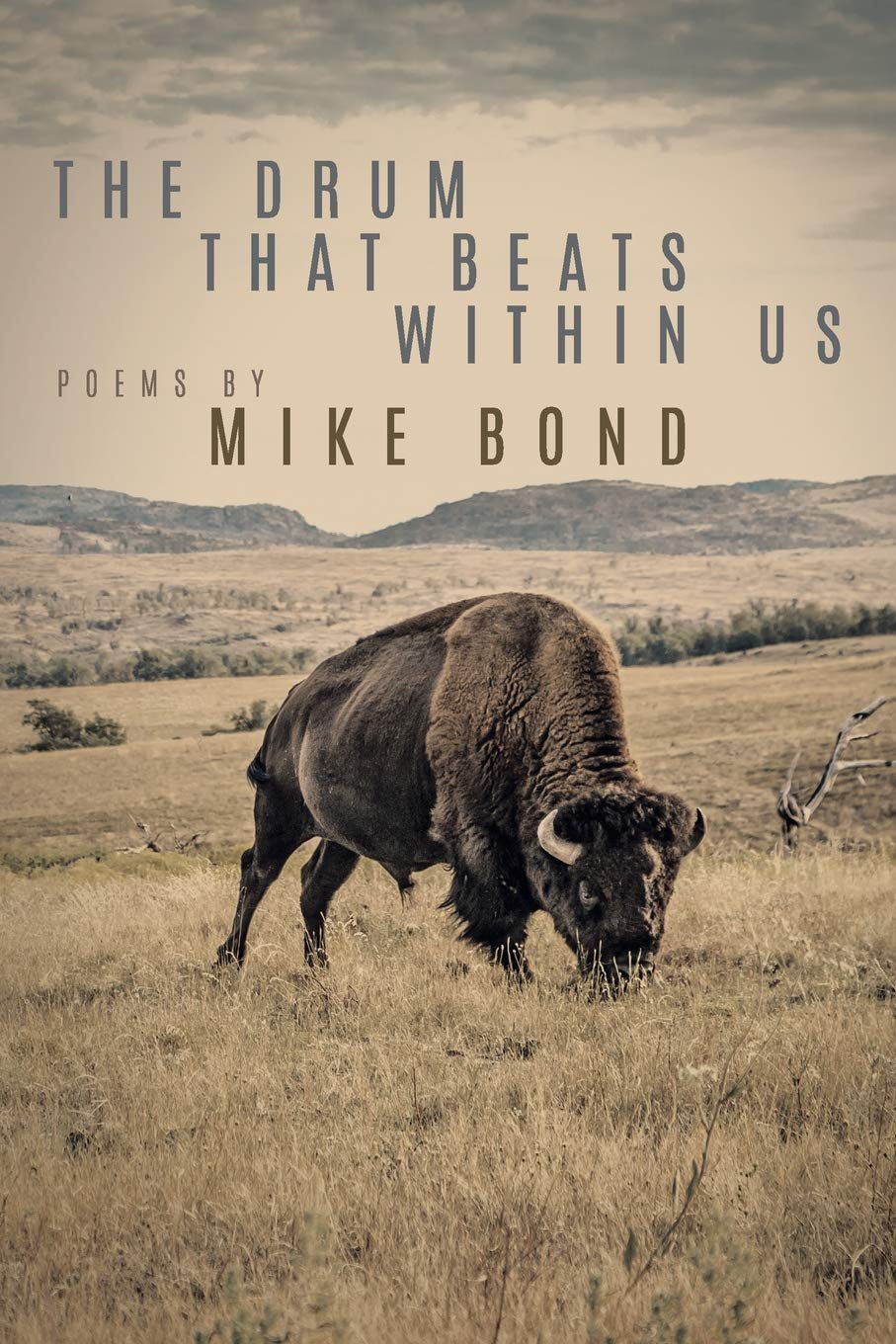
THE DRUM THAT BEATS WITHIN US :: Mike Bond
My poetry reading is still in the beginning experimental stages. Being a novice, I pick poetry books like I pick most others, I'm captured by a cover. Such was the case with Mike Bond's The Drum that Beats Within Us, which called out to the beast and nature lover in me. How could I lose when the insides seemed destined to be full of connections between humans and their surroundings?Bond believes poetry was born the moment we began to speak. It existed before then in "what whales and wolves sing." Every clan needs stories and lessons from the past, and to make them more memorable, the stories were often told in rhythm and rhyme. Poetry and stories are "how we find meaning in the incomprehensible, beautiful, tragic and sacred mystery of life."
This line sums up how I feel about poetry: "What counts is what we learn emotionally. When something hits us emotionally it stays in our experience..." Poetry feels like the ultimate in emotional connection. I can't tell you what poetry is, what different meters and rhythms mean. I can only tell you what I happen to connect with emotionally, what gets me in my gut. Mike Bond's work does that, and I connected with the themes of the havoc we are wreaking on the earth:
Hungry Magpie
A hungry magpie
is a world
out of order,
when after so much killing
there's nothing left
to die.
The earth barren
as the raw red skin
of Mars,
the seas deadly
as the toxic
skies.
And to think
one little biped
did it all.
Paradise Ducks
Paradise ducks don't know
about men and steel.
In rainforest rivers
they love
and raise their young,
always paired, the
dark multicolored male
and white-necked female.
Paradise ducks so easily fly,
don't know about airplanes
carrying men halfway
round the world,
shotguns in their baggage,
men who shoot thousands of ducks
for fun,
who have shot ducks in Brazil,
Mongolia, Canada, and now
in the far south
of the South Island
of New Zealand.
Paradise ducks mate for life.
Men don't.
A duck never kills.
Men do.
Ducks love misty dawns
that men sleep through,
flashing rivers and skies
blue as the gun barrels
that the men to love
to kill ducks
look down
before they fire.
Most Evil Thing
The most tragic thing
humans do
is war,
our greatest joy
is life's
creation.
The most evil
is to call one
the other.
Mike Bond is an award-winning poet, ecologist, and war and human rights journalist. I loved his no-punches-pulled approach, addressing the our vanishing natural world and calling us to account. This is a book I will buy for my growing poetry shelf and reread with pleasure.
Monday, October 14, 2019
BEYOND THE TREES :: Adam Shoalts
Beyond the Trees is the result of Shoalts surviving a months-long, 2,500-mile trek across the Canadian Arctic with nothing but his canoe, a backpack and two barrels crammed with rations (more than 170 pounds of dead weight). He faced down grizzly bears and muskox (sometimes right at his tent opening) and battled severe winds, chunks of ice drifting like jigsaw-puzzle pieces and hordes of blood-sucking insects. Most remarkable (and perilous) was that to chase the ice melt, Shoalts's route required he travel upstream, against the flow of rapids that generally called for parties of six to 12 to travel down safely.Shoalts approaches the many dangers with smarts and aplomb, while also transmitting the tension in his recounting. Despite the risks Shoalts conveys, Beyond the Trees is an earnest love story to one of the last portions of the Earth that remains undeveloped and where large animals still roam free. Peppered with Shoalts's corny humor and legends of lone trappers' unspeakable deeds, this white-knuckle affair is a travelogue, adventure story and horror-movie-in-waiting that sparks an urge to get out and go.
STREET SENSE: An intrepid explorer paddles and portages the vast and treacherous Canadian Arctic, sharing its unparalleled beauty and crucial need for its preservation. Nature lovers, risk-takers, travel nerds alike will dig this one.
COVER NERD SAYS: Pretty picture, passable fonts with good balance. Subtitle here passes muster, as the title needs a little more explanation. I will say this photo makes the trip look much more peaceful than it was. A little more urgency or danger might have added to it, but overall a great looking cover.
Wednesday, October 9, 2019
WILDHOOD :: Natterson-Horowitz and Bowers
Advice on "how to ask out a whale" may not seem a typical means to teach about adolescence, but evolutionary biologist and physician Barbara Natterson-Horowitz and science journalist Kathryn Bowers make such compelling and scientific connections between humans and animals that readers will come to believe that one can learn a trick or two from our fluked friends. In Wildhood, a follow-up to their acclaimed Zoobiquity, the authors explore the crucial stage between childhood and adulthood across the animal kingdom.
Safety, status, sex and self-reliance are the four universal challenges adolescents must navigate while transforming successfully into adulthood. Each is illustrated through one of the following points of view: Ursula, a king penguin who risks death from a voracious Antarctic predator she has never seen before on her first trip away from her parents; Shrink, a socially adept hyena pup born on the bottom of the ladder who rises through the hierarchy; Salt, a humpback whale who learns the complicated dating rituals of her species; and Slavc, a young wolf who sets out on a solitary journey to find his forever home.
Having identified the "core four" competencies to be mastered by every adolescent on earth, the team presents their cross-species theories in a highly entertaining yet skillfully informative format that will engross animal lovers and parents alike. Without anthropomorphizing, one still can't help but fall in love with these animals and, by association, hopefully gain some understanding and empathy for human adolescents. Wildhood is a roller-coaster ride through nature's wonders.
STREET SENSE: A cool cross between the human and animal worlds, I fell in love with each of these creatures (some more than others, not always in direct correlation with how interesting the point of the arc was) and also did come out with more empathy for human adolescents. Who can be such a true pain in the ass (Not talking about you, KRK!) I dug this one and it was apparently recently highlighted on NPR, so I'm going to check that out and also will be reading Zoobiquity.
COVER NERD SAYS: Fuckin' baby lions. Pretty much says it all.
Thursday, June 23, 2016
ARE WE SMART ENOUGH TO KNOW HOW SMART ANIMALS ARE? :: Frans de Waal
I finished this book several weeks ago and have had a difficult time figuring out how to write about it. Author Frans de Waal has summed up the premise with that lengthy title, but the execution of the premise is multi-faceted. It's fascinating, to be sure, especially for those of us who believe animals capable of more cognition than they've historically been given credit for, particularly in Science Land.
Yes, there are those of us who tend to be more anthropomorphic than others (anyone name their cars or other inanimate objects - show of hands?). This doesn't mean you've been wrong about animals. They are more than "stimulus-response machines" or "robots genetically endowed with useful instincts" and humans have been a bit more than merely egocentric when it comes to handing out awards for intelligence. What de Waal has done in Are We Smart Enough to Know How Smart Animals Are? is point out (1) just how smart many animals really are and (2) how we need to smarten ourselves up since many of our testing techniques have been flawed.
It's one thing to put an animal through a set of tests intended to measure its cognition. It's yet another to acknowledge the fact that cognition might exist that's different than our own (great discussion on Umwelt) and a need exists test animals in a way that accurately represents their cognitive abilities.
In other words, is it really fair to test the intelligence of a chimp using tests intended to measure the intelligence of children? Of course, chimps often kick human ass in some of those tests anyway, but the point is made. We need to set aside our egos and be smart enough to create tests that accurately measure the intelligence of different species of animals.
Short example: Chimps were thought to lack the ability to recognize faces when shown photographs of various people. Someone eventually wised up and began showing chimps pictures of other chimps, and it became clear chimps could recognize other chimps just as we do other people. We got smart enough to figure out how smart they really are.
In Are We Smart Enough to Know How Smart Animals Are?, de Waal discusses different schools of thought regarding animal intelligence and the history of discourse between them. He also, as a proponent of viewing human cognition as a variety of animal cognition (we are, after all, animals), shares a number of animal cognitive discoveries over the past twenty years that highlight the idea that perhaps we're not quite as special (or alone in our cognition, at least) as we think we are.
The studies and discoveries presented by de Waal come from various scientists studying different species, in order to provide an overview of advancements in the field using both testing and observational methods. Most of it is quite engrossing, some of it surprising, and all of it educational. These portions were the highlight of the book for me.
Overall, I didn't often feel overwhelmed by the content, but did at times feel I was getting mired in the length and breadth of it. A few times I found myself feeling like it was too much and/or too long. In those instances, I just picked and chose which issues I wanted to read in depth. The book is written in a fairly engaging manner, despite some of the heady material. If you're at all interested in these issues, de Waal generally did a great job presenting the material for various levels of knowledge and interest.
My friend Marisa over at The Daily Dosage also recently reviewed this book and we had somewhat similar experiences. But her review, found here, also includes a neat list of interesting nuggets of information she pulled from the text, along with a link to a TED Talk video of de Waal's presentation on Moral Behavior in Animals. Go check it out Marisa's review for another viewpoint and extra source material on the subject.
STREET SENSE: If you are into animals, science, and intelligence issues presented in an engaging and fairly straight-forward manner, even infused with a little humor, I recommend de Waal's work. Even if you just wanted to skim through and read the studies, this book would be worth the read, it's really compelling stuff.
A FAVORITE PASSAGE: And why is humanity so prone to downplay animal intelligence? We routinely deny them capacities that we take for granted in ourselves. What is behind this? In trying to find out at what mental level other species operate, the real challenge comes not just from the animals themselves but also from within us. Human attitudes, creativity, and imagination are very much part of the story. Before we ask if animals possess a certain kind of intelligence, especially one that we cherish in ourselves, we need to overcome internal resistance to even consider the possibility. Hence this book's central question: "Are we smart enough to know how smart animals are?"
Couldn't resist this one as well, which kind of sums up the whole shebang in one fell swoop:
However good our relations with apes, the idea that we can test them in exactly the same way we test children is an illusion of the same order as someone throwing both fish and cats into a swimming pool and believing he is treating them the same way.
COVER NERD SAYS: A big cat and a title that (however long and ungainly) intimates we're going to delve into animal intelligence? Doesn't take much more than that to suck me in. This cover isn't something I'd hang on my wall, but it certainly gets the job done. Part of me thinks the title could have been a bit less of a mouthful, but then again, it sums up what the book is about pretty much to a "T," so I really can't take that much issue with it.
Monday, October 19, 2015
THE DOGIST :: Elias Weiss Friedman
I came across The Dogist on Twitter and was captivated. As a fellow lifelong lover of dogs and photography, this work captures two things I hold dear, and does it quite well. Elias’ work is brilliantly expressive; it’s mostly close-up work on the streets of New York and truly captures the many different personalities and essences of “dog.”
The photos generally include the dog's name (which is something I always love to know), breed, and age. Sometimes, if the dog does something interesting or the owner starts talking with Friedman, we also get a little fact about the dog. The international posts (Friedman doesn't stop working when he travels) are especially fun, treating those of us here in the U.S. to breeds (and names) we don't see as often or at all.
As Friedman once said in an interview, "Every dog deserves recognition." I believe he practices what he preaches, as the spectrum of unique is fully explored in both Friedman's work and the book. The collection is put together in entertaining categories too numerous to recount here, but includes: heavyweights, barkers, sassy, haircuts, head tilts, rare breeds, snow, bionic, tongues, beautiful blends, cones of shame—you get the picture.
There’s something for everyone and I guarantee you’ll see at least one thing you’ve never seen before. Elias has been doing the work long and steadily enough that there is no shortage of material to work with, and each page is a lesson in the beautiful and unique qualities of human’s best friend.
Elias also created the Give a Dog a Bone program, featuring stories of shelter dogs (more than 50 in 20 different shelters), most of which have since found homes. Says Friedman, "I visit shelters and photograph adoptable dogs to be featured on the site. From there people from my audience will sponsor the dogs. It gives these dogs more exposure than they would otherwise have and helps tell an important piece of the story."
The Dogist is highly recommended for photographers and dog admirers alike, and would be a super Christmas present for the dog lover in your life.