Showing posts with label non-fiction. Show all posts

Tuesday, July 19, 2022

TWO-CENT TUESDAY

Below are a few (somewhat) brief $.02 opinions about books I've read or listened to recently but don't have the opportunity to review in full. Many of these titles I enjoyed as much or more than those that got the full court press. I hope you'll consider one or two for your own TBR stack if they strike your fancy whether they struck mine or not. 


And There He Kept Her, Joshua Moehling

I wish I could remember where I heard about this book, because I would not have chosen it based on cover or title, neither of which I think do it service. Almost to the other side, as much as I like gritty stuff (see Pete Farris's latest, which starts with a great line about a woman being bound in a trunk), the toxic masculinity this title/cover combo bring to mind would have put me off. Which is really a bummer, because this book is fabulous. It's Moehling's debut, which makes it even more impressive. Yes, there is a woman locked up. Yes there are horrible people. But the plot is clean and moves swiftly, no extraneous fluff that got in the way. Best of all, Moehling's characters left me hoping the small historical backstory arc that doesn't get resolved means another installment of Deputy Ben Packard's story. Here, he's returned to the small lake town in Minnesota where he has history and some family. He's running from tragedy and himself (a trope, yes, but it felt authentic here, and I'm not going to give it away because the reveal should be experienced while reading. When two local teens go missing, including Packard's taciturn cousin's daughter, he takes a personal and professional interest. As he and his team investigate, coming into contact with some great (and not so great, and some morphing) colorful locals, time is running out for the woman in the locked room. Who is she and who has her? I highly recommend taking the time to read this one and finding out first hand.

Nightcrawling, Leila Mottley

Another dazzling debut from a 19-year-old who was also the 2018 Oakland Youth Poet Laureate and the youngest author to be chosen for Oprah's book club pick. Those who live in or around Oakland as I do will likely remember the horrific Oakland Police Department sexploitation scandal of 2016, and Mottley took inspiration from those events and began writing while she was in high school. Kiara is 17, living in the Regal-Hi apartments (and its pool filled with bags of shit) with her brother Marcus, left to fend for themselves by addiction, death and the prison system. Marcus won't find a job, clinging to his dreams of rap stardom, and Ki and left to pay their increased rent, which is already overdue. Ki's responsibilities get heavier when she begins to care for the 9-year-old boy next door, whose mother is strung out and gone most of the time. A nighttime misunderstanding sucks Ki into a situation she can't seem to get out of--where will the money come from? what will happen to Trevor?--and soon she's selling her soul to keep the balls in the air. Haunting, electric, and a dazzling display of the perils the system and society heap atop the Black community and the resilience and fortitude of Black women. Mottley's writing is searing and authentic, and though my praise certainly isn't needed on top of her many accolades, she's got it.

Directed By James Burrows, James Burrows

I was raised on the genius television of James Burrows. He's been called "the greatest director of comedy in television history" by his creative partners Les and Glen Charles. He's the greatest "by any measurement: number of episodes, number of gigantic hit series, number of awards, and the amount of volume of laughter he's been responsible for." He has directed more than seventy-five pilots that have gone to series and well over a thousand show episodes. GREAT shows. The Mary Tyler Moore Show, The Bob Newhart Show, Laverne & Shirley, Phyllis, Taxi, Cheers, Frasier, Friends, Mike & Molly, Will & Grace--shows that belong in the television Hall of Fame. I was so anxious to read his memoir, which he calls "a celebration of the great people [he] worked with and the joy and challenges [we] had together. Burrows begins at the beginning, his childhood as the son of legendary playwright and Broadway director Abe Burrows, his start in the theater, and his foray into his milieu, television comedy. He proceeds chronologically through each show, sharing facts and highlights. Ultimately, while I loved the content, I had some of the same feelings about this memoir as I did about Bob Odenkirk's. The work is so damn good that on the page it suffers a bit. Burrows writing is very matter-of-fact. You know the joy (or hardship) is there, but it doesn't leap off the page and sock you in the guts. Other than one behind-the-scenes story from Cheers, there wasn't much in the way of new or "wow" information. It's a great read from an individual I am SO thankful for, and maybe my expectations were too high. Burrows television is some of the best of my life, and that's a tough bar for anyone, even Burrows himself, to leap. 


Sunday, April 11, 2021

A MOST REMARKABLE CREATURE :: Jonathan Meiburg

A version of this review previously appeared in Shelf Awareness and is republished here with permission.

If a bird can be said to have inappropriately flown beneath the radar of public fascination, that is the caracara. Jonathan Meiburg's fabulously epic account, A Most Remarkable Creature, sets the record straight. Meiburg is frontman for the band Shearwater (named after a long-distance marine bird); in 1997, he received the Thomas J. Watson Fellowship, which awards a year's travel to remote communities, sparking his enchantment with islands, birds and natural history.  

In the falcon family, caracaras are unlike other birds of prey, who focus on hunting. Caracaras, innately curious and "disarmingly conscious," seek out interaction regardless of food. Calling a caracara a bird of prey, says Meiburg, "feels like calling the painters of the Italian Renaissance a group of unusually gifted apes." Caracaras fascinated Darwin, who wrote more about them than any other bird.

Caracaras will "pluck the cap from your head, tug at the zippers of your backpack, and meet your eye with a forthright, impish gaze." This "earnest, playful quality" is what spurred Meiburg's research, yet A Most Remarkable Creature is much more than a scientific profile. It is a grand intellectual adventure involving dinosaurs, DNA, naturalists, exploration and survival. Meiburg is a gifted storyteller, and one can't help but fall under the same spell he did, daydreaming about "keeping a striated caracara in my apartment. It would be the world's most exasperating roommate, but watching it build a nest of shredded T-shirts, LP jackets, and guitar strings in my bookshelf might be worth it."

Wednesday, September 11, 2019

SHULA :: Mark Ribowsky

A version of this review previously appeared in Shelf Awareness and is republished here with permission.

When Don Shula was in junior high school, his hardworking Hungarian-immigrant parents refused to let him play football after he tore his nose open in a game. Undeterred, Shula forged his parents' signatures on the permission slip, and kept playing. The determined 11-year-old didn't become the priest his family hoped he would, but not even he imagined playing and achieving Hall of Fame status as a coach in the National Football League.

Mark Ribowsky, biographer of sports and music personalities (Dreams to Remember), details the "lantern-jawed" stalwart's five decades of football in Shula: The Coach of the NFL's Greatest Generation. Shula's career had more than adequate peaks to overshadow the valleys, but Ribowsky does not gloss over the "failures" that provided grist for the success mill and forged Shula's process of gritty, old-school discipline and grinding. An undefeated season coaching the Baltimore Colts went famously sideways in Super Bowl III, when the heavily favored Colts fell prey to Broadway Joe Namath's outlandish guarantee that his Jets team would win.

After losing another championship coaching the Miami Dolphins in 1972, Shula finally got a Super Bowl ring, and an as-yet-unmatched perfect season, in 1973. Ribowsky provides superb particulars about that game (and many others), including Shula's wife cold-cocking a rude fan and his watch being stolen off his wrist as his players hoisted him in victory. Comprehensive and straight-shooting about Shula's persona and career, touching on cultural influences of race, drugs and politics, Shula is a treasure trove of insight on one of the game's greats.

STREET SENSE: I love a biography that doesn't universally glow about the subject. We all have our shittiness. Ribowsky does a great job of that here. Shula was a big part of the football I watched as a kid and back in my day we rarely saw or knew much about the "off-the-field" persona (at least vastly diminished from today). I came away from this book with mixed feelings about Don Shula. His was a different age in so many ways, making it hard to "judge" by today's standards. No one can doubt he was driven and to many a great coach. I balked at some of the religion and (of course) resultant hypocrisy. But complex human beings are fascinating and Ribowsky kept me fairly riveted.

COVER NERD SAYS:  Simple, but I like it. When you have a face as recognizable as Shula's you don't have to get very fancy to hit/find your audience. A good, old-timey photo and font in Dolphin colors. Done. If there's any doubt, the well-placed yet still unobtrusive subtitle does the trick (even though I take issue with the subtitle's text, which doesn't really compute when you sit and think about it - so don't).

Monday, August 19, 2019

STATE :: Melissa Isaacson

A version of this review previously appeared in Shelf Awareness and is republished here with permission.

Melissa Isaacson spends the evening before her Niles West High School basketball team's 25th reunion with her parents, both long suffering from Alzheimer's-induced memory loss. As she reconnects with her teammates, they implore her to delve into their own recollections and document the team's story. For more than a decade, she turns her sports journalist's eye to the tale of a remarkable group of girls from Skokie, Ill.

State begins shortly after the 1972 inception of Title IX, prohibiting sex discrimination in federally funded education activities. Isaacson was one of many "tomboys" who wanted to play sports and were running out of patience. Given the opportunity, her teams made spectacular runs at the state championship, ultimately winning it all in 1979, only five years after the school's inaugural season.

State is a treasure trove of personal reporting at the "squeak and rubber" level of shoes on the court. Significantly, looking back as an adult allows a view of the glory days through varying lenses of school, family and societal experiences and traumas that lay hidden under the surface for these suburban teenage girls. Details emerge about the coaches and administrators who fought for and supported them, and parents who sometimes did not.

Isaacson, the Chicago Tribune's first woman columnist and beat writer, artfully shifts voice between youthful naiveté and seasoned veteran. Her pre-game poems have evolved into great storytelling, imbued with warmth and, quite often, hilarity--a testament to the game that shaped the lives of the girls who played it.

STREET SENSE: Fans of sports, camaraderie and feel-good stories will enjoy Isaacson's recollections. The writing is insightful and often hilarious. As a fellow tomboy who came of age just after Isaacson, I recognized so many elements of her history. Many maddening, but some sweet. I particularly loved Isaacson's relationship with her father, who, when he learned how nervous she was about getting her new warm-up suit dirty, came home with a suit bag from the dry cleaners for her to keep it in. He then went back and got 13 more for the rest of her team. Her descriptions of him were some of my favorites, such as his running "with painful-sounding pants" from the "30 dollars of excess change in each pocket." Lovely stuff.

A FAVORITE PASSAGE:  Our relationship with the sport was one that we coveted and pursued, then was allowed to grow and deepen over time. Basketball was, in many ways, one of our best friends, dependable and fulfilling and intoxicating in its unpredictability. It gave us a feeling of belonging and security and confidence we so desperately needed during the angst of adolescence. Unlike the average high school social group or clique, we had a common goal that would not shake us, withstood petty bickering, and deterred all the usual grounds for rejection like the wrong hair or body type.

Also, this one. Because while there are many who focus on the glory of offense, one of my favorite things in the world is stopping someone else from doing something (this will surprise no one who knows me). There is nothing better than throwing someone out at the plate from center field. Isaacson is a kindred spirit: "Aside from basketball, I was never happier than when I was diving for sinking line drives in the outfield, then bouncing up and firing the ball home to nail an unsuspecting base runner." Preach, sister.

COVER NERD SAYS: I'd be lying if I said this cover is fancy, but I can't help but be won over by it nonetheless. It doesn't get much better than an old black-and-white photo of some tough ladies cutting down a net in celebration. The font is very "amateur sports/collegiate" looking, which is both awesome and appropriate. The colors and curve of the text, like the arc of a jump shot or as if the words are resting on the top of a ball, are super nifty. I can't even argue with the blurb, which sits pretty nicely out of the way and, despite being off to one side, doesn't ping my OCD-meter. Plus, motherfuckin' Steve Kerr. Most of these are changes from the ARC and all pay off. 


Wednesday, August 14, 2019

KANSAS CITY VS. OAKLAND :: Matthew C. Ehrlich

As a young sports junkie born and raised in the Bay Area of California with some roots in Kansas, I grew up with Oakland and Kansas City baseball and football. While I had a sense of the rivalry when it came to athletics, I remained mostly clueless as to the real history and depth of the two cities' connections until I read Matthew Ehrlich's Kansas City vs. Oakland: The Bitter Sports Rivalry That Defined an Era. An in-depth look at the franchises and the cities that support (and sometimes don't support) them, Kansas City vs. Oakland is recommended for anyone who is a fan of either team, lives in the surrounding areas, or has an interest in the impact of sports on a city (and vice versa).

I find the history of sports franchises fascinating in general, but you'd be hard-pressed to find an ownership foursome more colorful and intriguing than Charles O. Finley (owner of the Kansas City A's who moved them to Oakland--and named the mascot after himself), Al Davis (owner/GM of the Raiders), Lamar Hunt (owner of the Chiefs and a founder of the AFL), and Ewing Kauffman (who established/owned the Royals and brought baseball back to KC).

Ehrlich charts the rise and fall of each team through the years from dream to fruition to present day, along with the rises, falls and championships along the way. Views of sportswriters, broadcasters and social figures of the times add insight, and the interplay of the teams and cities with stadium building, political strife, race, economic turbulence, and fandom evidences the many layers of impact sports have had on both locales.

Ehrlich organizes the book in chronological sections alternating between baseball and football in each chosen period of time. With the addition of the stories of the two cities, I sometimes found myself wishing there was just one chronology for each team. However, with the interplay and rivalry factors, along with some of the city and cultural parallels, I think Ehrlich made the right call on organization when he had so much information to present and relationships to mine.

STREET SENSE: A detailed history of two cities and the sports teams that helped define them. Recommended for fans of sport and its impact on culture and urban "progress."

A FAVORITE PASSAGE: The Oakland Coliseum was different. In the fond words of the Raiders' Ken Stabler, it was a "little ol' bullring filled with blue-collar crazies" consisting of "everyone from bikers to longshoremen." Rather than sip cocktails, Raiders fans "drank out of the same bottle," according to one fan: "And when they were done, they threw it at somebody."

Also: "Holy Toledo!" (Because there was no one better than the great Bill King.)

COVER NERD SAYS:  I don't want to be too hard on this cover, because I don't expect a University Press to have a huge art and marketing budget and there's really nothing wrong with it. When I see it, I'm confident in what it's about. The colors, fonts and image have good interplay. The subtitle in a standout color gives it an added boost. But the book packs more punch than the cover might indicate. There's not much to separate this look from the many sports books or fantasy magazines on the shelves. It's a solid cover that lacks a little emotional oomph.

Friday, June 21, 2019

TRACE :: Rachael Brown

A version of this review previously appeared in Shelf Awareness and is republished here with permission.

Australian crime journalist Rachael Brown's grandparents taught her "questions are a precious way to show care." When Brown discovered seeming contradictions in a cold case that left two brothers without answers for more than three decades, she started asking questions. Brown's inquiry into the brutal murder of Maria James is recounted in Trace, the gripping account of her search for a killer. It's also the name of her acclaimed true-crime podcast, which aired during her investigation, allowing the public to contribute.

Mark and Adam James were boys when their mother was murdered in the home attached to her Melbourne bookshop in June 1980, stabbed 68 times. As Brown pours through old files and the minds of those who worked or had connections to the case, she digs up long-buried horrors. Startling key evidence comes from painful secrets held by those closest to Maria, suggesting either a "huge cock-up" or widespread conspiracy.

Trace is a brilliant and compelling look into a horrific crime that affected countless lives. Brown struggles with the knowledge that reopening such a case takes "haunted people on a rollercoaster ride." It is, indeed, such a ride, emotionally, procedurally and forensically. As the Trace podcast ended without definitive answers, Brown responded to disappointed listeners: "This is not a show, folks. This is someone's death. And I can't invent an ending--it's real-life nonfiction. I want to scream, 'Imagine how the James boys feel?' " Regardless of the ultimate outcome, Brown's work enthralls while never forgetting the burden of care.

STREET SENSE: My desire to read this stemmed from the fact that I like to read and support Australian authors whenever possible. I had not heard of this case or the podcast, but Brown's recitation of both is well worth your time. I didn't speak too much to the plot to avoid spoilers, but whether cock-up or conspiracy, there's enough anger to go around. Maddening.

A FAVORITE PASSAGE:  I read a quote recently, that asked, 'What if the word "victim" could be redefined into something closer to "hero," recognising that the path some have tread will spare others from the same?

[I picked this quote because it resonated not only within this case but also with much of what our world is dealing with today. A vision of Dr. Christine Blasey Ford leaps to mind, as well as the many others who have been and keep speaking out about the violence perpetrated against them. Heroes, even if we're not very good at listening.]

One more, because this one also resonates:

"Sometimes the truth can never be fully told, because it breaks your heart forever."

COVER NERD SAYS:  This cover has some fantastic elements--the fingerprints on the word "Trace," the puzzle pieces, and, mostly (a surprise to me since I usually dislike them), the subtitle. When I try to consider why it didn't speak to me, I find it too busy and distracting. Each of the three colored puzzle pieces includes additional text and/or photos, there's a blurb in addition to the subtitle (in fairness, any Aussie author would be hard-pressed to resist putting a quote from Helen Garner on their cover). It's overwhelming. Separately, I understand each piece (the podcast tie-in, Helen Garner, publisher name--though that last one gives me pause), but I don't think as a whole they do the cover any favors. I would have lost the photograph, the quote, the podcast line and the publisher name, made the three puzzle pieces black and left Rachael Brown's name in the lower right. THAT makes me want to know what's missing. This cover doesn't let those missing puzzle pieces "breathe." I'm being exceptionally hard on this work, probably because I liked the book so much, so take it all with that grain of salt.


Thursday, June 20, 2019

NORCO '80 :: Peter Houlahan

A version of this review previously appeared in Shelf Awareness and is republished here with permission.

Norco '80 is enthrallingly detailed, down to the pencils thrown by opposing counsel in the criminal trial that followed "the most spectacular bank robbery in American history." Despite the depth and breadth recounted by journalist and EMT Peter Houlahan, the urge the book generates in readers to further explore this devastating true crime is impossible to suppress.

Houlahan begins with the not-well-laid plans of the felons (46 counts worth), who instead of seeing themselves as criminals saw themselves as simply needing funds to support their survivalist ideals in the face of the impending apocalypse. How else were they going to get it but to steal it? They were armed to the teeth, sparking a ferociously one-sided firefight that spanned more than 40 miles of crime scene in Riverside County, Calif. Responding law enforcement agencies were vastly overmatched, and the tragic outcome helped prompt a sea change in police weaponry, interagency communications (lack of which resulted in a life-and-death game of "telephone") and mental health support.

The drawn-out capital murder trial was perhaps even more outlandish than the pursuit preceding it, "highlighted" by a judge who took pictures during proceedings as mementos, a sex scandal and the defense continually attempting to "shove... sticks in the spokes of justice," including pinning the crime on a nonexistent man. Houlahan has admirably mined and winnowed the boundless material, and while nonfiction purists might be put off by some liberties taken (e.g., the inner monologue of a dying man), he has compellingly translated a high-octane story to the page without losing traction, leaving the reader satisfied yet craving more.

STREET SENSE: I was woefully and shamefully uneducated about this case. I'll admit, I had not heard of it (despite being California born and bred). Whoever hid it from me deserves a noogie, because holy cats this is a fascinating true story of robbery gone very wrong and the bizarre, drawn-out trial of the surviving perpetrators (I am ashamed to be in the same profession as some of these maroons). It's horrific, yet sometimes so comical you can't believe the truth. My "issues" with the narrative were total nitpicks, though I admit they made me question if other liberties were taken. Either way, well worth the ride.

A FAVORITE PASSAGE:  In a sea of weird, this may be one of the weirdest, but maybe I simply hold judges to a higher standard than I should:

Later in the trial, an incident occurred that raised eyebrows inside the courtroom and out. Clayton Adams was in the process of cross-examination when he noticed something strange. "No offense intended to the court," Adams protested at the next recess, "but I did want the record to reflect that while I was cross-examining the witness...the Court was, from the bench, photographing jurors." Asked about the incident by a reporter afterwards, Hennigan said, "We've been together a long time. I like having a memento of them." The AP wire story about the incident was headlined "Judge in Robbery-Murder Trial Photographs Jury for Souvenir." A quote...summed up the sentiments of anyone who had been following the proceedings from the start: "For this trial, it's not weird."

COVER NERD SAYS: By the time I was done reading I was in love with this cover--there is a lot that's smart about it. I misinterpreted it at first glance and thus found it a bit misleading. Because I didn't know about the case, "Norco" for some reason gave me thoughts of "narco." Perhaps because the dudes in the picture look a little hippie-druggish, I assumed this was a drug case and wasn't too interested. Usually not a fan of subtitles, in this case it hooked me, because I realized this was a robbery, not all a drug story. The 70s color scheme also totally knocked my socks off and, in no small part, influenced my asking to cover this one for review. Now that I'm educated, I love the whole thing (though to be honest it still gives me a bit of a drug vibe).

Thursday, May 16, 2019

FOLDED WISDOM :: Joanna Guest

A version of this review previously appeared in Shelf Awareness and is republished here with permission.

Every morning for 14 years, Bob Guest--artist, husband, father and man of routine who was "ahead of his time"--sat down to write notes to his children on a 6x9 pad of paper. Often folded like little footballs, the notes were tucked into lunchboxes or waiting on the kitchen counter. His daughter, first-time author Joanna Guest, was seven when they began. As an adult looking back at the more than 3,500 notes (out of roughly 4,775) that survived time and the family washing machine since 1995, Guest found wisdom and meaning in them that she couldn't fully appreciate as a child.

In Folded Wisdom, Guest shares the inception of the notes and how they progressed as she and her younger brother, Theo, grew older and their life problems became more complex. Bob was sparked by a desire to encourage Theo to read, and was dedicated to connecting with his kids. One of eight children of a rear admiral in the navy, Bob had a "minimal" personal relationship with his absentee father.

The notes, which often included puzzles and drawings, ranged from snippets of love and encouragement to pages of thoughts on what it means to be part of a family, deal with life and say "I'm sorry." As insightful and charming as the notes themselves, Guest's narration winds between photographs of the real deal. Folded Wisdom is a wonderful testament to love and to Bob's success in perpetuating thoughtfulness and value in expressing ourselves to others.

STREET SENSE: Charming as hell. The advanced copy did not include color illustrations, but a few of the pages can be found with a Google search. They make me want to go track down a finished copy. Who wouldn't love to wake up to something like these notes each morning? This book made me want to meet Bob. What a beautiful testament to fatherhood he, and thus this book, is.


A FAVORITE PASSAGE:  The unsung hero of Folded Wisdom is Guest's mom, who never read the notes (until now, I presume) unless she was rescuing one from the wash, saying "They weren't addressed to me." Thus my favorite passage is actually from the Acknowledgments:

To my mom, Gloria--I know you think you had nothing to do with all of this, but the truth is you had everything to do with it. You found every note you could. You stored them in a safe place. You moved them all from our tiny two-bedroom apartment into a big old house. Then, when asked if you knew where they were, you said yes.

COVER NERD SAYS: Probably because I am a person who relates to order and organization, this cover is a bit jarring to me. As I look closer I can see that it's a bunch of folded football notes, but until you read the book that might not be particularly clear. I think fewer notes on a background would have been more appealing to me, but it's not all about me (despite everything you just read). I also would have thought this book to "cutesy" for me, but it's not (whether because it's less cutesy inside or I'm more cutesy inside, who knows? (But you can guess).

Tuesday, May 14, 2019

TEN INNINGS AT WRIGLEY :: Kevin Cook

A version of this review previously appeared in Shelf Awareness and is republished here with permission.

When Kevin Cook launches into the sagas of the Chicago Cubs and Philadelphia Phillies, fan partisanship gives way to the lore of two of the league's oldest teams. In Ten Innings at Wrigley, Cook delves into the culture of baseball at a tipping point through a May 17, 1979, rubber match that turned into "the wildest ballgame ever."

Cook admirably winnows remarkable team histories to set the table. The Cubs, "born to lose" and cursed by a goat, were not a big market team in 1979, with Wrigley (a character in its own right) used for other events (e.g., ski-jumping contests) to make money. The Phillies were also "lovable losers," the last original franchise yet to win a World Series. But they were on the rise with something to prove, winning three straight division titles.

The game supports an inning-by-inning and pitch-by-pitch written recounting. With winds gusting to 30 mph, six runs in the first 10 minutes, 97 total bases and a run total of 45 that stands as the second highest of all time, the garbage truck fire beyond the bleachers is a mere afterthought. Many of the game's legendary and most colorful characters were playing (Rose, Bowa, Buckner, Kingman, Maddox) on the brink of epic cultural and league changes--cable television, the high-five, facial hair, computers, labor strikes and modern metrics, to name a few. Cook seamlessly blends these issues into this reconstruction of the game and its aftermath, a slice of history fans of any team will relish.

STREET SENSE: It may be because I'm old and nostalgic, but this book reminded me how great baseball was in the 70s. So many characters that I just don't feel in today's game. Maybe it's free agency, maybe, perhaps more likely, it's just that I'm old. But this book was a fun trip down memory lane.

A FAVORITE PASSAGE: In a book reciting balls and strikes, this was more replete with funny one-liners than notable passages. I did laugh often, and whether talking about a player getting "the fondue treatment "(gas, heat and cheese) or an individual's weaknesses (sliders low and away and cocaine) Cook really took me back to the feeling of that era of play.

COVER NERD SAYS: I get the old-timey baseball feel to this font, but I'll admit it was the subject matter rather than this cover that attracted me. I would have picked it up from a bookstore shelf or table display just because the red jumps out and there's a ballplayer on the front, but the cover as a whole didn't light my socks on fire.

Thursday, March 28, 2019

THE SALT PATH :: Raynor Winn

A version of this review previously appeared in Shelf Awareness and is republished here with permission.

Raynor Winn and Moth, her husband of 32 years, are living a nightmare at the start of Winn's memoir, The Salt Path. Having lost everything, they huddle under the stairs of their lovingly restored farm haven, hiding from the bailiffs come to evict them. Tragically, losing their business and home isn't the worst of it. The day after the judge's decision, they finally have time to follow up on Moth's ongoing shoulder pain and learn he's terminally ill.

Peering at packing boxes, Winn spies a copy of Five Hundred Mile Walkies, Mark Wallington's story of traversing the South West Coast Path, England's longest footpath. Homeless, penniless, with two kids at university and a bleak future, they look at each other and think, "What the f*ck, let's go for a walk." Despite the doctor's admonitions that Moth not get cold, tire himself, walk too far, carry heavy weight or look too far ahead, they fill their packs and head out for the 630-mile trek.

Winn's chronicle is filled with beauty, humor and surprises. Glorious landscape a given, the loveliest scenery is the pair themselves, their affection and easy camaraderie treasures to behold. Facing grief, harsh elements, starvation and judgment about being homeless, they relish growing feelings of achievement and purpose. When, miraculously, Moth starts to feel better, their future grows more unclear. The Salt Path is a great travelogue of surroundings, passersby and local merchants, but its heart is in Winn and Moth finding meaning in the chaos.

STREET SENSE: The lives of a husband and wife are transformed by financial ruin and terminal illness, then by their decision to walk a 630-mile coastal path in England. I loved most of this read, particularly the repartee between Winn and Moth. Although the premise starts with a downer, there is strength, humor (it becomes obvious Moth is being mistaken for some lookalike celebrity) and resilience. It sometimes became a teensy bit tiresome and repetitive (passing people on the path) for my particular wheelhouse, but it was easy enough to give a quick skim to those parts and carry on with the journey. If you're a fan of nature, comeback (kind of) stories and interesting couples, add this one to your list.

A FAVORITE PASSAGE:  The first few times we'd been asked how it was that we had time to walk so far and for so long, we had answered truthfully: "Because we're homeless, we lost our home..." People recoiled and the wind was silenced by their sharp intake of breath. In every case the conversation ended abruptly and the other party walked away very quickly. So we invented a lie that was more palatable. For them and for us. We had sold our home, looking for a midlife adventure...That met with gasps of "wow, brilliant, inspirational." What was the difference between the two stories? Only one word, but one word that in the public perception meant everything: "sold." We could be homeless, having sold our home and put money in the bank, and be inspirational. Or we could be homeless, having lost our home and become penniless, and be social pariahs.

COVER NERD SAYS: I have a hard time resisting an ocean scene, especially one with a craggy shoreline and wildlife. I found this cover art really beautiful, particularly how the hikers are almost an afterthought in the grand scheme of nature. I did completely miss the very small (and sideways) note that this is a memoir, and was surprised to find this was non-fiction. It didn't really matter and is probably chalked up to my in attention to detail. In my defense, I was captivated by the font and the ocean drawing. Other than that being more clearly stated, I love this cover.

Tuesday, June 26, 2018

THE ADDICTION SOLUTION :: LLOYD I. SEDERER, M.D.

A version of this review was previously published in Shelf Awareness and appears here with permission.

"Drug taking is a highly complex and variable human and social phenomenon...[that] is not going away." Material on addiction is seemingly limitless, and choosing who and what to believe can be treacherous territory when lives are at risk. Lloyd Sederer, M.D., chief mental health officer of the New York State Office of Mental Health, brings a prestigious pedigree to his perspective, The Addiction Solution.

Sederer engenders confidence on numerous fronts, particularly in acknowledging that drugs are winning the "War on Drugs" by a landslide; that current drug policies are actually institutionalized racism; and that there is no "one-size-fits-all" answer to a very individualized epidemic. Confining his discussion to illegal drugs and the abuse of legal drugs, Sederer presents a straightforward, plain-language overview of available options and best-care treatment scenarios.

He advocates the use of social values and family influence over "control and consequences," which he considers a "puritan approach" akin to tilting at windmills. Moreover, a community methodology emphasizes identification of risk and the importance of eliminating adverse childhood experiences. As Frederick Douglass said, "It is easier to build strong children than repair broken men."

Summarizing available methods and treatments, Sederer believes single-method recovery (i.e., 12-step) is not the road to maximum success. He recommends a multifaceted plan attacking addiction on multiple fronts that enhance one another. The Addiction Solution offers guidance; it is not a textbook or exhaustive treatise. It proposes tools to fight the disease and plainly, though not overly simplistically, suggests the best means to implement them.

STREET SENSE: A common sense overview of the various means and methods to fight addiction based on a community and multi-treatment methodology.

COVER NERD SAYS: This cover didn't really float my boat and, frankly, didn't fill me with confidence. When I read the author's credentials I felt much better and the theories presented were actually quite valuable and well-presented. I wish the cover weren't so elementary, although I can see how a more "intense" or "serious" cover could lead one to think this was a treatise-type work and fail to attract the target audience. Tough call, but I would have liked to see something a bit more formal.

Tuesday, May 29, 2018

AMATEUR HOUR :: Kimberly Harrington

A version of this review previously appeared in Shelf Awareness and is reprinted here with permission. This book was also one of my Nerdy Special List picks for May. Go see all of the May recommendations here.

You don't need to be a mother (or foulmouthed) to enjoy Amateur Hour: Motherhood in Essays and Swear Words. A self-described "Real Piece of Work," freelance creative director Kimberly Harrington lets her yearning, indignation, exhaustion and attitude fly in pieces that span far beyond motherhood.

Harrington has a caustic, intelligent wit, and her humor pieces, generally laced with biting sarcasm or satire, are exceedingly entertaining. Yet her talent shines most when that wit merely eases the sting of deeper candor about challenging subjects--grief, divorce, the desire to be seen--particularly when jarringly juxtaposed with a comic listicle.

Harrington evokes a swaggering Hell yes! vibe with her take on "If Mama Ain't Happy, Ain't Nobody Happy" ("If Mama ain't yelling and instead is very, very singsongy, ain't nobody getting out of this one alive"), then pulls the emotional rug out with the devastation of a first-pregnancy miscarriage in "Tiny Losses." "What we finally saw, as she held the wand still, was a small gray jelly bean resting on its side at the bottom of my uterus, like a stone in an empty bucket."

The collection varies widely in form and substance, grounded by Harrington's insight and sincerity. Pinpoint observations communicate an intimacy that compels appreciation regardless of personal experience with the subject matter. One does not have to be a mother to enjoy Harrington's work. If the promise of swear words isn't enough, come for the humanity.

STREET SENSE:  I was so happy Shelf Awareness starred this review to hopefully give Ms. Harrington's work a little extra notice. Her essays are hilarious and often touching, hitting such a variety of subjects (motherhood, marriage, parenting, bodies, bake sales, grief, careers and other perils of adulthood) there really is something for everyone and even those about a subject far from one's own experience is read-worthy. In fact, those were often the ones that grabbed me the most.

A FAVORITE PASSAGE:  Actually, a few one-liners(ish) I loved and portions from a piece on the invisibility of women:

From Your Participation Trophies are Bullshit:  "We are good-jobbing kids right into incompetency."

From If You Love Your Grandparents, Go Visit Them: "The powerless and the vulnerable, forever the canaries of our own morality."

From Dear Stay-at-Home Moms and Working Moms, You're Both Right:  "Of course reducing all of mothering to two opposing sides is such an American thing to do, isn't it? To make it a catfight wrapped in apple pie."

From Ashes to Ashes: "The surgery scars sprinkled across her body marked every time age or disaster tried to take a swipe at her. They did not mark her deficits; they were a tally of her triumphs."

From Hot-Ass Chicks:  Because no one really sees middle-aged women, do they?..So. Pardon me if by the time we are middle-aged and it seems we are not making enough of an effort to be on proper display while not grossing men out with our very existence and teaching our daughters how not to be assaulted and arranging the magazines on our coffee tables just so, pardon me if I don't get a bit down about how it'd be great to just have a tighter neck or a thinner waist. Because I feel like I'm owed something for having juggled all these chain saws for so long, that all that balancing and "on the other hand"-ing should've resulted in some killer core strength right now. That I should be rewarded with just the right amount of visibility.

COVER NERD SAYS: I admit it, I picked this one for the subtitle. Promise me swearing and I'll follow you just about anywhere. There is an art to doing it well, however, and Harrington nails it. This cover is not directly in my wheelhouse, but I recognize it's super well done. The grenade with lethal heart fragments is spot-on. I get the target audience might be primarily women and mothers, but I think that doesn't do the book justice. I wonder if having the grenade a color other than pink might draw more varied sets of eyes. But that's likely just my anti-pink self and overall this cover is a winner.


Tuesday, May 22, 2018

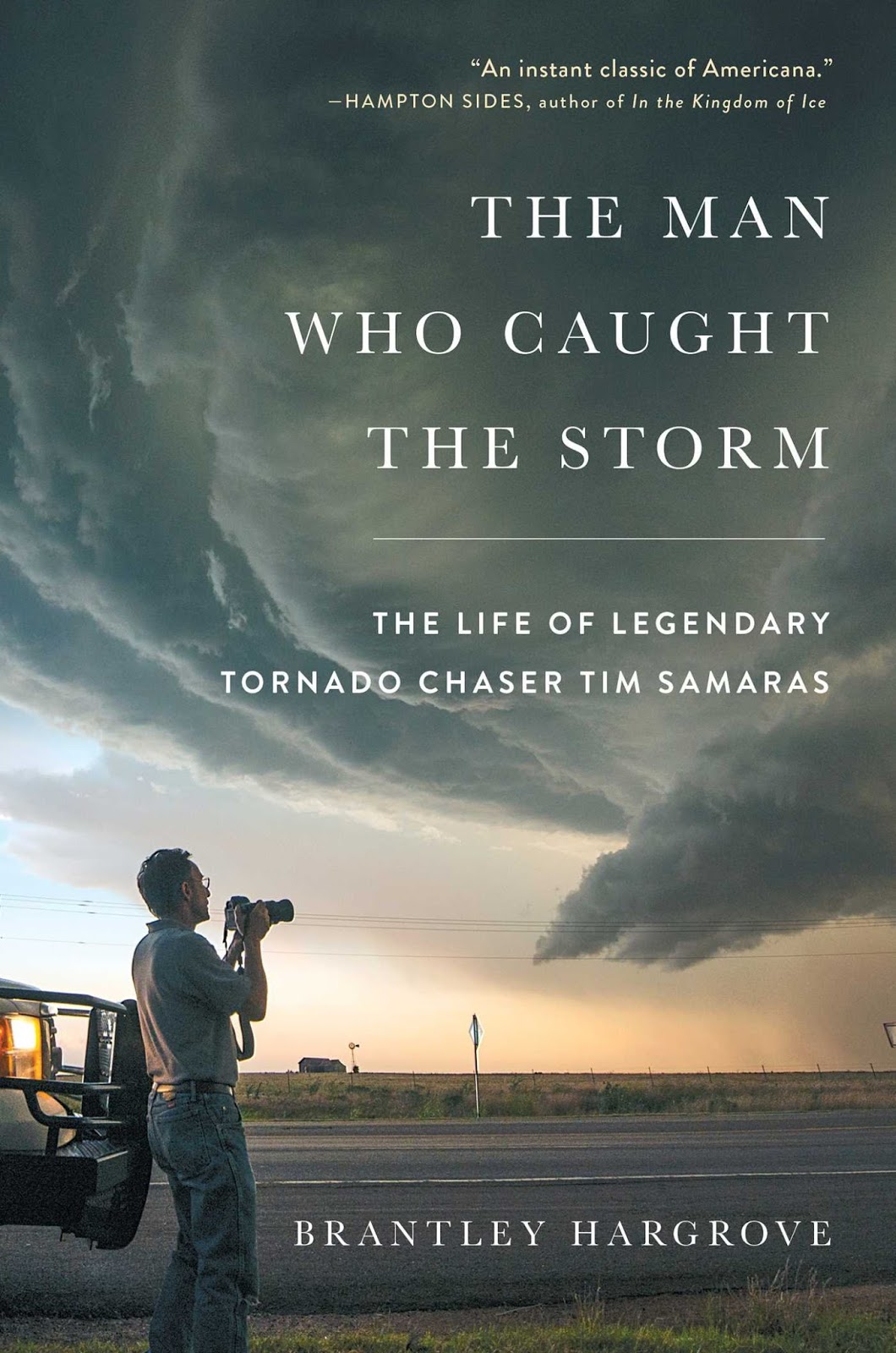
THE MAN WHO CAUGHT THE STORM :: Brantley Hargrove

A version of this review previously appeared in Shelf Awareness and is reprinted here with permission.

Tim Samaras was one of those uncommon individuals who turned his childhood obsession into a lifelong passion that he used to change the world. Captivated by The Wizard of Oz and a PBS storm-chasers special as a boy, Samaras evolved into the greatest tornado researcher of our time. The Man Who Caught the Storm is journalist Brantley Hargrove's intimate portrait of the soul and intellect of a fascinating man whose life goal was to do the undoable--map ground-level data from the heart of a supercell twister.

Samaras, a self-taught weather forecaster and electrical engineer, made his living testing weapon systems at the Denver Research Institute, a job he obtained with no experience and a resume hand-written on a lined sheet of paper. The fervor and fortitude that jump from Hargrove's well-researched profile evidence Samaras as a person who simply would not be denied his legacy. During tornado season, Samaras lived and breathed storms, chasing weather fronts along with funding to continue his research. Finding greater renown on Discovery Channel's reality series Storm Chasers, Samaras's level-headed yet persistent boundary pushing made him a legend in the weather community.

Writing about weather is difficult at best, but Hargrove does a marvelous job mixing heady science with an engrossing and personal narrative. Nirvana for weather fanatics, the storytelling remains appealing to a broad audience, infused with the soul of a loving family man on a mission to reach his dreams and dance with nature's devil while trying to make the world a safer place.

STREET SENSE: I can't tell you how much I hate tornados. Having been born and raised in the fair climes of Northern California, anything much different than 70-degrees and sunny is foreign (P.S. earthquakes, but eh)(P.P.S. Not counting the short time I spent white-knuckling it while living in "Tornado Alley," never to be repeated). Scary weather, the type of weather that brings (seemingly) 8,000 days of anticipation angst, I hate it. I wouldn't be caught dead watching an episode of Storm Chasers. But Brantley Hargrove did such a great job with this book that I loved the hell out of it despite my anti-tornado sentiments. It is scientifically detailed yet heartwarming, and made me wish I had been able to meet the man it profiled.

A FAVORITE PASSAGE: Until the early 1950s, official policy forbade even the utterance of the word tornado in weather forecasts. The government was convinced that citizens were no more sensible than stampeding cattle, that entire cities would descend into hysteria upon hearing the dread word, resulting in far more fatalities than the thing itself. Tornado was a word of power: deadly if spoken; deadly if left unspoken. Better to leave it unsaid, decided the U.S. Army Signal Services, and later the U.S. Weather Bureau, since few within their ranks believed tornadoes were actually predictable. The forces causing the winds to coalesce were shrugged off as the acts of a jealous God. All that meteorologists could do was catalog their epidemiological particulars: deaths, injuries, property damaged.

COVER NERD SAYS: Hatred of extreme weather be damned, photographs of extreme weather are some of the most beautiful you'll ever see and this cover is a perfect example. I believe it's an actual photograph of Tim Samaras, which makes it all the better. The beauty along with proximity to danger make this a dead bang winner.


Thursday, May 17, 2018

THE LITERARY STRIKEOUT

Sometimes, as much as you might think a book is smack in the middle of your wheelhouse, straight hard cheese down the middle of the plate, you swing and miss. The titles below are three I recently whiffed on, sending me back to the dugout with my head hung and bat dragging behind me, alone in the reading minority. (Warning: The baseball metaphors don't end in the introduction.)

H is for Hawk, by Helen Macdonald


In hindsight, I probably should have known better about this one. While I was all in for the forging of a connection between the author and her goshawk, I blinded myself to the downside: Mabel was bred in captivity to kill for a master. I finished, but the upside of being able to dispatch an injured rabbit because of the need for the skill (so Mabel didn't eat her quarry alive) kind of took the glow off. I found parts of the book fascinating and educational, just not for me. Strike one. (Even though, very little known fact, I dated a guy in college who was a falconer. Super cute and funny=I overlooked the dead chicks in the freezer for as long as I could. Spoiler alert - not long.)


The Hearts of Men, by Nickolas Butler


Since I loved Shotgun Lovesongs and Beneath the Bonfire with the heat of 1,000 suns, Butler became an author I would read without knowing anything about his latest work. That just bit me in the ass, though I would have picked up Hearts even after reading the summary. It *sounded* great, but the execution didn't work for me. I loved (yet hated, because mean kids suck) the first section and was engrossed in the premise of seeing how Nelson would respond, what his life would become, after camp. But then I got a looping curveball that took me off to visit other characters I really didn't enjoy reading about. It all came back around, but by that time I was just going through the motions and the ultimate shocking event seemed contrived and more than a bit eye-rolling. I'll still go back for Butler's next offering, but right now I'm sitting on an 0-2 count.


Our Kind of Cruelty, by Araminta Hall


I was so in for this one. I admit it, the Gillian Flynn blurb got me. I'm not even sure where/when I saw it, because I am not a blurb-reader. Weird as it may seem, I love spending time in the mind of a well-written narcissistic sociopath. [Deleted great line about the biggest one in my life]. I found Mike Hayes fascinating and was impressed with the job Hall did writing from his head. Here's the gist: Mike and his ex-girlfriend V played a game called Crave. They would go out, super attractive V would sit by herself until someone hit on her, at which time Mike would intercede and they would go off to have hot sex somewhere nearby. When V breaks up with Mike and becomes engaged to another man, he is certain she has just taken the game to the next level and he continues to play. It's a fantastic concept and for the first half of the book I was transfixed. But by 3/4 of the way through it felt a bit old and the twist I was hoping for never really twisted. The ultimate question of "Was she playing or wasn't she?" aside, it felt like it went off into a statement on victim-shaming that didn't really fit for me. Strike three, I'm out.

Wednesday, May 2, 2018

THE TRAUMA CLEANER :: Sarah Krasnostein

I requested a galley of this book based on two things: the cover and the subtitle. This admission shouldn't be shocking if you know me at all, as the adage "Don't judge a book by its cover" is, for me, one that applies to life but never to books. I am an admitted cover-judger of the highest order and this one got me good. A realistic image of a cleaning glove with a spot of blood on it? Sign me up.

The realism is key here, which leads to the subtitle: One Woman's Extraordinary Life in the Business of Death, Decay, and Disaster. I'm not a huge fan of subtitles, particularly the lengthy variety, but this one does the great favor of telling me exactly what I'm getting. Well, almost. Don't let the word "extraordinary" slip your notice, because this book is both exactly what it says it is and nothing you'd ever expect.

Sarah Krasnostein begins her profile of Sandra Parkhurst with the woman she is today--tall, perfectly coiffed and tethered to an oxygen tank. Sandra is the founder of Specialized Trauma Cleaning (STC) Services Pty Ltd and every day for the past twenty years she has entered homes where "death, sickness, and madness have suddenly abbreviated the lives inside." Sandra's business and her empathetic connection with her clients is fascinating enough to carry the book, yet in the end it's the least fascinating part of the book.

The heart of the story is Sandra and how she became the person she is today, hardened yet compassionate, frustrating yet understandable, unlikable yet lovable. She is an admittedly unreliable narrator due to historic drug use and lifelong trauma, yet she shares openly, accurately or not, with Krasnostein about every detail of her life, no matter how personal.

Alternating between Sandra's history and current professional jobs that present similar to case studies, The Trauma Cleaner is two of the most unlikely stories being woven into one narrative. Yet it works. Sandra's history is necessary to understand who she is today. I'm not going to spoil that here, though the quote below might give a clue, so if you want to remain in the dark, I'd recommend skipping it. Suffice it to say this is one of the most horrific and yet beautiful character studies I've read.

STREET SENSE: There is no one street that fits this one. If you like intense character studies, this is up your alley. If you're more interested in the forensics and trauma scene side, perhaps a bit less so as that is not, nor should it be, the true focus. But since that's how I went into it and came out wowed, I'd still recommend you give it a go.

A FAVORITE PASSAGE:  Looking back on this review, I feel as though I didn't highlight how wonderful the writing is. Sandra and her story are so powerful it's easy for the writing to be overshadowed. It shouldn't be, because it's fantastic, but the fact that it's fantastic and still lets the story shine is another reason it's so good. I marked a ton of passages while reading, but settled on the following to share:

It didn’t start at the twenty-buck fuck shops. It didn’t start in the barnlike brothel where the girls roosted like hens, wire on the windows and around the light bulbs to prevent the men from ripping them out of the ceiling. It didn’t start with the boyfriends who stuck around only as long as her money lasted, or with the beatings from the cops who hated boys dressed like girls or with the women who wouldn’t open the door when she stood outside pleading in the dark, naked and bleeding. It didn’t start with any of that. It started when she was a little boy in a small house with a dirt driveway running up along the side.

(See what I mean? SO good.)

COVER NERD SAYS: Perfection. This book is so difficult to summarize and impossible to categorize. The image/subtitle combo was a little stroke of genius.

Tuesday, April 24, 2018

NO WAY HOME :: Tyler Wetherall

A version of this review previously appeared in Shelf Awareness and is reprinted here with permission.

Tyler Wetherall is spending her 12th birthday in St. Lucia with her father and older sister when the ever-looming phone call comes—authorities have tracked their fugitive father to his not-so-secret location and the girls need to escape back to their mother in London immediately. In No Way Home: A Memoir of Life on the Run, editor and creative writing instructor Wetherall artfully shares her life in pieces—from early days living as something resembling a family unit to adolescent years filled with secrecy and surveillance while separated from her on-the-run father and finally her adult efforts to learn and come to terms with the family legacy.

The first half of Wetherall’s memoir reads like emotionally-exhausting spy fiction. By age nine, she has lived in thirteen houses in five countries on two continents, yet knows nothing of fake identities or legal problems. Reliving the accounts of the three siblings as they begin to suss out the family secret is thrilling and gut-wrenching. Filled with clandestine phone calls, dark sedan tails and surprise visits from black-coated authorities, Wetherall, a journaler from a young age, infuses her early memories with a riveting presence of thought and perception.

Neither Wetherall nor the reader know her father’s true story until after his arrest. Aided by his 300,000-word prison treatise, Wetherall reveals the ongoing saga behind the screens her parents employed to protect their children. Although lacking the emotional resonance of Wetherall's childhood account, her father's impact on the relationships, dynamics and paths of the family lends completeness to an undeniably fascinating work.

STREET SENSE: In a memoir worthy of the big screen, the author shares insight and details into her family's life on the run as her father is pursued by the FBI and Scotland Yard. A breath-taking first half slows down in the present-day retelling from the author's father's perspective, but the whole is an incredibly worthy endeavor.

A FAVORITE PASSAGE:  While on the run, Mom used to travel in a floor-length pink fake fur coat. She argued that no one could suspect a woman dressed so outrageously of having anything to hide. She looked formidable with her five-foot-ten-inch height in a blaze of fuchsia topped by her now-blond cropped hair, yet so thin, the brittle birdlike bones in her neck pushed tight against her skin, making her look like a sorrowful bird of paradise.

(Here's a bonus quote since I loved Wetherall's mother and this is some of the best life advice ever: "Mom said it was important to do laundry badly or people might expect it from you, and if a man ever asked us to iron his shirt, we should immediately burn a hole through it, so he'd never ask again.")

COVER NERD SAYS: I found this cover somewhat intriguing despite a color palette that doesn't really speak to me. It does speak to a broken film frame, which I appreciate, but for some reason that pinkish color at the bottom does me in. Totally subjective, I'm just not a pink person and for me it doesn't evoke all the great stuff inside this book. I also thought the subtitle should, in this case, have been a bit bigger, since it's the pull and the payoff. Apparently I'm cranky(er) today, as this cover is really quite fine, just not in my wheelhouse. I'd still pick the book up from a display table, so the artwork did its job, even on this curmudgeonly non-pink person.

Tuesday, March 20, 2018

BACHELOR NATION :: Amy Kaufman

A version of this review previously ran in Shelf Awareness and is reprinted here with permission.

How did a reality-based television show that pits 25-30 media-defined perfect people against each other to "win" (i.e., become engaged to) a person of the opposite sex after six weeks of "dating" capture the cultural zeitgeist? There are varied answers to that question, but the one unshakable fact is that The Bachelor franchise (The Bachelor, The Bachelorette, Bachelor in Paradise, etc…) is still going strong in its 16th year (35 seasons of bachelors and bachelorettes combined).

In her expose, Bachelor Nation: Inside the World of America's Favorite Guilty Pleasure, Los Angeles Times staff writer Amy Kaufman, herself a proud devotee, delves into the hows and whys of a wildly popular guilty pleasure. Kaufman interviewed former contestants and production members to provide first-hand behind-the-scenes details about what goes on during pre-production, under the lights (and sometimes the covers) and in post-season fallout.

There are many intriguing facets to reality television and Kaufman skillfully hits a sweet spot between breadth and depth. Bachelor Nation provides insight into the beginnings of reality dating shows, their evolution over the decades and how an audience of tens of millions rationalizes its dedication to a genre that mostly horrifies critics.

Knowing her audience, Kaufman smartly provides salacious details fans yearn for while still addressing complex issues such as historical male and female stereotypes, the somewhat inherent conflict between female viewership and feminism, producer manipulation and the role dopamine may play in how events unfold. A must for members of Bachelor Nation, Kaufman's work will also appeal to students of the sociology of television.

STREET SENSE: A fun and interesting look inside reality dating television, its fandom and fallout from the point of view of a pop culture professional and genre insider.

A FAVORITE PASSAGE: So what's going on here? Are the contestants who go on the show--and the millions who watch them--really so wildly different from the so-called average young American? I don't think so. Because while the rules of the dating world may be shifting, the media--for better or worse--still propagates the idea that your worth as a woman is cemented when a man loves you enough to marry you...Then, on the other hand, there's all this single-ladies stuff and a celebration of independent women and not necessarily needing a man...I think women are straddling a set of contradictions here that are much greater than [those that] many generations had to navigate.

I laughed out loud at this tidbit (mostly because it's so damn true) from one of the short guest entries by celebrity viewers:

It's kind of awful to watch the show. And it's the thing I most look forward to every week. It's fucked up. ~Amy Schumer

COVER NERD SAYS: What other cover image would work here? Smart, clean, eye-catching. This is great cover work, particularly when, considering the subject matter, it could so easily have been way overdone.

Tuesday, November 28, 2017

BREAKING BAD 101 :: Alan Sepinwall

A version of this review previously ran in Shelf Awareness and is reprinted here with permission.

A television drama with a ludicrous premise (a dying chemistry teacher cooks and sells methamphetamine to build a nest egg for his family), Breaking Bad was rejected by major networks and shuffled off to cable. From humble beginnings, it became not only a critical darling but a top-rated, multi-Emmy-winning water cooler sensation. In Breaking Bad 101, longtime television critic Alan Sepinwall (The Revolution Was Televised) dissects a show so successful at captivating an audience that Sepinwall watched "the greatest hour of dramatic television ever made" (Ozymandias, S5, E14) from a hospital bed after nearly dying from a burst appendix:

By that point in the series, though, the only thing that would have prevented me from covering 'Ozymandias' (and the two concluding episodes that followed) live would have been something worse than appendicitis. It wasn't just professional dedication making me do it, but a kind of fever equal to the one that, because the appendix burst before doctors removed it, kept me hospitalized for almost two weeks.

From its focus on the "in-between moments" to its use of cinematography to show rather than tell, Breaking Bad is a model of successful storytelling. Many plots would crumble from the fragile framework upon which creator Vince Gilligan and his crew built their masterpiece, but this one grew to epic proportions on the strength of its foundation--the writing (and some admittedly happy accidents). Sepinwall reveals how the writing held millions of viewers in suspense while a year of real-time story was spread over several often glacially-paced seasons of television in a masterful display of craftsmanship. This is even more staggering when you learn how often the writers were "winging it." Says Gilligan:

We actively try to paint ourselves into corners at the end of episodes--at the end of seasons, at the end of scenes, sometimes--and then we try to extricate ourselves from those corners.
The book includes updated show recaps supplemented with insightful details about all 62 episodes, interspersed with sidebars of insider facts and backstories, commentary from the actors and creators, and brilliant black-and-white comic-style artwork that exemplifies the show's dark humor. Breaking Bad 101 is incredibly fun, but truly shines when Sepinwall explores the elements that elevated an impractical story to awe-inspiring success.

STREET SENSE: An episode-by-episode companion to arguably the greatest television drama of all time, with content to satisfy artists, casual fans and series aficionados. If you haven't watched yet, doing so along with reading this book would be a great way to dive in. If you have watched, five'll get you ten this will make you want to start all over again.

A FAVORITE PASSAGE: This is a toughie, both because so much of the writing is spoilerish if you haven't watched the series and because great writing about great writing is so infinitely quotable. There's the bit about how Sepinwall's fixation and fever over Breaking Bad is all the more amazing because at first he wasn't even sure he would like the show, which is exactly how I felt on both ends. There's a great piece on growth, decay and transformation. I almost took from the fantastic Foreword by Damon Lindelof, who praises Sepinwall's craft and soul despite Sepinwall's oft-times less than positive reviews of Lindelof's own show, Lost. In the end, this heavily redacted bit won out, mostly because it perfectly describes the breath-holding experience of watching Breaking Bad, which feels both slower and faster than real time, turning the process into something otherworldly:

Nearly twenty minutes of screen time pass from the moment [redacted] to the closing credits.  More than fifteen minutes pass from the moment Walt arrives at [redacted] to the closing credits, and more than ten minutes pass from the moment we return from the final act break and Walt is prepared to [redacted]. I know this only because I went back, multiple viewings later, to clock it all. In the moment, the action seemed to be simultaneously taking place in an instant and over an eternity. A parade could have gone by my window and I wouldn't have noticed. I'm sure I inhaled and exhaled, if only because I'm alive right now writing these words that you're reading, but I'll be damned if I was aware of any contracting or expanding of my lungs as [redacted] all converged on the spot where [redacted]--the same spot where the arrival of [redacted] made it clear to both Walt and us that nothing on Breaking Bad would ever go as expected. 


Wednesday, November 1, 2017

I CAN'T BREATHE :: To Review or Not Review?

I Can't Breathe is an expose that details the before and after of Eric Garner's murder at the hands of the NYPD. The author delves into myriad issues impacting police culture in New York in general and Staten Island in particular. Politics, culture, race and money all worked together to create a perfect storm of injustice that cost Eric Garner his life.

It's an even-handed account--Garner is not portrayed as a saint. He was as flawed as any man, but one who was almost universally liked and non-violent. Garner worked hard to provide for his family (often to his own detriment) and was a neighborhood fixture on Bay Street where he sold smuggled cigarettes. It's an important story, impressively researched and very well written considering the scope it undertakes.

So what's the problem? The problem is that as I sat down to write a review I saw this article about the author, who worked as a journalist in Russia many years ago. He was apparently also a ginormous asshole, misogynist and perpetrator of sexual assault (and maybe more) against women and perhaps underage girls. His antics are all proudly documented in a memoir he wrote with another journalist about their time in Russia.

He may now claim the memoir was satire, but I'm not sure I care and I'm not buying it regardless. Even as satire it was a supposedly non-fiction work that glorified the assault and denigration of women and children. A quick look-see on Twitter evidences a history of harassment and misogynistic behavior on the author's part since the memoir's publication, which pretty much brings the lie to the satire claim, methinks. So. Here I sat, stuck between the rock of promoting the work of an asshole and the hard place of not promoting an important piece of non-fiction.

I had decided to do nothing, but as I sat with that decision, the inaction bothered me. If this was a work of fiction, the answer would be easy. But it's not. It's an in-depth investigative report on a state of affairs in this country that is costing lives. What I decided to do is this: I am strongly encouraging you to read the book. I'm also encouraging you, even more strongly, not to buy it. Support your local library and borrow a copy instead.

It's no mistake I don't mention the author's name in this "review." That was intentional. Probably silly, particularly since it's right there on the cover image, but it's my own minor protest. In the end, we're all adults and you can make your own determination as to whether you want to put your money into the furtherance of this author's work. On my scorecard, he is a special kind of heinous that shouldn't be rewarded. Once again Eric Garner deserved better.

Tuesday, October 24, 2017

NOMADLAND :: Jessica Bruder

A version of this review previously appeared in Shelf Awareness and is reprinted here with permission.

In preparation for writing Nomadland: Surviving America in the Twenty-First Century, journalist Jessica Bruder immersed herself in a new American subculture: the houseless. These "vandwellers" are individuals and families who for myriad reasons have ended up on wheels. Far from carefree RVers, these are folks for whom the American dream has been proven a con, and they make ends meet by doing itinerant work across the country.

The practice of giving up real estate for "wheel estate" has increased exponentially in recent years, following stock market crashes, the housing crisis and increasing economic risks faced by American families. Having to choose between food or electricity, health care or warm clothes, these nomads live in converted vans, campers, even Priuses. Many thrive while surviving day-to-day, but being a "workamper" is no easy ride.

Skewing older (many are in their 60s or 70s and have lost their retirement funds) and subject to "harsh migrant labor treatment," they are nevertheless sought-after workers due to their experience and reliability. Amazon has unsurprisingly taken advantage of this shadow economy, setting up company towns and recruiting its own "Camperforce," for whom long, difficult hours and low pay are the reward.

Joining them in Halen--a converted van (the subculture is strong with vehicle puns)--Bruder became intimately knowledgeable about this often heartwarming mobile community that blurs class lines. She writes with a steady and thoughtful hand about the frightening consequences when long-held social contracts are breached and upheaval becomes the new American normal, and exposes their underbelly with grace and heart.

STREET SENSE:  A well-written and researched look at a microcosm of Americans who have taken up a life on wheels in order to survive national economic crises. High recommended.

A FAVORITE PASSAGE:  [F]or them--as for anyone--survival isn't enough. So what began as a last-ditch effort has become a battle cry for something greater. Being human means yearning for more than subsistence. As much as food or shelter, we require hope. And there is hope on the road. It's a by-product of forward momentum. A sense of opportunity, as wide as the country itself. A bone-deep conviction that something better will come. It's just ahead, in the next town, the next gig, the next chance encounter with a stranger.

COVER NERD SAYS: This cover is perfection in my book. The art work, the color palette, type face and spacing are all pleasing to the eye and give the viewer an at-at-glance idea of what they might get inside. Although the whole does not address the community many nomads experience on the road, the constant shift and upheaval does provide an overwhelming sense of solitariness that is exemplified in this image. This is one of my favorite covers of the year.

About Malcolm Avenue Review

I was lucky enough to be born and raised in a nifty, oak-shaded ranch house on Malcolm Avenue, a wide-laned residential street with little through traffic, located amid the foothills of Northern California. It was on that street and in that house I learned most of my adolescent life lessons, and many grown-up ones to boot. Malcolm Avenue was "home" for more than thirty years.

It was on Malcolm Avenue, through and with my family and the other families that made up our neighborhood of characters, that I first learned about and gained an appreciation for the things I continue to love the most to this day: music, animals, photography, sports, television/movies and, of course, books.

I owe a debt of gratitude to that life on Malcolm Avenue. It gave me a sense of community and friendship, support and adventure. For better and worse, life on that street likely had the biggest impact on the person I've become. So this blog, and the things I write here, are all, at their base level, a little bit of a love letter to Malcolm Avenue.

Labels

  © Blogger templates Newspaper by Ourblogtemplates.com 2008

Back to TOP