Below are a few (somewhat) brief $.02 opinions about books I've read or listened to recently but don't have the opportunity to review in full. Many of these titles I enjoyed as much or more than those that got the full court press. I hope you'll consider one or two for your own TBR stack if they strike your fancy whether they struck mine or not.
Tuesday, November 1, 2022
TWO-CENT TUESDAY
Tuesday, July 19, 2022
TWO-CENT TUESDAY
Below are a few (somewhat) brief $.02 opinions about books I've read or listened to recently but don't have the opportunity to review in full. Many of these titles I enjoyed as much or more than those that got the full court press. I hope you'll consider one or two for your own TBR stack if they strike your fancy whether they struck mine or not.
Wednesday, June 22, 2022
THE CHANGE :: Kristen Miller
Kristen Miller's The Change is not a book that would normally be on my radar, but I joined an Instagram buddy read group and this was their selection. I could have skipped it, but it sounded like it could be a bit of fun. I was so wrong - this book was SO MUCH FUCKING FUN! I understand some readers felt it was heavy-handed on the feminist front, but first, why the hell not? We certainly have plenty of heavy-handed books with women as the forever victim. Second, the heavy-handedness is, from my perspective, done intentionally and very well by Miller.
Harriett is a former advertising exec who is responsible for her husband's success while he gets the credit. She left the corporate world and is now divorced, tending to her outlandish garden (that breaks every HOA rule to hilarious end) and "helping" people with her plant-based potions. No surprise she's known as a witch. She is the embodiment of a strong woman who does what she wants, takes no prisoners and suffers no fools ("That’s why I choose vengeance. She’s the only mistress I serve.").
Jo used to work in the hospitality industry, but now runs an all-women's gym where she can rage-run to her heart's content. When she gets angry, her power manifests in extreme strength and heaven help those who piss her off.
Nessa is a former nurse who inherited the family legacy of being able to hear and see the dead. Her gift is what sets off the action, as the women discover a dead body surrounded by more dead young women and are bound and determined to figure out what's going on in their neighborhood.
The book was not without its flaws, and at one point I thought it was over, but it still had quite a few pages left. Some of the characters' intentions and true colors were telegraphed, but honestly, it just didn't matter. These issues didn't detract enough to keep me from finding this a fantastically enjoyable trip.
I'm a sucker for good character work and Miller's is stellar. Each of the women is multi-faceted and fascinating in her own right, with backgrounds and issues that kept the narrative fluid and on point rather than dragging it down. I wanted to know more about these women, especially Harriett, who is someone I would want to hang out with any day.
I'm so glad I was convinced to read The Change and will definitely seek out more work by Miller. It was by turns moving, hilarious, serious, outlandish, educational, motivational, and fun. A definite E-ticket ride.
Tuesday, June 21, 2022
THE DEVIL HIMSELF :: Peter Farris
"The girl in the trunk had been bound."
Tuesday, May 17, 2022
NOBODY GETS OUT ALIVE :: Leigh Newman
Monday, May 16, 2022
CHILD ZERO :: Chris Holm
As a huge fan of Chris Holm's work (go dig on The Killing Kind, I've been waiting with bated breath for Child Zero. On the other hand, I knew a bit about where this book was headed and was...let's say scairt. Holm is a super smartypants (molecular biologist) and I am a middling smartysock. When I got my copy I was elated and also, as I told him, "hoping it wasn't over my head." As usual, he had the best response: "If that's the case then I haven't done my job." I can now attest that Holm did his job to PERFECTION.
One of the things I adore about Chris's writing is that while story is Job 1, character is Job 1A. Once again, he's nailed both in thrilling fashion. In a not-too-far-ahead future, we have continued to fuck up. Unchecked climate change results in a deadly virus being unleashed from the Siberian permafrost. Also, whoopsy!, it renders antibiotics useless. That hangnail you're nursing? That teeny scratch from your beloved Dashiell? They might now be the death of you.
Child Zero is the thrilling story of people trying to adapt to a horror landscape several years following a bioterror attack. We experience that terror through NYPD Detective Jake Gibson, who lost his wife in the attack and is raising his daughter Zoe alone. As we meet Jake, Zoe has a temperature high enough he is mandated to report it to the Department of Biological Security. But Jake knows what happens when a report is made and he's willing to risk everything to keep Zoe safe.
Jake's problems are multiplied when he's notified of a massacre at Park City, an encampment of refugees stranded when Manhattan was quarantined following the 8/17 bioterror attack. The scene makes it clear the assassins were looking for something or someone and Jake and his kickass partner Amira "Amy" Hassan need to figure it out quickly.
As the Park City attack began, twelve-year-old Mateo Rivas was awakened by his uncle Gabriel and hurried to a planned escape route. Gabriel ensured Mat held a bound and wrapped package securely and remembered his instructions, then sent the boy out into the world via the sewer system.
What Mat possesses and why baddies might want it is at the core of Child Zero, a total barnburner from start to finish. The science is frighteningly on point and plausible, the characters are so well drawn you can't help but want more of them, and the sandbox the science and characters get to play in keeps the reader glued to the page. Holm's world-building is superb and, since the book was serendipitously (?) published during a pandemic, Holm has made it all too easy to imagine this world as our future.
If sciencey stuff makes you think twice, I'm here to tell you it's not an obstacle to your understanding or enjoyment. If science is your bag, there are more than enough juicy tidbits for you. If you are trying to escape pandemic reading, this didn't ring my "pandemic malaise" bell. Although we can all now sadly relate to many of the issues raised by the plot, Child Zero is still escapism at its finest.
I don't have a ratings system or give stars, so I'm just going to lasso the galaxy and hand it to Child Zero.
Wednesday, April 27, 2022
THE HAWK'S WAY :: Sy Montgomery
Sy Montgomery's The Soul of an Octopus is one of the most magnificent books I've ever read, so it was with great anticipation I cracked the e-cover of her new work: The Hawk's Way: Encounters With Fierce Beauty. Although Montgomery writes about nature and its creatures in a manner that resonates with me, and I admire that she considers multiple facets of her encounters (i.e., man's impact on the natural world), I was not as enamored with this account as her others.
Friday, April 22, 2022
WESTERN SKIES :: Darden Smith
With Western Skies, Austin-based singer-songwriter Darden Smith has created a multi-form artistic experience unlike anything I've seen/read/listened to before. Created as a love message to his home state, the idea emerged during several road trips across West Texas, as Smith took polaroid photos to memorialize his trips and composed lyrics behind the wheel.
Thursday, April 21, 2022
PASSERSTHROUGH :: Peter Rock
Not since Iain Reed's I'm Thinking of Ending Things have I finished a book and thought "I have little to no clue what I just read, but I loved every damn minute." Peter Rock's Passersthrough is all kinds of crazypants, and I am far from understanding everything that happened, but in the words of Trip in Meatballs, "It just doesn't matter!"
After her mother's death, Helen begins reaching out to Benjamin, although tentatively. She gives her father a machine that he can speak into (and vice versa) and his words will be transcribed and sent to her machine. Helen is not yet to the point where she trusts him enough to spend time him or speak directly about what happened.
Through their communications, we learn snippets of what that camping trip involved, including a blue tarp and a lake they called Sad Clown Lake, a body of water filled with bones that never seems to be in the same place twice. They also had a notebook they left in their tent while they were out, leaving it for "passersthrough" to write in.
As Helen and Benjamin talk remotely, Benjamin has a semi-catastrophic encounter with a woman and her dog in the market parking lot. Melissa helps Benjamin home and tends to him, but also reads some of the transcriptions on Benjamin's machine. As Melissa and her "brother," who are squatting in a "murder house," try to help Benjamin figure out what happened on that ill-fated camping trip, things start to get really cuckoo.
To share more would be both too much information and me providing a perception that might not be anywhere near correct. Although the story seemed to remain outside my grasp, it was so beautifully written and intriguing that I didn't want to put it down for a minute. It's haunting, eerie, bizarre, lovely, and tragic. Rock is a beautiful writer (his heartbreaking My Abandonment was a gift of a novel and also made into a fantastic film, Leave No Trace) and even though much of Passersthrough escaped me, I enjoyed the hell out of it and will pick up Rock's next work without hesitation.
Wednesday, April 20, 2022
THE OTHER DR. GILMER :: Benjamin Gilmer
Holy cats. Benjamin Gilmer may be a doctor, but he could have a second career as a thriller or true crime writer, because The Other Dr. Gilmer is a barnburner. A story that, almost too bizarre to be believed on multiple levels, held me rapt from cover to cover.
Dr. Benjamin Gilmer was something of a late bloomer, a medical resident who, unlike his twenty-something classmates, was 39, married with a mortgage, one child and another on the way. He had decided on family medicine as his path and found a calling towards a rural practice. He found that at a tiny six-room clinic in Fletcher, North Carolina. After a three-year hiatus, the clinic was being reopened and desperately needed help.
Dr. Benjamin Gilmer learned that his predecessor, Dr. Vince Gilmer, had quite a story. Gilmer the second opens the book with this passage, hooking me instantly:
On June 28, 2004, in rural Appalachia, a man with my name and my profession strangled his father in the passenger seat of his Toyota Tacoma.The morning after killing his father, Gilmer the first showed up for work as usual and saw his patients like nothing had happened.
Benjamin Gilmer was in a tough position, coming in after Vince Gilmer (no relation) and trying to win over the patients that, UNIVERSALLY, loved their prior doctor. An upstanding member of the community, beloved by his patients, a man who, according to all reports, went above and beyond to help people and couldn't even bear to kill the mice behind the clinic. No one ever had a glimmer of what was coming.
But how? And why? Feeling the need to answer those questions, Benjamin Gilmer started investigating. Little did he know that deep dive would require all of his (and others) medical acumen, a legal battle, and end in the most unimaginable way possible.
I can't recommend The Other Dr. Gilmer highly enough. On top of a top-notch true crime mystery unfolding before your eyes, the writing of Dr. Gilmer is fabulous, keeping the story moving at a wonderful pace while keeping the complex facts, medical issues and legal process easily comprehended. This is simply one of the most amazing stories I've ever read.
Wednesday, April 13, 2022
EMOTIONAL INHERITANCE :: Galit Atlas, PhD
Every individual and family hold a history of trauma. Those who study the intergenerational transmission of familial trauma investigate how the trauma of those who came before us is passed down like a gene, an "emotional inheritance," leaving its mark on us and future generations. In Emotional Inheritance, Dr. Galit Atlas describes how different traumas are held within families and impact those who are not yet even born, even if those traumas are kept secret. Fascinating, mind-blowing, and difficult to think about.
The work is broken into three sections. The first relates to our grandparents and the trauma of past generations. The second involves our parents and how those secrets and traumas are carried on to our generation, and the final section is about you and me, ourselves and how we break the cycle.
Dr. Atlas writes in a matter-of-fact way that is not dumbed down but quite understandable by a layperson. Some ideas are wilder than others, yet when walked through some of Dr. Atlas's examples, one is left without doubt. For example, evolutionary or epigenetic changes occur when a generation (or individual) is marked by trauma. Take, for instance, the Holocaust. Research has shown that the offspring of Holocaust survivors (similarly to enslaved people, war veterans, etc...) are more likely to present with PTSD following traumatic events.
Perhaps in a "survival of the fittest"/Darwinian way, the biological changes of such trauma might be seen to prepare the children of survivors for environments such as those experienced by their ancestors. However, they also often leave them vulnerable to carrying symptoms of trauma that they didn't experience firsthand.
By weaving the stories of her patients' narratives in with her own personal stories, Dr. Atlas helps provide a way for us to recognize some of these issues or changes within ourselves. The key is to deal with the disconnect between ideas and feelings, thus knocking down the protective walls that keep us from feeling something devastating. Of course, the walls also keeps the trauma "isolated and unprocessed." An emotional Catch-22, for sure, but one that gives new meaning to the phrase "we are only as sick as our secrets."
Emotional Inheritance is an utterly engrossing work that will have readers thinking about their own histories, family terminologies and stories, and the trauma that shapes so many of our relationships and paths in life.
Tuesday, April 12, 2022
SUNDIAL :: Catriona Ward
Holy cats. If you've read Catriona Ward's prior novel, The Last House on Needless Street (which I HIGHLY recommend), you know not to believe a word she writes (in the best way ever). For me, this only amped the tension up to 11 in her latest, Sundial. Although I'm not generally one for genre labels, someone called this psychological horror and I can't really quibble with that. I took a dip into the "horror" genre a couple of years ago and promptly discovered Ward and Stephen Graham Jones, who are now two authors I trust implicitly to give me creeptastic entertainment.
Monday, April 4, 2022
SOMEDAY THE PLAN OF A TOWN :: Todd Boss
Following the loss of a 20-year marriage and strained relationships with his children, poet Todd Boss sold all he owned and gave up his Minneapolis apartment ("only half-facetiously writing "Trump" on the "Reason for leaving" line of the Lease Cancellation form). In that grief-stricken state, he traveled the world for two years utilizing a series of thirty housesitting gigs. In each location, he wrote. This collection of poems is a result of that trip, reflecting Todd's emotional difficulties permeated with the essence of the different locations he visited.
I was also drawn in by his summary of the saga, as he was "alternately inhabiting thatched-roof farm-houses, hillside estates, urban apartments, and lush gardens in Berlin, Barcelona, Marrakesh, Singapore, Auckland. Housesitting gigs often came complete with pets or livestock for which I was responsible. I tended sheep from a stone cabin in the Pyrenees. I minded two sleepy cats in a Tuscan villa, a coop full of unruly chickens in London, and a playful puppy on the Gold Coast of Australia."
There were some incredibly lovely moments within the collection. I especially loved the titular piece, a lyrical run-on about finding your place in the world, a dream for everyone who just doesn't feel quite right where they lay their head:
Someday the Plan of a Town--right down to its sidetracks and back alleyways--will match--or so goes the dream--with some identical patch of neural network your rogue thoughts roam in--overlay it like those musculoskeletal transparencies with which anatomy textbooks come bound--and you'll be at home in its dogleg jointwork of cobbled kinks--and your body will resound at every fork, tuning-fork-like--and every road you ever rambled will be re-scrambled to appear to have brought you here, where you fit so perfectly... (Tarifa, Andalucia, Spain)
From my perspective, the most engaging pieces described the essence of Boss's particular surroundings, taking the reader along on some portion of his trek. From Workmen Discarding a Parquet Floor, Vienna:
It's a four-handed band performing the complete works of Beethoven using only wooden castanets in incomplete sets. What once a woman danced across. What once in a sash of sun the cat snoozed afternoons upon. Un-glued, un-patterned, going, gone.
And this, from Why Empty Barber Shops Draw Me, I Don't Know:
...we want to talk when we want to talk & we want sometimes instead to sit quietly while someone touches us all about the head with the edges of a scissoring scissor & the neat teeth of a comb. Small comfort, but lucky for us, the wealthy as well as the poor, that there are a few things left in this old world we still need other people for. (Baltimore, Maryland, USA)
There are also moments that are beautifully-worded knife cuts that reflect Boss's current state. From He Divides his Time Between:
I had a married life before, in a subdivision of peace and war.
In equal thirds my loved ones ate my heart like a festival roast.
Now my father's son is a ghost, a wisp of smoke, a metaphor.
He divides his time between nothing and much and matters and anymore. (Greenville, South Carolina, USA)
Then there were the pieces that came from what felt like a very dark place. I won't say these works ruined the collection for me, but they somehow tinged those lyrics I enjoyed with their perceived venom. For example:
Fairer The claw marks in my neck long faded, the steam of hate evaporated, attempted identity theft subverted, assets, passwords, passport converted, accusations of assault reversed, two years' court fees reimbursed, restraining orders at last elapsed, libelous campaigns collapsed, attempts to turn my friendships rotten and threats of murder and vengeance forgotten, I'm finally ready--whatever comes next--to reengage the fairer sex.
And, in Men, Then, Maybe, as Boss wonders if he couldn't love or touch a man just as generously as he has women:
Men aren't faultless, oh, I know. Now and then a prick, okay, but let's just say the "fairer" blooms I've picked so far, though lovely, are no prick-less clutch. So, men, then. Maybe. Huh. The hot mechanics may yet be a mystery, but at least I know the parts already. (Auckland, New Zealand)
This last bit, in a vacuum, I actually love. We can all be pricks, and why are love and touch any different depending on the "mechanics?" But when taken on the heels of the Fairer, it felt more vengeful, a little "fuck women"-ish. Which Boss may be entitled to, and the hurt and disappointment are bound to come out in the words of a poet. I'm not sure why these two hit me wrong. They don't strike me as much now as I reread them as they did initially. Perhaps because we know which woman they are directed at they feel viciously one-sided when we don't know the facts.
Overall I enjoyed this collection, but mostly so when Boss fell into the first two categories. I love a good evisceration poem, poems of honest hurt and devastation. When they delve into real personal intimate lives, I'm more likely to feel the judgment than the camaraderie.
Tuesday, March 22, 2022
FUNNY FARM :: Laurie Zaleski
Who doesn't love a good animal rescue story. Of course, animal rescue stories come with their share of pain, anguish, and difficult times. I still had no idea the depths of storytelling I was in for when I cracked open Laurie Zaleski's Funny Farm: My Unexpected Life with 600 Rescue Animals. Zaleski didn't start the rescue, but continued it as a labor of love for her indomitable mother, Anne McNulty, who started it accidentally, borne out of kindness and necessity. Anne McNulty may be one of the greatest people I've ever read about and Zaleski did a brilliant job of painting a full-color portrait any mother would be proud of.
Zaleski was born into wealth. Before they were thirty, her parents had three homes with a housekeeper and nanny for the kids. Her father, however, was domineering, controlling and violent. At twenty-six, Anne McNulty took her three children and ran for their lives. With no child support or alimony, the foursome ended up living in a run-down structure (I can't even call it a house) with no electricity or functioning bathroom.
With plenty of them, the "Funny Farm" turned into a free-range free-for-all full of assorted rejects who lived together, often in the house and on the couch. Eventually, the farm opened to the public and donations helped the family and the continued growth of the rescue.
Zaleski, "a tomboy, an ass-kicker, Tarzan and Jane rolled up into one propulsive locomotive of a girl," turned into a force of nature just like her mother. She became a successful designer and founded her own graphic design company, Art-Z Graphics, of which she is also the President and CEO. Her life goal, however, was to fulfill a promise to her mother to buy a real farm where she could retire and rescue animals full-time. Of course, in McNulty fashion, that road wasn't smooth either.
Told in alternating chapters, Zaleski weaves the tale of her family's horrific (and beautiful) past into the present, where, in 2019, the Funny Farm's 600+ denizens welcomed over 100,000 visitors from all over the world. A story of hardscrabble existence, exhausting work, ongoing terror, and the power of family, love, and the healing nature of animals, Funny Farm is a triumph. It made me want to get on the next plane to the remote Jersey Pinelands and wish I could meet and hug Anne McNulty. Laurie Zaleski's writing is smart and engaging, informal and welcoming while flowing with ease. It uplifts and drops the bottom out, over and over, until you are both in love and can't take anymore. Highly recommended.
Monday, March 21, 2022
COMEDY COMEDY COMEDY DRAMA :: Bob Odenkirk
I've appreciated Bob Odenkirk for decades, particularly his somewhat dry charm and humor. I've also admired him for presenting, from the outside, as a kind, smart, funny family man. But he really earned my high regard when he took the Bryan Cranston path from jokester to dramatic genius: tighty whitey-wearing comedic foil Hal on Malcolm in the Middle to tighty whitey-wearing drug kingpin Walter White in Breaking Bad.
Although Odenkirk's Saul Goodman was and is something of a comedic foil in Breaking Bad, the part was layered in drama and character, and that has only amplified within the spinoff Better Call Saul, which has provided material for electrifying dramatic performances from the entire cast.
Monday, March 7, 2022
TIDES :: Sara Freeman
Mara is understandably devastated when her baby is stillborn. Unable to stay put in her grief, particularly when her brother lives just downstairs with his newborn, she leaves her husband takes off to a small beach town where everyone is a stranger and she can disappear ("She could no longer live in this fixed way: with their joy so firmly lodged beneath her grief.").
Drinking more than she eats, sleeping where opportunities arise, Mara is intentionally slipping "into a blind spot." As her money disappears and her phone shuts down, Mara's wandering takes on a small sliver of something resembling stability, if you don't look too closely, when she notices a Help Wanted sign in the window of the town wine shop.
...eyebrows like tadpoles swimming lazily across her forehead.
Still hot into the evening, when the sun is a red face dipping its chin into the water.
The only visible sign of life: a sliver of moon, butcher's hook looking to grab at tender flesh.
She is seventeen or forty-seven or somewhere in between. She is the walking dead: the child inside her floating dangerously near the surface, gasping its final breath.
They remind her of childhood, when the world seemed to dangle from a string and adults moved around with their scissors, cutting on a whim.
Sometimes she wonders what might have happened if she'd been born less flawed, if she'd turned, on occasion, right instead of left. Maybe then she'd be more like [her brother], not a bay stripped bare by the tides, all the scum and rocks and dented plastic bottles on hideous display.
Tuesday, February 8, 2022
TWO-CENT TUESDAY
Below are a few (somewhat) brief $.02 opinions about books I've read or listened to recently but don't have the opportunity to review in full. Many of these titles I enjoyed as much or more than those that got the full court press. I hope you'll consider one or two for your own TBR stack if they strike your fancy whether they struck mine or not.
Tuesday, February 1, 2022
TWO-CENT TUESDAY
Below are a few (somewhat) brief $.02 opinions about books I've read or listened to recently but don't have the opportunity to review in full. Many of these titles I enjoyed as much or more than those that got the full court press. I hope you'll consider one or two for your own TBR stack if they strike your fancy whether they struck mine or not.
1414°, Paul Bradley Carr
Pride (who is Black) and Piazza (who is white) have crammed so many social and racial issues into this book that I'm frankly amazed and impressed it didn't dissolve into something confusing and preachy.
A hot button premise, they have taken two lifelong best friends, one white, one Black, and thrown them into a horrific situation and let the emotions fly. Jen is white, pregnant with her first baby, and married to a white cop. Riley is a television journalist on the precipice of becoming the first Black anchor in Philadelphia.
The book opens as a young Black boy is shot by a cop. Jen's husband was involved in the shooting. This side alone could be and has been the premise of a book. But throw in Jen's close-as-sisters relationship with Riley, who is covering the story, and you get real world, friendship, family, career, media, community issues circling the tragedy and changing as things progress. It's a fascinating, sad, emotional, and educational process, and Pride and Piazza handle the whole thing brilliantly. There are no clear-cut issues (other than that Black people, especially Black men, are killed by law enforcement at scary proportions) and thus no right or wrong answers proposed by Pride and Piazza. No answers at all, really. Just people struggling to do the right thing on many fronts in the face of a divisive tragedy. Highly recommended.
Nanny Needed, Georgina Cross
What made this whackadoodle book extra fun is that I read it with Gretchen Beetner for an ongoing She Said/She Said segment on the great book podcast Writer Types (available at most popular podcast sites), hosted by author Eric Beetner. Each month we would pick from a group of titles Eric had from various publishers and picked one to read and discuss. We both got a huge entertainment jolt from Nanny Needed.
Sarah and her fiance are struggling to make ends meet in New York, particularly when she is saddled with the medical debt she incurred taking care of the aunt who raised her. So when she sees a job posting in the lobby of their building she can't but be intrigued: "Nanny needed. Discretion is of the utmost importance. Special conditions apply." The exclusive address tells Sarah this job may be her way out. Unfortunately, it's also her way into a family that has all kinds of "special" secrets. A fun read that will keep your head spinning.
Tuesday, January 18, 2022
POETRY AND VERSE
As I continue to dive into poetry, lead only by an uneducated poetry brain and my well-tuned cover gut, it's amazing how often I hit on work I connect with, in whole or in large part. I say this not because of any lack of "worthwhile" poetry, but the exact opposite problem - we are surrounded by a heavenly wealth of authors of all backgrounds writing fantastic things.
The problem is, as always, mine. Poetry is the hardest thing for me to read. I would guess it is one of the harder forms to write. So I don't always get the connections or see/understand the symbolism. But I also rarely pick up a collection that doesn't teach me SOMETHING. Maybe if I collect enough golden nuggets my reading ability will be honed. A girl can dream. The three titles in this post ran the gamut in form and substance and also hit the spectrum of how much I could connect.
I had not heard of this work when a trusted book friend went nuts over it and highly recommended it to me. It was my first read of 2022 and all I can say is "WOW." Starting the year with your socks blown off is pretty fantastic.
Two summers ago our car broke in half like a candy bar on the freeway & we all spilled onto the pavement as crumbled as sticky caramel-peanut filling.
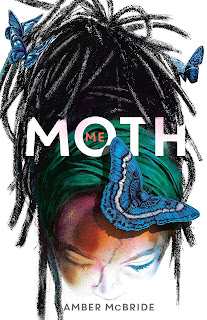
Black teenager Moth lost her entire nuclear family in a bad accident. Who is she now, without her family to define her? Where she previously found solace in dance, to do so now feels too joyful and greedy. Moth is struggling with her identity and grief, feeling alone and uprooted. One day she meets a Navajo boy named Sani, from a differently-fractured family but also struggling with depression and uprootedness.
Sani and Moth set out on a road trip out West, technically to his father's home on the reservation, but in reality a zigzagging tour to find themselves and save the other. McBride's verse is gold that shines so brightly you need to sit with eyes shut and reflect on it. She sucks you in and grabs your guts and twists the story into something that both breaks your heart and fixes you. For grades 8 and up, this book is and should be for everyone. I don't do ratings, but this one gets every star in the universe.
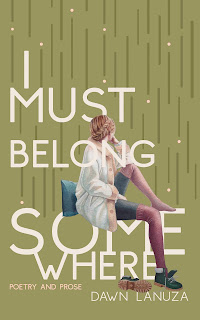
Dawn Lanuza
Every once in a while she is convinced that she doesn't belong here anymore.
Yet she doesn't know where she should be just yet.
She finds herself where she is because she doesn't know where else to be.
These first lines in the second piece very much hit home (or someplace home is waiting) for me. A lovely yet inquiring collection that deals with themes of longing, loneliness, home, exploration, suicide (and living with someone who is suicidal - "I've never read your suicide letters. I've lived with them instead."), surviving v. living, and various other branches that spring from these thoughts. From a few lines to a page, each packs a personal, thoughtful wallop.
Beautifully done, I highly recommend this collection for anyone who wonders or searches for SOMETHING - love, connection, meaning. The end of the piece quoted above is where I felt the poems connected, even though it's the second in order:
Sometimes, when she's in a new place, wandering and learning its streets, she just hears herself sighing, I must belong somewhere.
She hasn't found it yet,
but she hasn't given up on the idea of it.
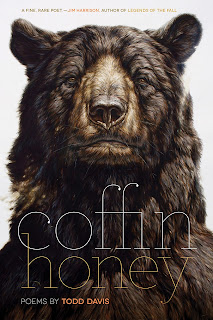
This cover is a work of art and I could not turn away. I also assumed (which is much of the cover gut operation) this collection would be steeped in nature, which it was. It was also a collection that, while quite patently excellent, was over my head a bit. Even when I don't "get" poetry, there are always lines/passages that resonate, oftentimes quite deeply. This bit, for example, about virus-ridden deer victims of the automobile:
The pastor of grief and dreams waves them into the road, a suicidal gospel written on warm macadam.
Davis's nature is not all about beauty, and he writes the brutal side, human and animal, with prose that is lovely but doesn't mask the horror. A hunt, pedophilia, lynching, death, racism, immigration, man's destruction of the natural world--all laid bare without apology for the monsters we can be.
[W]ithout any shame, we construct machines that make a mountain disappear, no regard for the memory or souls of trees.
* * *
White men stole black bodies to chain below deck, the only light seeping in where chinking failed. Unlike them, Ursus learned to share the one soul the world gives freely.
If only men could see the beauty without museums, the dismemberment, the displays of paws, claws and eyes outside of sockets, bodies stuffed and set on wired legs, caricatures of the real thing.
Friday, December 24, 2021
END OF YEAR THRILLS
As we close out 2021 and head into another abyss, for some reason it's beginning to feel as though I'm getting my reading legs back. To that end, I immediately jumped into my backlist to hit a book from Ryan Gattis I have been really excited about, and a couple of raves from the book tribe, one of which panned out greatly, the other simply panned.
Gattis's All Involved was so fantastic I was anxiously awaiting his next work. Which, sadly, had been languishing while I get my brain back, but wow was the wait worth it. Written in the same real-time format as All Involved, The System unsurprisingly delves into our justice and penal systems. When a gang hit goes down, an addict witness, the dropped weapon, a predatory parole officer and the young man who lives with the beautiful woman the officer covets all combine to allow Gattis to display the power (and misuse thereof) and grind of the system. Gattis utilizes his characters to pointedly show what happens when a power vacuum occurs on the outside while the guilty and innocent sit inside, and the system the incarcerated are forced to quickly learn in order to survive and/or thrive. Tense and fast-paced, Gattis has another winner that educates without preaching.


.jpg)