Showing posts with label fiction. Show all posts

Wednesday, June 22, 2022

THE CHANGE :: Kristen Miller

Kristen Miller's The Change is not a book that would normally be on my radar, but I joined an Instagram buddy read group and this was their selection. I could have skipped it, but it sounded like it could be a bit of fun. I was so wrong - this book was SO MUCH FUCKING FUN! I understand some readers felt it was heavy-handed on the feminist front, but first, why the hell not? We certainly have plenty of heavy-handed books with women as the forever victim. Second, the heavy-handedness is, from my perspective, done intentionally and very well by Miller.


At its base level, The Change is about three women "of a certain age" taking their power back. They discover each other at the right time in their lives where they are ready to take control and take charge. While the plot is serious (young girls have been murdered), large parts of the goings-on are underpinned by fantasy and social commentary. 


Harriett is a former advertising exec who is responsible for her husband's success while he gets the credit. She left the corporate world and is now divorced, tending to her outlandish garden (that breaks every HOA rule to hilarious end) and "helping" people with her plant-based potions. No surprise she's known as a witch. She is the embodiment of a strong woman who does what she wants, takes no prisoners and suffers no fools ("That’s why I choose vengeance. She’s the only mistress I serve.").


Jo used to work in the hospitality industry, but now runs an all-women's gym where she can rage-run to her heart's content. When she gets angry, her power manifests in extreme strength and heaven help those who piss her off. 


Nessa is a former nurse who inherited the family legacy of being able to hear and see the dead. Her gift is what sets off the action, as the women discover a dead body surrounded by more dead young women and are bound and determined to figure out what's going on in their neighborhood. 


The book was not without its flaws, and at one point I thought it was over, but it still had quite a few pages left. Some of the characters' intentions and true colors were telegraphed, but honestly, it just didn't matter. These issues didn't detract enough to keep me from finding this a fantastically enjoyable trip. 


I'm a sucker for good character work and Miller's is stellar. Each of the women is multi-faceted and fascinating in her own right, with backgrounds and issues that kept the narrative fluid and on point rather than dragging it down. I wanted to know more about these women, especially Harriett, who is someone I would want to hang out with any day. 


I'm so glad I was convinced to read The Change and will definitely seek out more work by Miller. It was by turns moving, hilarious, serious, outlandish, educational, motivational, and fun. A definite E-ticket ride. 
  

Tuesday, July 6, 2021

TWO-CENT TUESDAY

Below are a few somewhat brief $.02 opinions about books I've read or listened to recently but don't have the time, inclination, or opportunity to review in full. Their appearance often here has little to do with merit. Many of these titles I enjoyed as much or more than those that got the full court press. I hope you'll consider one or two for your own TBR stack if they strike your fancy whether they struck mine or not.

Although I generally try to slip some books in here that I wasn't too thrilled with, that isn't the case this week. Whether I read a physical copy or listened to an audiobook, each of these titles was a winner. Some were known authors I knew were unlikely to let me down, a couple were shots in the dark based on my gut that paid off tremendously. 

We Had a Little Real Estate Problem: The Unheralded Story of Native Americans & Comedy, by Kliph Nesteroff

I thought this would be an important, yet maddening, read. It was all that plus very well done and some great blasts from my past. It had me down a rabbit hole of old late night talk show clips (going back to Johnny Carson) to find old comedy bits. Look up Charlie Hill if you get the chance. He was the first Native American comedian to appear on The Tonight Show and also ended up writing for television. It is one of Hill's bits that inspired the title of the book: "My people are from Wisconsin. We used to be from New York. We had a little real estate problem.” 

Nesteroff has been called "The Human Encyclopedia of Comedy" and "The King of Comedy Lore," and after a bit of a slow-moving start, the material kicks up several notches when it hits "modern day" comedy (i.e., when my old ass was alive). A highlight of the impact Native Americans have made on the comedy world despite their historical denial of representation, this is a great (and sorrowful) read well-worth the time and education. 

 
What's Done in Darkness, by Laura McHugh

Since I fell in love with her debut, The Weight of Blood, McHugh has become a must-read author. Her latest continues her hot streak. In this one, 17-year-old Sarabeth's abduction is less than believable since she had been rebelling against her strictly religious parents when she was allegedly taken and then released a week later. Despite her torment, the abduction does give her the chance to finally escape the Ozarks.

Five years later, FBI Agent Nick Farrow calls, asking for Sarabeth's help. Another girl has gone missing under circumstances Farrow thinks may be related to Sarabeth's abduction and her memories may help the case. 

Reluctantly, Sarabeth agrees to help, and delving into her own kidnapping releases memories and a past full of evil just waiting to be uncovered. McHugh is a wonderful writer who tells a great story. When those two elements come together, an intriguing read results, even if one might not be into some of the plot arcs (i.e., religion). It really doesn't matter, I'll read anything McHugh writes. If you've not read her work, I highly recommend it.

Local Woman Missing, by Mary Kubica

Mary Kubica is another author who blew me away with her debut, The Good Girl. I've read everything she's written since and have only been slightly underwhelmed once. She remains an auto-read and when I hit her latest on audio my mind didn't wander at all (which it almost always does when I'm listening to a book while multi-tasking). 

Meredith, a doula, and her six-year-old daughter go missing. Meredith's car is found at a local motel, where it appears she committed suicide. Her daughter is nowhere to be found. The anxiousness in the neighborhood is amped up due to the recent disappearance of another local woman who turns out to have been one of Meredith's clients. 

Told in the usual rotating timeline, alternating POV that Kubica does so well, this one is well worth a listen despite some far-fetched plot points.


The Mighty Oak, by Jeff W. Bens

I was won over by a cool cover and a short plot summary and found a true gem inside. Tim "Oak" O'Connor is a goon for the El Paso Storm of the West Texas Hockey League. As a hockey hitman, he's paid to be violent and his body is basically jelly held together by a skin suit. He's also been away from home for a long time; long enough to lose his wife to his best friend and miss out on his daughter's life.

When he returns to Boston for his mother's death, he begins to confront all he's given up for a sport he still can't imagine giving up, even as he crunches oxy to keep upright. He also makes new connections with a haunted attorney and a young boy facing issues of his own. Bens writes wonderfully and The Mighty Oak had me entranced from the start. 


Wednesday, June 30, 2021

JUNE GEMS

These titles are two of my favorite of the year and each will sit with me long after this year is over. One is crime fiction at its finest, filled with social themes that don't beat you over the head but work with the non-stop plot to sink into your bones. The other is flat out one of the finest memoirs I've ever read.  


Razorblade Tears, by S.A. Cosby

A kickass plot filled with potential pitfalls, extraordinarily well carried out to avoid all of them. That's really all you need to know about Shawn Cosby's latest. I've read Cosby's other work (My Darkest Prayer and Blacktop Wasteland) and enjoyed both. Even more enjoyable is seeing a really good writer hone his craft before your eyes. Each outing is stronger than the last and I can't wait to see what follows Razorblade Tears, because it knocked my socks off. 


Two fathers avenge the deaths of their sons. That's a good enough story. But add to that the fact that the sons were a mixed race couple with a daughter. Both had difficult relationships with their fathers who, surprise!, had some issues with their sexuality. One Black, one white, Ike and Buddy Lee have only checkered pasts, their sons, and a need for justice in common. When the police investigation goes cold, justice turns to personal revenge. 


This story will translate beautifully to film. On the surface a fun, high-octane buddy story with two characters that feed off each other wonderfully. At its heart a well-painted picture of grief, regret, and social failings that lie so directly in the center of our society that they can separate families. If I had to find a quibble with this book, it's just a personal one -- my own weariness of the "family in peril" plotline. Yet Cosby also handles that well enough that I had to put my prejudice away.  


Punch Me Up to the Gods, by Brian Broome


I did not know who Brian Broome was when this gorgeous little face and intriguing title captivated me. I will now never forget him, as this is certainly one of the finest memoirs to ever torture me. It's the story, like so many others, of the perils of being a young, poor, Black boy, queer to boot, and his efforts to find a place in the world. The search for a path made all the more treacherous by his father, who was an angry, violent man who would rather kill his son himself than have him killed by a white person.


While one can hate the methods, Broome does a stellar job of explaining the undercurrents of raising Black boys. This is where the memoir skyrockets from uber-talented writing to genius -- the format through which Broome tells his story along with that of our societal failings. He begins with one bus ride he shares with a toddler named Tuan and his father. One of the first things Broome observes is Tuan falling headfirst onto the concrete while waiting for the bus. Out of fright and/or pain, Tuan begins to wail. At which point his father tells him to stop crying and be a man. Thus begins the chapters titled The Initiation of Tuan. 


Through these chapters, Broome observes ongoing interactions between Tuan and his father. Each chapter then feeds into Broome's own story and the way he learned those same lessons of hyper-masculinity. Through these alternating chapters, Broome tells his story and the story of young Tuan, both of which will empty your guts out like a rusted melon-baller. At turns hilarious and raw, Broome's ability and willingness to convey his innermost emotions are extraordinary. 


Tuesday, June 15, 2021

DARK DONE MASTERFULLY

I am a lover of the dark. In fiction, movies, whatever media you want to throw my way. Why is a question for my psychiatrist, but I hope you'll read on and reap the benefits of my hollow core. The following titles are two of the best I've read, particularly when they deal with such disturbing subject matter.


I also can't take credit for discovering either of these books, as each were rocketed to the top of my reading list based on recommendations from trusted reviewers. They both nailed it and now I pass along their brilliance to you.


A CERTAIN HUNGER, by Chelsea G. Summers


My cover gut is a well-honed machine, but every once in a blue moon it steers me into a ditch. This is one of those times. When I saw this cover I immediately moved on, as the image harkened artsy historical fiction, which is generally not my bag. Then Katrina Niidas Holm (master reviewer and interviewer for PW, Mystery Scene, Crimespree and others -- see her outstanding, in-depth review here) raved and said I would love it, so I set my reservations aside. We often like very different things, but she also talked me into my greatest recent love, the joy that is Ted Lasso (I can do joy once a year), so her cred was sky high. 

What to say about this book? It's the superbly written, first-person account of James Beard Award-winning food critic Dorothy Daniels, who somewhat accidentally becomes a cannibal. Sorry, had to write that line because it sounds so funny. And don't get me wrong, A Certain Hunger IS funny. Sometimes slyly so, often side-splittingly so. But Dorothy is no humorist, she is simply self-assured AF. Although we find out early on that Dorothy is writing from prison, it's a long, windy road there and the story of her path and how she eventually slips is better than a four-star meal. 


THE FIRST DAY OF SPRING, by Nancy Tucker


When an 8-year-old narrator begins a book by saying "I killed a little boy today," your guts swirl in a way few things can twist them. We're used to adults committing heinous acts, but a little girl? How the hell is Nancy Tucker going to (1) make Chrissie empathetic and/or (2) write anything approaching a good book about a child killer? 

A narrow set of questions, yes, but it's not every day someone tries to make this scenario a read of interest, much less one of insight and understanding. Tucker is tremendously successful. Narrated by both Chrissie (the child) and Julia (post-Chrissie adult), The First Day of Spring is astounding in its ability to put the reader in the mind of a tormented child and understand why she acts and reacts the way she does. (The tragedy behind Chrissie's view of death alone is a stellar piece of multiple character development in one fell swoop.)

All Chrissie wants is attention, to feel some warmth, though by the time we meet her she's almost past the point of accepting any positivity. She knows she's a "bad seed." She can feel it in everyone she meets, reinforced by her mother, who I would like to dropkick to the ends of the earth. She thinks of herself as both "an outline with nothing inside and also full of broken glass -- "I thought perhaps that was why if Mam ever had to touch me, she looked like she was being sliced by something sharp. Because she saw what Da and Linda didn’t see: that I was broken-glass girl. I hurt other people just by being me."

I would have skipped this book because despite the black background on the cover, flowers and spring give me feelings that are the opposite of what this book is. But Catherine of The Gilmore Guide to Books  gave it five stars and that made me sit up and take note. I didn't have to read much of her fabulous review to know I should crack this one open. The subject matter is rough, but hugging this piece of broken glass is assuredly worthwhile. 


First Day of Spring

Saturday, April 24, 2021

THE FUTURE IS YOURS :: Dan Frey

A version of this review previously appeared in Shelf Awareness and is republished here with permission.


Dan Frey (The Retreat) does a bang-up job imagining a scenario in which computers can communicate with their future selves and the impact that could have on society on a variety of levels. Cleverly told entirely via documentation (e-mails, blog posts, texts, reports, etc.) to avoid spoilers,
The Future Is Yours
is an "opposites attract" tale of friendship set in the thought-provoking and cutthroat world of technology.


Ben Boyce, a confident connection-maker with a gift for wooing venture capitalists, and Adhvan "Adhi" Chaudry, an intellectual genius with woeful people skills, become best friends while rooming together at Stanford University. The story begins with an e-mail sent by Ben to Adhi from a year in the future--immediately proving Stanford whiffed by not backing Adhi's Ph.D. thesis proposing communication with the future using quantum computing.


The engrossing road from college to rolling out their product, a computer-type unit called The Future, is centered around the transcript of a 2021 congressional hearing where the legality of The Future is to be decided. Despite a subpoena, Adhi is mysteriously absent from the hearing. Frey ups the suspense by putting limitations on The Future: it can see only into a one-year future window, to a reality that cannot be altered.


Unsurprisingly, data from The Future becomes problematic. As Adhi struggles with morality issues, Ben drives passionately ahead, their friendship, relationships and the future of the world at risk. Frey's work as a screenwriter shines through in form and substance in this gripping work of science fiction

Sunday, March 21, 2021

THE SALT FIELDS :: Stacy D. Flood

A version of this review previously appeared in Shelf Awareness and is republished here with permission.


In Stacy D. Flood's gorgeous novella, Minister Peters boards a train in South Carolina in 1947, laboring under the burdens of very personal loss and the generational damage to a Black man from the South. Minister was a single father after a killing took his wife (in "the age when the murder of a black woman didn't warrant the pen, ink, or gasoline that it would take to investigate"). Now, after losing his daughter also, Minister departs for the promise of the North and an escape from his ghosts.


The Salt Fields puts Minister at a crossroad, with little left to breathe life into him and nothing to lose. He's seated on a train with three strangers, and the dynamic flows from there. Flood packs generations into a novella not much more than 100 pages long, with language cradling the horrific thorns of the past. If prose about lynchings and whippings could ever hold beauty, Flood accomplishes it. Words are never wasted in this compact work, and Flood is proficient at painting the piece with few strokes. Sometimes this occurs on a small scale, with a line or two (e.g., the action in a club is "a long kiss between everyone in the room."), but he's equally adept regarding societal issues such as racism and sexism. In a short yet significant description, the whites-only entrance to the train station is freshly painted with Romanesque pillars, the Black entrance chipped paint over old pine. Yet both lead to a common platform where everyone awaits the same train to somewhere else.

Friday, March 12, 2021

OSLO, MAINE :: Marcia Butler

A version of this review previously appeared in Shelf Awareness and is republished here with permission.


The intense and vivid ensnaring of a pregnant moose sets in motion a chain of events that highlights Marcia Butler's shining character work in Oslo, Maine. Relationships are at the forefront in a town where news travels swiftly and secrets are hard kept. Husbands and wives, parents and children, neighbors and friends intertwine with the doomed moose, one of the novel's briefest but most poignant narrators.


Twelve-year-old Pierre Roy suffers severe memory loss following an encounter with the trapped moose. His injury puts additional stress on his parents, Claude and Celine, who now "fling synonyms at each other" over what kind of boy Pierre is. Man's man Claude, already eaten alive by Pierre's disturbing love of books ("They'd abducted his son with stealth and breathtaking speed from the day he'd started kindergarten"), becomes more despondent when Pierre finds solace in violin lessons and the crevasse between Claude and Celine widens.  


Neighbors Sandra and Jim, professional musicians, have issues and secrets of their own. Sandra is not only teaching Pierre but doing much of the housework while at Pierre's since Celine is adrift in a haze of drugs. The more Sandra helps, the closer things come to spinning out of everyone's control. Butler (Pickle's Progress) writes beautifully and with depth, each character mined for internal gems. Story is secondary, and while some plot arcs are dropped and the rest are tied up a bit too abruptly in an epilogue, the personalities that occupy Oslo, Maine are sufficiently intriguing to buoy this peculiarly engrossing tale. 

Friday, September 25, 2020

MARLENE :: Philippe Djian

A version of this review previously appeared in Shelf Awareness and is republished here with permission.

Philippe Djian's Marlene begins ambiguously with a man named Dan breaking down a door behind which Mona has locked herself. The initial section, entitled "Girl," is but a few short paragraphs long, beginning a crisp yet dreamlike trip through five lives torn apart by war, secrets and betrayal. It is eventually revealed that Mona is the angst-ridden 18-year-old daughter of Richard and Nath, and is staying with Dan due to trouble at home. Dan and Richard are bonded combat veterans, serving and saving each other's lives in Iraq, Afghanistan and Yemen, each struggling to return to "normal" life.

The difficulties faced by veterans is a theme grimly underlying the whole of Marlene. Dan lives with an "indispensable vigilance" and dedication to structure that keep him contained but still can't tamp his night terrors. Richard exists at the other end of the spectrum--drinking, driving and spending to excess, seeking thrills in schemes fraught with danger. Mona returns home from Dan's just as Richard is released from a stint in jail. Then Nath's estranged sister, Marlene, comes to town looking for a fresh start, lighting the fuse on a powder keg yearning for ignition.

Djian (Oh…, winner of the Prix Interallié) writes in a lean style that is both smooth and abrupt, almost as if the translation is off, even as it understands how every word and short section is intentional and effective. A slim volume, Marlene begs to be read in one tense sitting.

Friday, August 21, 2020

THE BRIGHT SIDE SANCTUARY FOR ANIMALS :: Becky Mandelbaum

A version of this review previously appeared in Shelf Awareness and is republished here with permission.

Becky Mandelbaum's debut novel, The Bright Side Sanctuary for Animals, is a fabulous entry to long form after her stunning and multi-prize-winning story collection, Bad Kansas. Mona Siskin kicks off a long-coming reckoning when she steals the Fuller brothers' pro-Trump sign. Soon after, Mona's estranged daughter, Ariel, reads a headline that knocks her cold--"Fire at Animal Sanctuary Ruled Arson." Antisemitic messages were also left on buildings and on Lady Madonna the pig. The suspect, Sydney Fuller, was Ariel's only friend growing up, the lone ally she unintentionally betrayed.

Worse is the news Mona has to sell the Bright Side, the sanctuary where Ariel was raised and that cost her family so much. Her father left one day without a word. Her mother, so busy caring for the animals, made Ariel feel more like hired help than a daughter. Six years earlier, Ariel also silently snuck away, to attend college against her mother's wishes. She left her home, the animals and her first love, Mona's ranch hand Gideon.

Insightful and cuttingly funny, Mandelbaum has a grand knack for character depth and point of view. The author handles rudderless Ariel's return to a marvelously complex mother masterfully; she doles out each woman's unspoken emotional history and trauma with precision and affection. Trailed by her hapless fiancé, Dex, Ariel also has to face Gideon and his girlfriend, Joy, both steady ships in the storm. The Bright Side is a thorny family drama filled with edgy humor and snappy prose, with love and dogs at its heart.

STREET SENSE: I fell in love with Mandelbaum's writing when I covered Bad Kansas for Shelf. Who could pass up a title like that? It was a very pleasant surprise and I couldn't wait to see what Mandelbaum did in the long form. I'm signing up for whatever she writes in the future.

COVER NERD SAYS: This beautiful cover amps up my desire to run away to a simpler place, even though what Ariel gets when she gets home is far from simple. But how could you not want to step into this cover image?

Monday, July 27, 2020

THE LIVES OF EDIE PRITCHARD :: Larry Watson

I was sucked into Larry Watson's writing almost twenty years ago when I picked up Montana 1948. I've got multiple copies of that book taking space on the shelf and I'll never get rid of them. He immediately became one of those authors I just buy and read whatever he puts out, regardless of cover (thought they're always great), synopsis (though they always sound great), publicity (I've never read a bad word), anything. I just jump. So I was thrilled to see that a new book was coming on July 21. The Lives of Edie Pritchard begins thusly:

Sunlight glints off the slope of the hood like a snowdrift, and Roy Linderman puts on his sunglasses. Like a man born to drive, he lets one arm hang out the window of his Chevy Impala while the other rests on top of the steering wheel to keep the big car in line.


When you've read some Larry Watson, those lines feel like pulling into the gravel driveway of home after some time away. The Lives of Edie Pritchard is described by the wonderful Algonquin Press as "a multigenerational story of the West told through the history of one woman trying to navigate life on her own terms," and synopsized as follows:

Edie—smart, self‑assured, beautiful—always worked hard. She worked as a teller at a bank, she worked to save her first marriage, and later, she worked to raise her daughter even as her second marriage came apart. Really, Edie just wanted a good life, but everywhere she turned, her looks defined her. Two brothers fought over her. Her second husband became unreasonably possessive and jealous. Her daughter resented her. And now, as a grandmother, Edie finds herself harassed by a younger man. It’s been a lifetime of proving that she is allowed to exist in her own sphere. The Lives of Edie Pritchard tells the story of one woman just trying to be herself, even as multiple men attempt to categorize and own her.

Triumphant, engaging, and perceptive, Watson’s novel examines a woman both aware of her physical power and constrained by it, and how perceptions of someone in a small town can shape her life through the decades.

Praise has been high and wide, including starred reviews from Kirkus:

Watson is insightful in his depiction of Edie and those who seek to control her, and his descriptions of small-town Montana life, where guns are frequently a menacing presence, reflect how the potential for violence is ever present beneath the surface of things. The novel crackles with tension, especially the second and third acts; Watson is a born storyteller, and it shows on every understated page. But Edie's story also rings with a hardscrabble poetry . . . A riveting and tense examination of identity, violence, and female anger.
and Booklist:
Watson remains incapable of creating characters who aren't fully formed individuals, as courageous as they are vulnerable, and here he again displays his rare ability to craft strong women and to describe their everyday lives with rare power.
Always noted for his novelization of the regions of Montana, his cracking dialogue and unparalleled character work, Larry Watson is a treasure to behold. The Lives of Edie Pritchard is the latest in a line of stellar novels from one of our greatest artists.


Tuesday, July 21, 2020

SURVIVAL INSTINCTS :: Jen Waite

A version of this review previously appeared in Shelf Awareness and is republished here with permission.


"There are some stories that don't need to be told." Anne keeps secret the story of her daughter's father in order to protect Thea. But Thea is now 12 and the Internet is a powerful tool. For reasons unknown to Anne, Thea has recently changed into a volatile preteen, her relationship with Anne strained by deceit. Since Thea is tight with Anne's mother, Rose, Anne schedules a girls' getaway to a remote cabin, hoping to reconnect. There, the past fractures the present, threatening the lives of all three women.

Jen Waite is infinitely qualified to write about psychopaths, having shared the story of her former marriage in a courageous memoir, A Beautiful, Terrible Thing. Waite now folds her experience into a novel, Survival Instincts, focusing on the lengths to which mothers will go to protect their children. Starting "Four Days Before the Cabin," Waite alternates timelines and points of view as Anne, Rose and Thea head to the cabin. Meanwhile, an unidentified man spins a tale of violence as he goes on the hunt.

Waite deftly dips into the past to fill out the framework of her characters and ultimately connect the women to "The Man." Satisfying turns and surprises highlight the narrative, which, despite some extraneous exposition, remains tense and quickly paced. Waite keeps readers invested in each woman, despite their human faults and wrong turns, and everyone will wish they had a grandmother like Rose. Waite's fiction debut is an intense story of women doing what it takes to survive.

STREET SENSE: If you don't remember how much I loved Jen's memoir, check out my prior review and the Maximum Shelf issue we got to run about it, including an interview with Jen. She has become one of my favorite people and I was psyched to see she was making the leap from non-fiction to fiction. It was a great leap. Jen weaves knowledge she has from her own life into a tense story with characters you come to care about. And, seriously, Rose kicks ASS. It's what I would call a "page-turner" if I didn't hate the term "page-turner." Give it a look-see, it pubbed on 7/14.

COVER NERD SAYS:  This is one of those times I knew I wanted to read the book before I had even seen the cover, so I was predisposed. That being said, I am fairly certain this would have caught my eye if it had been written by Jane Doe. Love the whiteout and the font that doesn't overpower it. I'm generally tired of covers with people or half-people walking or running, but this one is different and works really well. There's an air of menace about it that I really dig. This is a really good-looking cover.

Saturday, May 30, 2020

SHEPHERD :: Catherine Jinks

A version of this review previously appeared in Shelf Awareness and is republished here with permission.

Catherine Jinks's Shepherd takes place over several days in 1840 New South Wales, and the gritty cat-and-mouse thriller evokes emotions that linger. Tom Clay was 12 years old when he was nabbed for poaching and shipped to Australia to serve his sentence working for Mr. Barrett. Tom is reliable despite his age, and Barrett sends him to a remote shepherds' hut to help guard the flock.

A boy among rough and violent men, Tom has been failed by most everyone in his life. Trained to silence by his father, Tom keeps his own counsel, sharing himself only with his beloved dogs and fiercely tending the sheep he has named. Menace lurks in the form of Dan Carver, a former shepherd and "black-hearted villain" whose motto is "No witnesses." When Carver returns for vengeance, Tom goes on the run with Rowdy Cavanagh, a handsome no-hoper with the gift of gab that Tom wants nothing to do with.

Tom comes from the best poachers in Suffolk County, and his and Rowdy's lives now depend on his wit and skill. To beat Carver, he'll also need to share his burdens and trust others. Multiple award-winner Jinks (Evil Genius) steps out of her middle-grade norm and crafts a breathtaking pursuit novel full of brutality and tenderness. Painting the reality of the frontier colony, where "the blacks" were feared but the true treachery lay elsewhere, Jinks highlights a world of unfair punishment, where one must endure it, but the weight is lighter with a friend to share it.

STREET SENSE: In the fashion of True Grit, a boy and his unwanted companion navigate harsh territory to outwit a vicious man trying to kill them.I loved this book. It was a great "in peril on the run" story with tons of grit and heart. Picked it because of the Aussie author, will definitely go back for more of Jinks's work.

COVER NERD SAYS:  This rustic look with a highlighted pitchfork (which I can never view as a tool of innocent farming work) was a no-brainer for me. Still not a fan of cover blurbs, but at least this one, while lengthy, is tucked away somewhat unobtrusively. The layout is pleasing and the various font sizing and placement is also great on the eyes. But if I'm honest it had me at pitchfork.


Friday, April 10, 2020

BLACKWOOD :: Michael Farris Smith

A version of this review previously appeared in Shelf Awareness and is republished here with permission.

Michael Farris Smith creates an atmosphere of hypnotic claustrophobia in the masterfully haunting Blackwood. Set up by a traumatic 1956 event, the novel immediately jumps ahead 19 years to a broken-down Cadillac in Mississippi hill country. In 1975, Red Bluff is overrun by empty storefronts and land "long since conquered by the timeless vines" that creepily engulf everything in their path, running up to the very edge of the blacktop.

The vehicle's occupants--man, woman and boy--are confronted by Sheriff Myer after a run-in at the drugstore. The Caddy is gone the next morning, but the trio slinks through the kudzu and roams the town like revenants, pushed to the brink by circumstances, escalating resentments and emotional burdens. Meanwhile, industrial sculptor Colburn Evans is brought to town by an advertisement for free artist workspace, but mostly the call of his tragic past. He's drawn to bar owner Celia, unaware of both the married man who covets her and the 1956 link between her mother and Colburn's father.

Smith (River; Desperation Road; The Fighter) perpetually sets his characters on insecure terrain, and Blackwood may present the most treacherous and suffocating yet. Madness descends, jealousies flare and old regrets surface, leaving no one untouched. The ghostly presence of the dementedly patient kudzu and an old slave-built tunnel system create a gothic horror bent, amplified superbly by Smith's prose. The writing is stunning and steady, but short chapters create an almost frantic apprehension as Colburn's noble search for himself is marred by wickedness, past and present.

STREET SENSE:  You know that feeling when a favorite author comes out with a new book and you're both excited and trepidatious because how could they ever equal or top their prior works? I don't even have that feeling about Michael Faris Smith's books anymore. Each one is an amazing work that amazes me all over again. This one is creepy, lovely, tense, and gorgeously dark. I'm not sure I can pick a favorite, but this one is up there.

COVER NERD SAYS: It doesn't get much better than this. The kudzu leaves forming a skull is simply spot on. I love this cover so much I actually tried to draw it, and I have no doubt this will be in my top covers for the year.

Wednesday, April 1, 2020

CITY OF MARGINS :: William Boyle

A version of this review previously appeared in Shelf Awareness and is republished here with permission.

William Boyle's City of Margins is a marvelously nuanced study of light and dark, infusing the gritty, melancholy detachment of The Lonely Witness with a dash of the "screwball noir" abounding in A Friend Is a Gift You Give Yourself. The early 1990s Southern Brooklyn denizens in City of Margins muddle through thinly partitioned lives, toting their loss, hope, desperation and yearning. When chance encounters increase their overlap, perilous links form between people who might otherwise have rubbed against each other without consequence.

Donnie Parascandolo is the epicenter, an emotionally wrecked cop who lost his son and then his wife, Donna. Donnie is connected to Mikey Baldini by a 1991 night of violence that resulted in the death of Mikey's father and left widowed Rosemarie Baldini with a crushing gambling marker held by Big Tommy Ficalora. Two years later, Donnie has been thrown off the force. His surprising new emotional attachment to widow Ava Bifulco is jeopardized when Ava's son recognizes Donnie. Nick dreams of writing the next great mobster screenplay and sees Donnie, rumored muscle for Big Tommy, as his meal ticket. The web of connections thickens when Mikey finds a note leading him to Donna and his ultimate discovery of the explosive truth behind his father's death.

Boyle's love of books and movies that blend crime and comedy wonderfully informs both his style and the bonds among his characters. The arts bridge generations, start conversations and, in Boyle's masterful hands, provide softening, wide-angle lenses to the broken and tortured souls of the margins.

Saturday, February 22, 2020

MOLLY BIT :: Dan Bevacqua

A version of this review previously appeared in Shelf Awareness and is republished here with permission.

Dan Bevacqua's Molly Bit is the stunning portrait of a young artist who has "it," the price she pays to triumph and the personal sacrifices of her success. Everyone at her college wants to be famous, including Molly Bit. At 19, she sees signs from the universe that she's one of the chosen and makes a promise to herself to "chop off the old, dead parts and come out new, to burn them off, if need be, like she was a house fire."

Told through third-person narrative installments that leapfrog through her timeline (college in 1993; dues, 1997; success, 2001; etc.), Molly is well-drawn but also inaccessible--readers know her, yet she could be almost any aspiring celebrity on the rise. Molly's stardom breeds the need for bodyguards. Bevacqua is her literary bodyguard, using the arm's length he's constructed to masterful effect as Molly's life widens and contracts simultaneously. As tragedy befalls her ("You can't escape the confines of a traditional narrative story arc in a life like Molly Bit's"), the point of view shifts to one of Molly's oldest friends and the mystery of her demise.

Bevacqua's debut novel is compelling on multiple fronts. A pseudo-character study, it is a deeper examination of moviemaking, fame, violence and power, balanced by Bevacqua's wit. With descriptors that often reflect the celebrity absurd ("Finals exhaustion had lifted like a face peel." "A golden retriever bounded through the snow as if auditioning for a catalogue."), Molly Bit captivates as it lays bare the often-high costs of entertaining.

STREET SENSE: This is a quirky one - a character study, relationship piece and a look at Hollywood with a mystery wrapped in. I liked how Bevacqua told the story in pieces. I'll definitely check out his next offering.

COVER NERD SAYS: If you can pass up a clever take on the Hollywood sign at sunset, you're a stronger reader than I.

Thursday, January 2, 2020

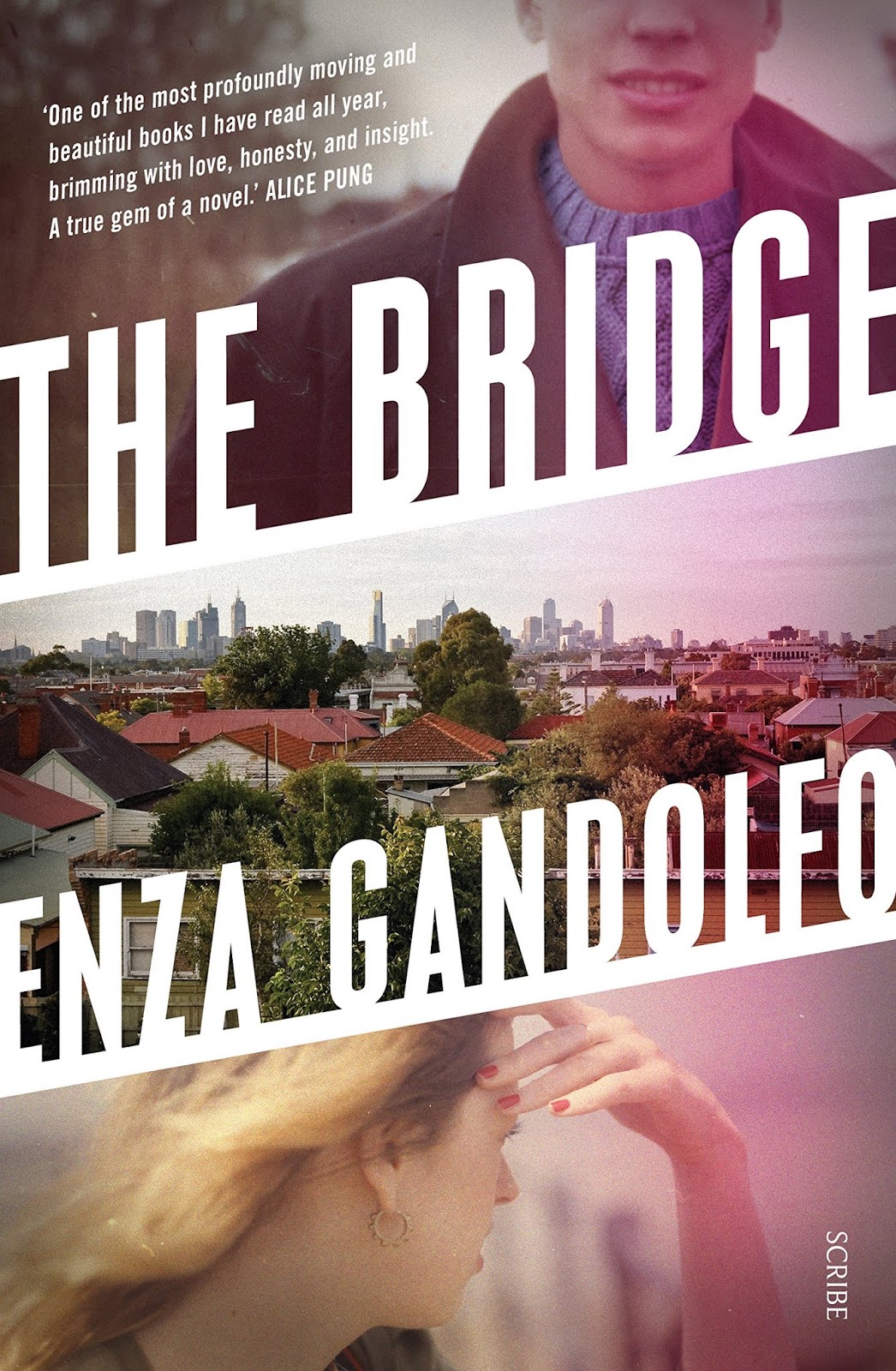
THE BRIDGE :: Enza Gandolfo

A version of this review previously appeared in Shelf Awareness and is republished here with permission.

On October 15, 1970, a span of the West Gate Bridge in Melbourne collapsed during construction, killing 35 workers and sucking countless souls into the aftermath. Out of one of Australia's worst industrial accidents, Enza Gandolfo crafts a novel that imagines the long-term fallout as the 40th anniversary of the catastrophe approaches.

Newlywed Antonello was one of the survivors, an Italian immigrant trying to be "Australiani," working as a rigger high atop the structure. Nello lost friends and his father-figure foreman; he gained anger, depression and guilt--they had all known things weren't right with the bridge. In 2009, Nello is a grandfather with a lovely family. But he's just "partly human," unable to be the man he intended, emotionally blocked and haunted by persistent nightmares about falling: "There was no escaping the bridge."

Across town, single mother Mandy is struggling to get by with her 18-year-old daughter, Jo. Like Nello, Mandy sees signs of trouble but fails to speak out. The cost of staying silent is a tragedy that locks the two families together.

In The Bridge, Gandolfo tenderly explores the repercussions of trauma, providing a tribute to the men who built the bridge and their long-suffering families. Shortlisted for the 2019 Stella Prize, The Bridge is a gripping look at life through the prism of grief and blame.

STREET SENSE: I was unaware of the West Gate Bridge tragedy, to my shame. The Bridge helped me learn about an important event in Australian history through a lovely and painful story of relationships, grief and healing.

A FAVORITE PASSAGE:  As if orchestrated by a callous conductor, the morning came crashing into the room.

COVER NERD SAYS:  These three images make sense with respect to the story, but they make for a busy cover. A bit busy for me, and I honestly didn't pay them much attention until I looked at the cover for this section of the review. I'm glad the title and author are in large, crisp font. While the images are likely Nello and Jo in their respective early years, without knowing the story they don't do much to grab me like perhaps a graphic image of the bridge might have.


Monday, September 9, 2019

LAST ONES LEFT ALIVE :: Sarah Davis-Goff

A version of this review previously appeared in Shelf Awareness and is republished here with permission.

Sarah Davis-Goff's view of dystopian Ireland is vividly displayed through fierce adolescent protagonist Orpen. As Last Ones Left Alive begins, Orpen is boldly pushing toward potential salvation. She's alone save for her dog and her birth mother's partner, Maeve, bound and ambiguously lifeless in a wheelbarrow.

The narrative compellingly alternates between Orpen's perilous quest and what necessitated it. Portentous flashbacks paint solitary yet idyllic beginnings on an abandoned island with her mothers Mam and Maeve, where the state of the world was a mystery and death seemed far away. The existence of the zombie-like skrake, "real enough to kill you dead," is also tantalizingly revealed.

Orpen's childhood ends abruptly at seven when she's given a set of knives and a punishing training regimen under Maeve's tutelage. When disaster strikes, Orpen takes her warrior ways on the road, trying to find a mysterious city mentioned by her mothers. Warned not to trust others, Orpen fights a longing for people, one thing she has in common with skrake, and an encounter with other survivors hurls her plans along an even more dangerous path.

In her debut novel, Irish author Davis-Goff, co-founder of Tramp Press, writes Orpen's apocalyptic world in a compelling cadence and shines at the bleak details--a road is "barely a path, a rough line, like a finger drawn across dry dirt." Her fight scenes hit the sweet spot and help highlight the natural feminist bent of the work. Despite the grim surroundings, there is beauty in Orpen's world, where she was taught to survive, but also how to live.

STREET SENSE: A dystopian future filled with zombie-like creatures and a strong young girl trying to make her way to salvation. Some minor hiccups involving the folks she meets on the road, but overall this was a cool read.

COVER NERD SAYS: I like this cover quite a bit. I'm a sucker for a road to nowhere (I'm living that metaphor), but I really dig the red X. A simple addition to the art that adds more than two simple lines to the mystery. I can't take much issue with the cover blurb since the text was kept very small, but if you're going to use a blurb, is "A riveting novel" enough to use cover space? Ivey's full blurb is on the back and the rest of it is much more powerful.

Monday, July 8, 2019

THE VAN APFEL GIRLS ARE GONE :: Felicity McLean

A version of this review previously appeared in Shelf Awareness and is reprinted here with permission.

"They're kids, for heaven's sake. What have they got to be fearful of?" Perhaps more than anyone knew. In 1992, sisters Ruth, Hannah and Cordie Van Apfel disappeared during Tikka Malloy's skit in their school's Showstopper production. Twenty years later, Tikka returns to Australia to face her sister Laura's lymphoma diagnosis and her own decades-long haunting.

Tikka and Laura knew things they didn't tell in 1992. What Tikka knew, or thought she knew, has gnawed at and unsettled her ever since, with false Cordie sightings continuous as a tic. The detective told them to "sit tight"--he would find their friends. But Tikka can no longer sit tight, compelled to address the past and whether her family did enough to help their neighbors.

Australian journalist Felicity McLean's The Van Apfel Girls Are Gone is a well-layered puzzle with unexplained pieces to spare. At the core of this gripping debut novel are the uncertain perceptions of young Tikka and 2012 Tikka, still partially trapped in her 11-year-old self.

McLean's often striking prose swirls deftly between the two Tikkas as suspicions begin to emerge--about the Van Apfels and their violently pious patriarch, Cordie's broken arm, and the school's first male teacher. A slow burn that maintains an electric current of dread, the narrative is also cleverly colored by the underpinning of the infamous Chamberlain case. Although more than 30 years later it was confirmed that Lindy Chamberlain's baby was indeed snatched by a dingo, the Van Apfel girls may get no such closure.

STREET SENSE: Fans of ambiguous mysteries will dig this one. I love an author who has the guts to leave questions unanswered, or at least up for interpretation. There is some beautiful writing here, and I loved young Tikka's relationship with her father.

A FAVORITE PASSAGE:  I'm a sucker for writers who can pull off a long passage and a quick, down-and-dirty beaut. Some of my favorites by McLean contain spoilers, but here are a couple of safe bits:

Then Mr. Van Apfel appeared, stepping forward with his arms outstretched and his palms to the sky as if coming in from the Lord’s outfield.

They had six femurs, ninety-nine vertebrae, three skulls and thirty fingernails. Six kneecaps, forty-eight carpal bones, and more than three million strands of blonde hair, all tinged alien-green by the chlorine in their pool which, up until the day they went missing, we’d swum in almost every single day that summer. And yet all these things vanished—just evaporated in the heat. Not a single sign was left for us.

It was a ganglion, Macedon Close. A ganglion. (I got “ganglion” from our extension spelling list in week five of term two, back when we did “The Human Body.”) That’s what our cul-de-sac was: a lump that grows in some place it shouldn’t and nobody’s really sure why.

COVER NERD SAYS:  I was attracted to this cover the instant I saw it, despite never having been a big pink person. I'm not even sure when I sat and tried to figure out the image in the font, or how long it took me. The image is there if you look, but the girl has really disappeared into the font, just like the Van Apfel sisters. Clean and striking, this cover does a great job with a title that could be tricky, and thankfully didn't fall prey to the overused theme of girls/women seen from behind running into dark woods, which could easily have been done here. Kudos. 


Tuesday, June 25, 2019

MAN OF THE YEAR :: Caroline Louise Walker

A version of this review previously appeared in Shelf Awareness and is republished here with permission.

Crowned "Sag Harbor Citizen of the Year," Dr. Robert Hart is at a fancy soiree with his wife and son, Elizabeth and Jonah. The one thing sticking in his craw is the presence of Jonah's visiting college friend, Nick. Although Nick has been good for Jonah, Robert's gut is telling him something about the kid isn't quite right, and he bristles when Elizabeth wants Nick included in the family photograph on Robert's big day.

Robert's antennae tingle further when Elizabeth suggests her stepson's friend stay in their guest house for the summer. As Nick accepts fresh towels from gorgeous Elizabeth, Robert's mind is assaulted by the possibilities. He knows what Elizabeth is capable of--the two met and carried on an affair while married to others. Is this the thanks Robert gets for rescuing her from a dreary existence?

Caroline Louise Walker takes readers deep inside the mind of an increasingly obsessed man, mining the depths of power, insecurity, image and assumption. Robert slowly swirls from semi-reasonable to outright paranoid as his suspicions about Elizabeth, Nick and his own son drive him to distraction and dangerous exploits. Tragedy leaves the survivors swirling with doubt, secrets and mistrust.

Man of the Year is an impressive slow burn that builds suspense and cracks the whip at the end, widening the lens from a Robert-centric narration to include the "truth" from other points of view. A debut redolent with menace and ego, Walker has expertly taken on the complex family dynamic. --Lauren O'Brien of Malcolm Avenue Review

STREET SENSE: A doctor with an image to protect loses his perspective to dangerous ends when he feels his family is threatened by an outsider. Fans of domestic drama and characters spiraling out of control should get a blast out of this one. Robert's arc pushing the bounds of realism a bit was offset by the varying points of view at the end, which I thought was a great finish.

COVER NERD SAYS: Wood, booze, good lighting (though if I was to pick a total nit, I'm not sure where that blue tint comes from). I was in before I had a clue what this book was about. Added points for good fonts that are appropriately sized and don't distract, a blurb that is at least tidily tucked away unobtrusively at the top, and this is a total win.

Tuesday, June 18, 2019

AUG 9 - FOG :: Kathryn Scanlan

A version of this review previously appeared in Shelf Awareness and is republished here with permission.

Through an inventive format, Kathryn Scanlan shares a serendipitous treasure discovered long ago in a box of unsold estate auction items destined for the garbage. Worn and water-damaged, its physicality intrigued Scanlan, but she ultimately set it aside, assuming its contents were mostly indecipherable.

Years later, Scanlan rediscovered the diary--given to an Illinois woman for her 86th birthday--and spent a decade immersing herself in the distinctive language that chronicled the days between 1968 and 1972. Eventually, the diarist's particular and measured language ("Terrible windy   everything loose is traveling." "That puzzle a humdinger.") became intertwined with Scanlan's own voice, the diary "something like kin--a relation who is also me, myself."

Exasperated but unable to resist, Scanlan surrendered to the mixed influences and wrote Aug 9 - Fog. In fleeting, diary-esque entries sectioned by season, Scanlan writes in a new vernacular resulting from the commingling, an unusual "co-authoring" that holds multiple layers of mystery. Where the diarist's nonfiction and Scanlan's fiction meet or marry is unknown--somewhat frustratingly unknowable in the most intriguing of ways.

The "story" is by turns clear and vague. Day-in-the-life details (weather changes, church-going, pie-making, visiting) and profound life and death events paint a full spectrum over the course of time. Guesses can be made as to the identities of recurring characters "Vern" and "D.," but the varying forms and linguistic style is both provoking and devilishly satisfying. Aug 9 - Fog is a one-sitting read that echoes long after the final "Winter" has passed.

STREET SENSE: This very fast read is really quite fascinating--a true-life artifact and the author's imagination melding together to depict the life of an elderly woman from a small Midwest town. If you've lived in the Midwest or a small town, many of the snippets will resonate. It's half maddening (what is true v. what is fiction?) and yet since it's not earth-shattering information being relayed (except, perhaps, for the diarist), it's easier to just sit back and enjoy the minutiae.

A FAVORITE PASSAGE:  D. & Bucky going to see about head stones. She bought one. Seen 8 9 10 11 jets tonite, 2 airplanes & new moon while we eating supper 6 to 6:45.

[NOTE: I loved this not for the content but the strikethroughs. I imagine the woman sitting with her diary counting planes and crossing the count total out as each new one goes by. There's something relaxing about simply reading about someone taking the time to watch and count the planes]

COVER NERD SAYS: The mysterious nature of this title, along with the cover that really doesn't explain it, got me good. The cover could be seen as quite boring, but the intrigue amplifies it to a curiosity that can't be ignored (at least by me). Once I read the synopsis, I was hooked. So. Well done, cover.

About Malcolm Avenue Review

I was lucky enough to be born and raised in a nifty, oak-shaded ranch house on Malcolm Avenue, a wide-laned residential street with little through traffic, located amid the foothills of Northern California. It was on that street and in that house I learned most of my adolescent life lessons, and many grown-up ones to boot. Malcolm Avenue was "home" for more than thirty years.

It was on Malcolm Avenue, through and with my family and the other families that made up our neighborhood of characters, that I first learned about and gained an appreciation for the things I continue to love the most to this day: music, animals, photography, sports, television/movies and, of course, books.

I owe a debt of gratitude to that life on Malcolm Avenue. It gave me a sense of community and friendship, support and adventure. For better and worse, life on that street likely had the biggest impact on the person I've become. So this blog, and the things I write here, are all, at their base level, a little bit of a love letter to Malcolm Avenue.

Labels

  © Blogger templates Newspaper by Ourblogtemplates.com 2008

Back to TOP