Showing posts with label Poetry. Show all posts

Tuesday, January 18, 2022

POETRY AND VERSE

As I continue to dive into poetry, lead only by an uneducated poetry brain and my well-tuned cover gut, it's amazing how often I hit on work I connect with, in whole or in large part. I say this not because of any lack of "worthwhile" poetry, but the exact opposite problem - we are surrounded by a heavenly wealth of authors of all backgrounds writing fantastic things. 


The problem is, as always, mine. Poetry is the hardest thing for me to read. I would guess it is one of the harder forms to write. So I don't always get the connections or see/understand the symbolism. But I also rarely pick up a collection that doesn't teach me SOMETHING. Maybe if I collect enough golden nuggets my reading ability will be honed. A girl can dream. The three titles in this post ran the gamut in form and substance and also hit the spectrum of how much I could connect.
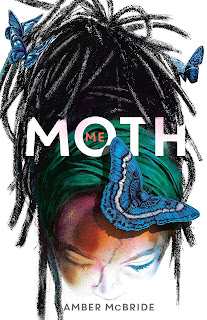


Me (Moth), Amber McBride

I had not heard of this work when a trusted book friend went nuts over it and highly recommended it to me. It was my first read of 2022 and all I can say is "WOW." Starting the year with your socks blown off is pretty fantastic. 

Two summers ago our car broke in half like a candy bar on the freeway & we all spilled onto the pavement as crumbled as sticky caramel-peanut filling.

Black teenager Moth lost her entire nuclear family in a bad accident. Who is she now, without her family to define her? Where she previously found solace in dance, to do so now feels too joyful and greedy. Moth is struggling with her identity and grief, feeling alone and uprooted. One day she meets a Navajo boy named Sani, from a differently-fractured family but also struggling with depression and uprootedness.


Sani and Moth set out on a road trip out West, technically to his father's home on the reservation, but in reality a zigzagging tour to find themselves and save the other. McBride's verse is gold that shines so brightly you need to sit with eyes shut and reflect on it. She sucks you in and grabs your guts and twists the story into something that both breaks your heart and fixes you. For grades 8 and up, this book is and should be for everyone. I don't do ratings, but this one gets every star in the universe.
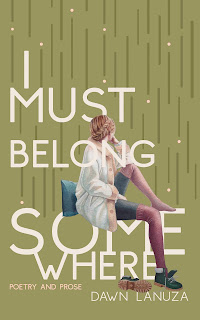


I Must Belong Somewhere


Dawn Lanuza
   

Every once in a while she is convinced that she doesn't belong here anymore.

Yet she doesn't know where she should be just yet. 

She finds herself where she is because she doesn't know where else to be.


These first lines in the second piece very much hit home (or someplace home is waiting) for me. A lovely yet inquiring collection that deals with themes of longing, loneliness, home, exploration, suicide (and living with someone who is suicidal - "I've never read your suicide letters. I've lived with them instead."), surviving v. living, and various other branches that spring from these thoughts. From a few lines to a page, each packs a personal, thoughtful wallop. 


Beautifully done, I highly recommend this collection for anyone who wonders or searches for SOMETHING - love, connection, meaning. The end of the piece quoted above is where I felt the poems connected, even though it's the second in order:


Sometimes, when she's in a new place, wandering and learning its streets, she just hears herself sighing, I must belong somewhere.

She hasn't found it yet, 

but she hasn't given up on the idea of it.
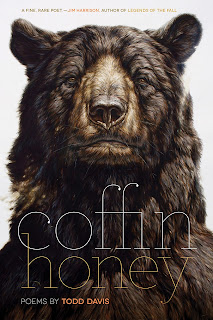

Coffin Honey, Todd Davis


This cover is a work of art and I could not turn away. I also assumed (which is much of the cover gut operation) this collection would be steeped in nature, which it was. It was also a collection that, while quite patently excellent, was over my head a bit. Even when I don't "get" poetry, there are always lines/passages that resonate, oftentimes quite deeply. This bit, for example, about virus-ridden deer victims of the automobile:

The pastor of grief and dreams waves them into the road, a suicidal gospel written on warm macadam.


Davis's nature is not all about beauty, and he writes the brutal side, human and animal, with prose that is lovely but doesn't mask the horror. A hunt, pedophilia, lynching, death, racism, immigration, man's destruction of the natural world--all laid bare without apology for the monsters we can be.


[W]ithout any shame, we construct machines that make a mountain disappear, no regard for the memory or souls of trees.
 

                                                    *  *  *


White men stole black bodies to chain below deck, the only light seeping in where chinking failed. Unlike them, Ursus learned to share the one soul the world gives freely.


If only men could see the beauty without museums, the dismemberment, the displays of paws, claws and eyes outside of sockets, bodies stuffed and set on wired legs, caricatures of the real thing. 

Tuesday, August 10, 2021

TWO-CENT TUESDAY

Below are a few (somewhat) brief $.02 opinions about books I've read or listened to recently but don't have the opportunity to review in full. Many of these titles I enjoyed as much or more than those that got the full court press. I hope you'll consider one or two for your own TBR stack if they strike your fancy whether they struck mine or not.


FATAL FAMILY TIES, by S.C. Perkins

This third installment in the charmingest of the charming cozies is proof positive I'm a convert to the light side. Texas genealogist Lucy Lancaster's Flacos Tacos lunch is interrupted by her least favorite former co-workers. Camilla Braithwaite now needs a favor--a recent article accuses Camilla's ancestor Charles, a civil war corporal, of being a phony and a deserter rather than a hero, and Camilla wants Lucy’s help clearing his name. Of course, shenanigans ensue before Lucy can get to the bottom of the mystery. This series leaves me longing for more time with the recurring characters. Thankfully, we got some of Lucy's Grandfather and more of her delightful parents. That meant a little less of her office best friends and Neil Patrick Housecat, but their on-screen time is always fun. 


GUILTY ADMISSIONS, by Nicole LaPorte

A thoroughly researched and detailed account of the college admissions scandal that caught several big Hollywood names in its snare. I found the audio a great way to listen to the tale, and the meat of the story was fascinating. It started with a lot of background detail that seemed a tad superfluous, but overall I enjoyed this account of aholes aholing.


100 POEMS TO BREAK YOUR HEART, by Edward Hirsch

Edward Hirsch's Gabriel: A Poem was the work that got me started on a mission to read more poetry. It is a set of poems, longlisted for the 2014 National Book Award, about the life and death of Hirsch's son. When I saw Hirsch had collected this set of poems I was all in. Turns out it's much more than I bargained for. Not only does he lay out 100 poems, he analyzes them and assists in the reading and internalizing of them. Which means this collection is lovely, educational and lengthy. I'm still working my way through it in little snippets, but it came out some time ago and I didn't want to delay writing about it any further. A great place to start if you're trying to get more out of the poetry you read.

GOOD NEIGHBORS, by Sarah Langan

The premise had me really looking forward to this one, but it ended up a bummer. A picturesque neighborhood in suburban Long Island is thrown into chaos when the Queen Bee regrets telling one of the new, "misfit" neighbors a very personal secret. So she begins to sabotage the family. Which really makes no sense, but I went with it. As the Wildes are turned into outcasts and the tension builds, a sinkhole opens in the area. Not only does it keep widening without explanation, it sucks whatever gets close into its black hole, including the Queen Bee's daughter, leading to more accusations to...what end? I found the plot disconnected and a story written around issues and events the author wanted to address. I'm all for unlikable characters as I find them more interesting, but these left me cold. If I never read the word "bitumen" again I'll die happy.

FOOTBALL'S FEARLESS 
ACTIVISTS, by Mike Freeman

A fascinating and highly-recommended look at the story behind the protests of numerous Black athletes following the ongoing string of police killings of Black men, as well as the pushback they received from not only the fans but their own organizations and ownership. It's no secret 45 is shameful and to be honest I didn't expect much more from the NFL and I was still surprised by some of the reporting here. I'm glad there are athletes like these, who will risk it all for what's right. I did lose a little respect for the book when Barack Obama's name was misspelled twice. Once is a typo, twice is disrespectful. 

SHELTER, by Catherine Jinks

Jinks's The Shepherd blew me away last year and I was eagerly anticipating this title, which couldn't have been more different. Far from the sparse, cracking prose of the former, Shelter was told in a much more descriptive and "mainstream" hand. Which isn't bad, it was simply a much different experience. In Shelter, Meg lives alone in the bush outside town as a way to avoid her abusive ex. Knowing what it's like to try to escape that horrible situation, Meg agrees to provide shelter to Nerine and her two daughters. Of course all three are traumatized, but then odd things begin to happen. Not the least of which is Nerine asking Meg to get a gun (remember, this is Australia, where the people sensible about gun control live and this is no normal request or easy feat). Of course things spiral and questions come from all fronts, including Meg's past. Shelter is, if I have to label it, more domestic thriller than lean, gritty crime fiction. Thankfully, Jinks is a good enough writer to pull both off quite well. 


Friday, September 18, 2020

COFFEE DAYS WHISKEY NIGHTS :: Cyrus Parker

As I continue my quest to read more poetry, I really have nothing to go on but my gut. In this case, what better to take a chance on than this kickass cover referencing two of my favorite things? I had not heard of Cyrus Parker before picking up Coffee Days Whiskey Nights, but if I knew he describes himself as a non-binary storyteller and wrestler-turned-poet I would have been all-in from the get-go.

Turns out Parker's poetry really speaks to me. I have no idea what that means as far as style or subgenre. Poetry for me is like the most art-like of literary categories, I have no idea how poetry is subjectively judged, I can't write it, and I just know in my innards when I like it. This is such a collection.

Parker himself bills the collection in the best way, as "a collection of poetry, prose, and aphorisms that juxtaposes the hopefulness a brand new day can bring with the lingering thoughts that often keep us up into the late-night hours. A lot can happen between the first sip of coffee and the last taste of whiskey, and this book takes a look at the way a single day can change our outlook on everything from relationships with others, to our relationships with ourselves, and everything in between. Ultimately, coffee days whiskey nights illustrates that no matter how hopeless we may feel at the end of the day, a new one is only a few hours away."

The pieces speak on a variety of personal subjects--friendship, fitting in, control, eating disorders, gender dysphoria and the like. I enjoyed the clear precision of Parker's prose. I didn't have to guess or struggle to find meaning in his phrasing, it was all right there smacking me in the face. Maybe it's recognition that brings clarity from poetry, I don't know, but it's one of the reasons I love searching for a new collection that resonates. I'm not sure if connecting with this set means I do find hope at the beginning of the day or am used to feeling the lack of it at the end, but I always find hope in words strung together the way Parker lays them down. I highly recommend this collection and to give you a brief taste I've cited to some of my favorite lines below.

i’ve let some into my life, my home, whose words taste of cotton candy in the daylight, but drip like venom under cover of night.

my entire existence is a contradiction of itself. i hate leaving the house but i love to travel. i spend my day counting calories to counteract my need to consume until there’s nothing left. i was born into skin that i want nothing more than to tear off and reshape into something new. i crave companionship but never feel compelled to reach out to those i care about. i am a hopeless romantic but i have an inability to express love in a way that makes people feel loved. i make jokes about dying, when all i want to do is feel alive.

i think about all the parts of me i changed for others and wonder just who it is i’d be if i had just stayed true to myself.

no matter the size of my clothes, no matter how well they fit, my body is the most uncomfortable thing i wear.

i try to make myself as small as possible, to leave a footprint that is faint, to become invisible without actually disappearing. this body has never really felt like it belonged, so i won’t let it take up any more space than it already does.
This is a nifty and thoughtful collection that I highly recommend and I'll no doubt be on the lookout for more of Parker's work. This is one for the expanding poetry portion of the physical shelf.


Wednesday, July 8, 2020

THE POETRY OF STRANGERS :: Brian Sonia-Wallace

A version of this review previously appeared in Shelf Awareness and is republished here with permission.

"Do you need a poem?" With this question, Brian Sonia-Wallace began his journey as the RENT Poet. Just "another unemployed millennial at the tail end of the financial crisis, looking for a purpose," he took a typewriter to a downtown Los Angeles street party and set up a folding chair and tray table with a sign: "POETRY STORE/ give me a topic/ I'll write you a poem/ pay me what you think it's worth."

When his first customer, a tough, tattooed, buzz-cut Chicana, softened before his eyes after reading his poem about her father, Sonia-Wallace was hooked. He "accidentally started a poetry business with a $20 garage sale typewriter and an impending sense of doom." Intending it as a performance art experiment slash practical joke, Sonia-Wallace proclaimed, "I'm going to pay my rent with poetry!" Since he was in despair and felt his life was over, why not do something stupid?

In The Poetry of Strangers, Sonia-Wallace shares how he not only paid his rent, but ended up with corporate jobs, Amtrak and Mall of America writer residencies, fundraisers, weddings and numerous other gigs. More interesting is that he'd never loved and doesn't consider his work poetry. It's about relationships, the "shrapnel interactions left behind, bits of other people" that left him less alone. While social connections were fraying, Sonia-Wallace traveled the country connecting with poetic empathy. "It was poetry that led [him] to discover a private America, an America where intimacy was possible, one person at a time."

STREET SENSE: This is an interesting one and I'm not entirely sure who to recommend it to. Not that anyone couldn't or wouldn't enjoy it, but it's an amorphous story. It's a memoir, but it's also about community, the state our country is in, our lack of expression, so many things. That is a positive and a negative, as it felt a little messy at times. Yet it's something of a messy story about messy life, and much of it was truly fascinating.

COVER NERD SAYS: I'm not sure what it is about this image that was unclear to me, but it feels off somehow. It's obvious the author is holding a typewriter, yet every time I look at it I think "Oh! That's a typewriter." Maybe because it's odd to see a typewriter in a scene such as that? Which is kind of the point. In any event, this completely fine cover didn't sit right with me. Maybe with the fonts it looks a bit...homemade? Maybe if it kept a faint blue sky instead of falling off into stark white? Maybe I'm just missing the message?

Wednesday, May 6, 2020

SUBMERGE :: K.Y. Robinson

I've mentioned here before that I'm not a great poetry reader, but that I also love reading poetry. Poetry is one genre where it's harder to find what your groove might be when the form is so amorphous. That's also what I love about it. Within a collection there will be pieces that wow me and pieces that I can't figure out for the life of me. But all have meaning to the author, often express raw emotion, and can contain snippets of beauty I can take away even though the piece as a whole escapes me.

Such was the way with K.Y. Robinson's Submerge, which, as a whole, I really enjoyed. I didn't know anything about Robinson when I picked this book, I just liked the cover (shocking). Inside, Robinson is billed as an introverted writer with a journalism degree. She "draws from personal experiences as a woman of color and trauma and mental illness survivor."

This collection certainly reflects that.perspective, with pieces speaking to loss, depression, self-harm, violence, and racism. Broken into three parts (Immerse, Drown, and Emerge) that speak of change with metaphors of water, Robinson's collection does not have a happy ending, but it has waves of healing, strength, and courage.

One of my favorites ended up being a piece I completely misread in hilarious fashion. In the Immerse section, it's called "ode to my toy friends" and begins like this: "oh the mechanical miracles that never break my heart or ignore my text messages." I totally got that. How inanimate objects can sometimes be better friends than people. It took me back to when I was a kid and the Breyer horses and other items that soothed me.

Then I read further and realized I was both on point and waaaay off base. "to the bullet killing the craving in a dark alley between the sheets. the rabbit hopping happily in my valley." Oh. We are talking about DIFFERENT TOYS HERE. That kind of encapsulates poetry for me. How intent can differ from interpretation and yet the art and the power remain. That's why I love poetry and keep reading. I may miss the mark, but it hits a mark for ME. Maybe that's the best kind of poetry.

It's impossible to pick a favorite piece. One of the most powerful to me is called "how are you?" The text is "i'm fine," but is footnoted. The footnote says this: "i am not fine. i'm drowning in my thoughts. i cried myself to sleep last night and it took everything in me just to get out of bed this morning. i'm exhausted. i feel hopeless and alone. i feel like no one understands. help me. help me. help me."

How many times have we answered "I'm fine" to this question, when what we really feel is the footnote? Or some version of it? I wish we were better at communicating our pain. At our desire for help, a hand, some hope. How many times have I heard "I'm fine" and not thought about a potential footnote?

STREET SENSE:  I recommend this collection to anyone who enjoys poetry, is dipping their toes in poetry, or has never read poetry. There is a trigger warning, so take heed of that.

A FAVORITE PASSAGE:  This piece is short and sums up the main theme of the collection.

duality of water

a life-giving force
can become a life taker
with each swallowing wave
this is the duality of water

COVER NERD SAYS:  I bought this solely because of the cover, so it was obviously a winner with me. I love the palette and soft nature of the ink. I think this image also shows the duality of water. Is the woman rising from the water or giving herself to it? Despite the light, soft beauty, this art is also very serious and heavy. Really well done.


Friday, October 18, 2019

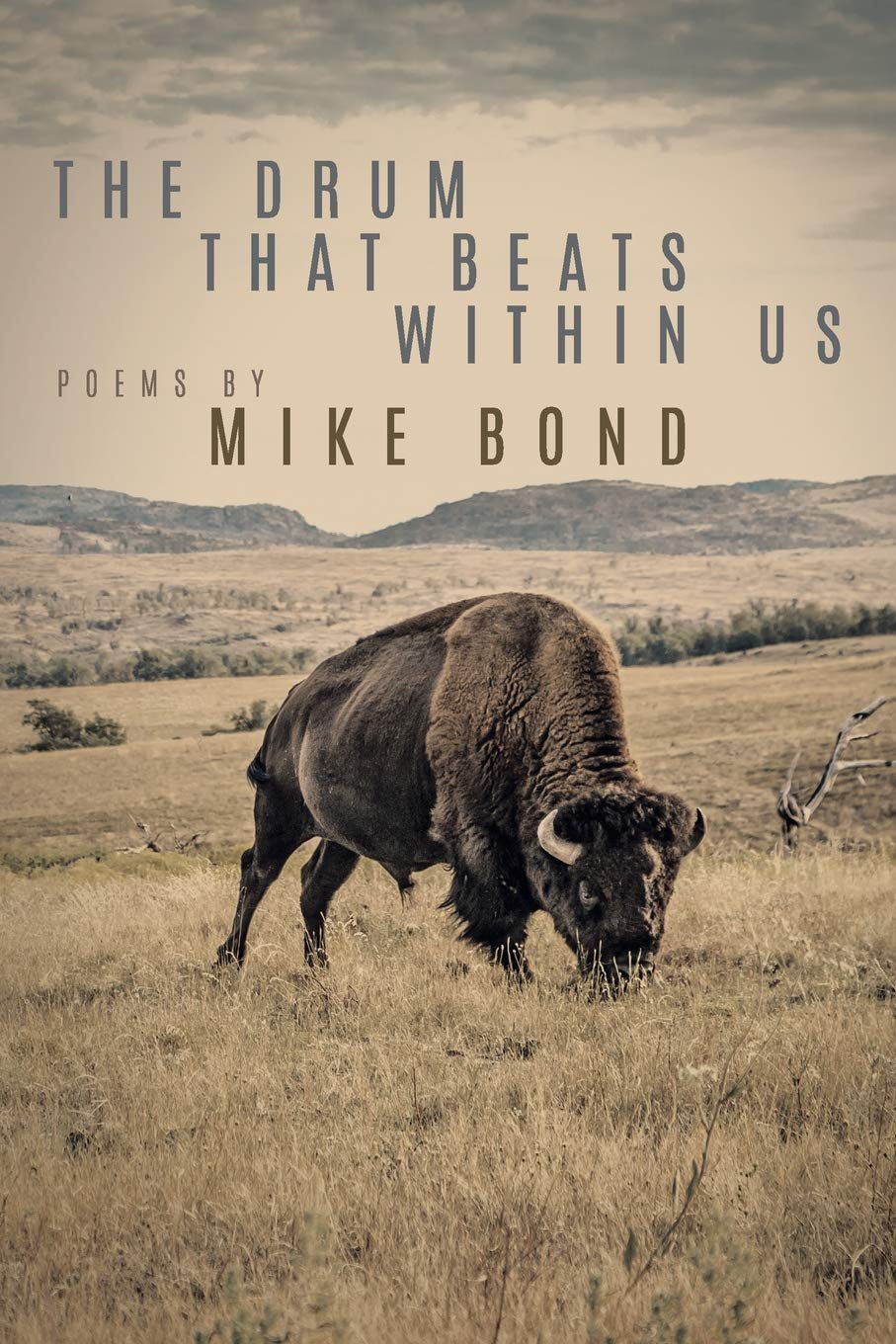
THE DRUM THAT BEATS WITHIN US :: Mike Bond

My poetry reading is still in the beginning experimental stages. Being a novice, I pick poetry books like I pick most others, I'm captured by a cover. Such was the case with Mike Bond's The Drum that Beats Within Us, which called out to the beast and nature lover in me. How could I lose when the insides seemed destined to be full of connections between humans and their surroundings?

Bond believes poetry was born the moment we began to speak. It existed before then in "what whales and wolves sing." Every clan needs stories and lessons from the past, and to make them more memorable, the stories were often told in rhythm and rhyme. Poetry and stories are "how we find meaning in the incomprehensible, beautiful, tragic and sacred mystery of life."

This line sums up how I feel about poetry: "What counts is what we learn emotionally. When something hits us emotionally it stays in our experience..." Poetry feels like the ultimate in emotional connection. I can't tell you what poetry is, what different meters and rhythms mean. I can only tell you what I happen to connect with emotionally, what gets me in my gut. Mike Bond's work does that, and I connected with the themes of the havoc we are wreaking on the earth:

Hungry Magpie

A hungry magpie
is a world
out of order,

when after so much killing
there's nothing left
to die.

The earth barren
as the raw red skin
of Mars,

the seas deadly
as the toxic
skies.

And to think
one little biped
did it all.

Paradise Ducks

Paradise ducks don't know
about men and steel.
In rainforest rivers
they love
and raise their young,
always paired, the
dark multicolored male
and white-necked female.

Paradise ducks so easily fly,
don't know about airplanes
carrying men halfway
round the world,
shotguns in their baggage,
men who shoot thousands of ducks
for fun,
who have shot ducks in Brazil,
Mongolia, Canada, and now
in the far south
of the South Island
of New Zealand.

Paradise ducks mate for life.
Men don't.
A duck never kills.
Men do.
Ducks love misty dawns
that men sleep through,
flashing rivers and skies
blue as the gun barrels
that the men to love
to kill ducks
look down
before they fire.

Most Evil Thing

The most tragic thing
humans do
is war,

our greatest joy
is life's
creation.

The most evil
is to call one
the other.

*  *  *

Mike Bond is an award-winning poet, ecologist, and war and human rights journalist. I loved his no-punches-pulled approach, addressing the our vanishing natural world and calling us to account. This is a book I will buy for my growing poetry shelf and reread with pleasure.

Monday, May 6, 2019

I'M LATE FOR POETRY MONTH

Spoiler alert: I am a horrible poetry reader. Often it feels like improvisational jazz - for some reason (perhaps my need for order?) I have a hard time connecting. I keep trying and may be getting a tad better at it. The best part of poetry (so many forms and formats) makes selection difficult. I can look at non-poem genres and covers and have a gut reaction to what's inside and whether it's for me. That ability has been ground into my bones by decades of experience with hits and misses. Poetry not so much, and the exact thing I love about it (the lack of "rules," or at least rules I understand) makes it hard to pick out what I might relate to. So I swing semi-blindly and hope to connect. Even when I don't, I learn something. Win-win.

There was simply no way for me to resist Claire Kelly's collection, One Thing - Then Another. Everything about this cover makes me want to figure out what the hell is going on inside.

I liked the collection very much. It's broken into sections--"East, "Then," and "West," and begins with a line from a Karen Solie poem, Bitumen: "The west stands for relocation, the east for lost causes." The bridge of "Then" is a move from Eastern to Western Canada with both ends a series of contrasts. See below for a description of the book from the book itself.

There are nifty cultural references (film titles, music, even a poke at Americans--rightfully so--about the Fox channel's use of a glowing puck during hockey games so we could follow the game) which I'm always a sucker for, but it still all comes down to language. Kelly has some fantastic lines, including: "Persistent as a raccoon drawn on by the perfume of antifreeze" and "ah blessed midnight organizer of books and records by alphabet, by genre, by country of publication, by size and year, by mood." She kept me engaged even when I was hesitant.

The collection starts with a lovely piece that highlights both what I get (the words) and what I don't (the format). It's called Yesterday I thought winter had given up:

Yesterday I thought winter had given up
all its images: white worn out, utter glut of neutral.
       But today, weird mitt-ruts. Snow-bank etchings from kids dawdling
their hands to school;
overhead another storm
isn't breaking but is moving on: the elm-edge and the cloud-edge slotting
into each other.
       As if the tree picked up the sky secondhand, and wears it--
       a sapphire heavened hoodie in the black and white film of early
March.
Then,
expertly, the elm-clutch
       lets loose, disrobes. A sliver of blue expands, becomes a sluice, a
gorge, becomes the whole
damned naked winter
       flouncing down a side street shoving her hands
knuckle-deep
in the bank.

I adore the image of the different "ruts" and "etchings" from the mittened hands of kids on their way to school. That was one of those "Yes!" poetry moments. I would love input on the format. As an anal-retentive with OCD, I usually find these formatting choices jarring. They disturb the natural order of things I'm used to. Which is good, but it also makes me want to understand and find a reason, when there really may be none other than what the poet felt in the flow. Maybe I'm trying to force too much reason into things (unsurprising). I'm trying to use poetry to loosen up a bit, but I also welcome all input into format from those who know much more about poetry than I. So comment away.

"One Thing--Then Another is a collection of poetry divided into three unique sections: "East" explores the constraints of living under the poverty line in a have-not province. "And" is a long poem about moving in a U-Haul across the prairies during an ice storm. "West" considers what it meas to live in the have-est of have provinces and trying to acclimate to that alongside an ever-present drought. The poems are largely about contrast: east to west, flood to aridity, poverty to comfort, small town to city."

This is a collection I now have on my list to buy for the shelf. It came out on April 19, 2019 from ECW Press. Claire Kelly's first full-length collection of poetry is titled Maunder and it's now on my list. Hope you'll give her a gander.


Wednesday, May 13, 2015

"No Day Rhymes with Poetry" Wednesday

As I mentioned last week, I'm trying to read more poetry after having been turned on to some really great pieces during April's National Poetry Month celebration. I saw one piece I really loved and managed to track down the book it came from, Love, An Index. Written by Rebecca Lindenberg, Love, An Index was written about Lindenberg's passionate relationship with poet Craig Arnold, who went missing in 2009 while hiking a volcano in Japan.

This is the piece that attracted me to the book. It's called Aubade, which means "morning love song (as opposed to a serenade, which is in the evening), or a song or poem about lovers separating at dawn." (Thanks Google!):

AUBADE

I woke in a gold dress,
you, in jeans.

Morning filled
wine bottles in the kitchen.

Fine mica glitter
of fish scales and salt.

Outside, it was quiet.

You said: That went well,
don't you think?

Sun behind you

I kissed the hole in the light
and said: Yes.

I fell in love with the line about kissing the hole in the light, which I found so beautiful and unique.

Unsurprisingly, some of the pieces in Love, An Index were lost on me due to form or content or both, but there was also plenty to make the book (a short 88 pages) well worth my time. I liked the fact that Lindenberg used various forms, it not only made things feel fresh, but I wasn't shut out by one form I didn't connect with.

The works included what I would call "traditional" poetry, "footnotes" about love, word translations, phrase translations of "losing language" (i.e., "My sympathies : I fear to say something that might make it worse; You're so strong : I can see you've showered"), status updates, and the main piece and my favorite, the titular Love, An Index. Love, An Index is just that, an alphabetical list of words, places, people, and things that had an impact on or defined Lindenberg and Arnold's lives.

For example (I've taken these from various places in the alphabetical list, it's quite a lengthy piece):

OH, a sound suggesting settlement, appropriate to situations of spiritual amazement and erotic bliss, but also polite boredom or the horror of learning the person who really knew you has died.

OMAHA, where we'd go to the Antiquarium for old books, the Zen Center for poetry slams, and to that one Persian restaurant, the chicken stewed in pomegranate-walnut sauce, conjuring what it might be like to sleep under a heavy rug in a desert palace in wintertime.

OVER, when I answered the phone that May morning and the man from the search team said, "It's over."

PERSEPHONE, the maiden, Queen of the Dead. You wrote her a hymn about "the grace to release our beloveds kindly into her care." I am trying.

TRANQUILITY, another thing you gave me that I didn't have before, and I am losing it again.

VOW, I think as much now about the ones we failed to make as the ones we faithfully kept.

You get the point. It's a beautiful, heartrending piece, the alphabetical history of a love affair and the devastation of its loss. I really recommend this book if you're a poetry veteran or someone like me who is interested in testing the waters. I hope to keep this "experiment" going, so if you have any poetry recommendations, bring 'em on.


Wednesday, May 6, 2015

CITIZEN: AN AMERICAN LYRIC

I'm not a poetry reader. Mostly because it usually feels like I'm reading a language I don't speak. I don't "get it." But April is National Poetry Month, and thanks to postings by friends last month I was exposed to some work that really hit me where it counts. It got me thinking that with a little effort I could probably find some poetry I might not only wrap my head around, but actually enjoy. I'm pleased to report my experiment was a resounding success and this is the first of several poetry posts to come.

I got another push, unbeknownst to them, from the folks over at The Socratic Salon. The Salon hosts down and dirty book discussions, spoilers and all. It's a fantastic community with intelligent and varied voices and I encourage you to take a look.*

I recently learned one of the upcoming titles to be discussed at the Salon is Claudia Rankine's Citizen: An American Lyric, about which I had heard fabulous things. I believe the messages in Citizen are important for everyone to hear, so I set my anti-verse self to the side and bought a copy. I was blown away. (So yeah, maybe those National Book Award folks know a thing or two.)

Did I "get" all of Citizen? Did I suddenly become a poetry savant? No, and far from it. There were pieces that went flying around the room and never had a chance at even a glancing blow off my head. But the language was still worth taking in. And the pieces that did hit home, those that resonated, wow did they do so with power.

One of the genius elements of Citizen is that the pieces take different forms. Some are what I would categorize as "traditional" poetry for lack of a better word. Short, staccato phrases, weird spacing, the whole nine confusing yards (to me). Some are what I consider short vignettes or anecdotes. Some are more visual, others are what the author calls "video scripts." Whatever you want to call any of them, the point is there's something for every reader. Everyone and anyone can (and should) read Citizen and take something important away.

Citizen is full of narratives of everyday encounters, often slights, intentional or otherwise. Some will shock you, some will surprise, disgust or embarrass you; many will make you wonder "Did I ever do that?" or "Have I made someone feel that way?" In our supposed "post-race" society, these encounters, these moments, big and small, still take place every day, often to the ignorance of those who don't have to experience them.

The messages are on the streets, in the media, at work, at the grocery store, in our sporting arenas and schools. Claudia Rankine gives them a beautiful, yet sorrowful, voice. These microaggressions deserve that voice, deserve to be unearthed and lifted into the light. Citizen should be required reading from middle school on.

The pieces that struck me most deeply were those about invisibility, and there were a lot of them. It was, depressingly, a major theme. There were several lines that almost literally took my air. For example, Rankine mentions the medical term "John Henryism," used to describe people exposed to the stresses of racism.** About them, Rankine writes:

They achieve themselves to death trying to dodge the buildup of erasure.

Another piece, a Script for Situation video comprised of quotes from CNN includes the following about Hurricane Katrina:

He said, I don't know what the water wanted. It wanted to show you no one would come.

In a revealing section including several pieces about Serena Williams, Rankine discusses the injustices Serena has had to deal with and play through; how they add up and add up until one day she lashes out at something she might have otherwise brushed off:

Yes, and the body has memory. The physical carriage hauls more than its weight. The body is the threshold across which each objectionable call passes into consciousness -- all the unintimidated, unblinking, and unflappable resilience does not erase the moments lived through, even as we are eternally stupid or everlastingly optimistic, so ready to be inside, among, a part of the games.
One of the most crushing pieces is on page 134, which you may have already heard about. It is a dedication page of sorts, in the memory of young black men killed violently at the hands of others, often the police. There are now four names on the list in the edition I own, the sixth. The last reads "In memory of Michael Brown."

The rest of the page continues the "In memory" line, followed by blank space, just waiting for the next name. A name we know will come. Names we know already have come several times over since Michael Brown was killed. The opposing page reads:

Because white men can't police their imagination, black men are dying

Citizen is only 160 pages long. It can be read in one sitting. I urge you to read it. For the artistry of the lyric, yes, but also to gain a deeper understanding of what the African American community feels and deals with on a daily basis. So you aren't the next maroon who tells a black woman you didn't know black people could get cancer. So you stop, and see, and think. And perhaps do differently. None of us should be invisible.

(*In fact, they just did a piece about fearing poetry, which was quite timely. Check it out here.)

(** John  Henry was an African American folk hero who worked as a steel-driver. His prowess was measured in a race against a steam-powered hammer, which he won, only to die in victory when his heart gave out as a result of his effort.)

NOTE: After I published this piece I noticed that the Salon discussion on Citizen also posted today. I'm sure there are more and better and deeper views being expressed there, please go read that discussion, as I am going to do right now.


About Malcolm Avenue Review

I was lucky enough to be born and raised in a nifty, oak-shaded ranch house on Malcolm Avenue, a wide-laned residential street with little through traffic, located amid the foothills of Northern California. It was on that street and in that house I learned most of my adolescent life lessons, and many grown-up ones to boot. Malcolm Avenue was "home" for more than thirty years.

It was on Malcolm Avenue, through and with my family and the other families that made up our neighborhood of characters, that I first learned about and gained an appreciation for the things I continue to love the most to this day: music, animals, photography, sports, television/movies and, of course, books.

I owe a debt of gratitude to that life on Malcolm Avenue. It gave me a sense of community and friendship, support and adventure. For better and worse, life on that street likely had the biggest impact on the person I've become. So this blog, and the things I write here, are all, at their base level, a little bit of a love letter to Malcolm Avenue.

Labels

  © Blogger templates Newspaper by Ourblogtemplates.com 2008

Back to TOP